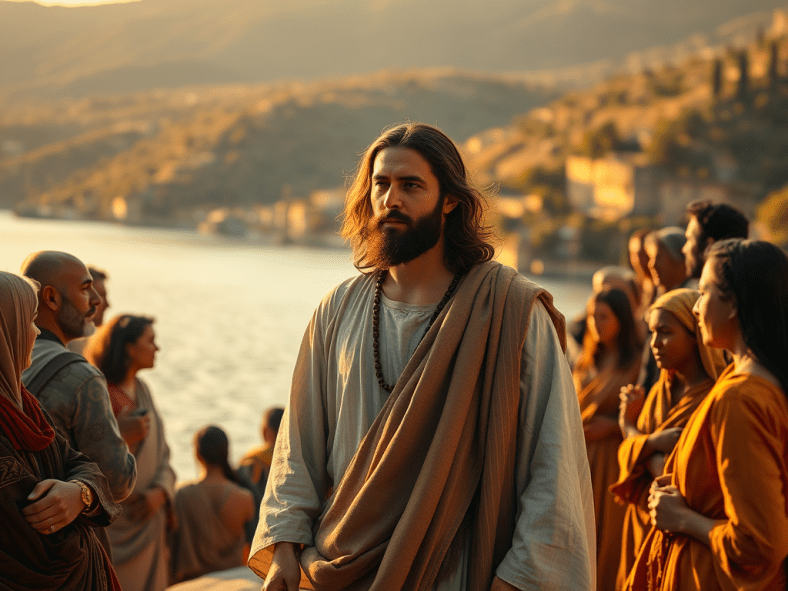
Matthew 4:12-23
“Now when Jesus heard that John had been arrested, he withdrew to Galilee.”
In Matthew’s telling of the life and work of Jesus, the arrest of John is the trigger that launches Jesus into his ministry of proclamation, teaching, healing and non-violent resistance. John’s arrest sets him on a path that will eventually lead him to his death in Jerusalem.
When Jesus launches his ministry, the timing is political. The arrest of John the Baptist is the catalyst that sets him in motion. Herod Antipas had John arrested because John had been speaking out forcefully against Herod’s abuses of power and other moral failings, including his adulterous marriage to his sister-in-law which was forbidden under Jewish law. As he railed against Herod, John had been attracting hundreds of followers, which made him dangerous. So Herod did what authoritarianism always does. He silenced the inconvenient voice of truth and criticism. He disappeared the leader of the potential resistance.
When Jesus heard that John had been arrested, he withdrew to Galilee. “Withdrew” is an interesting word choice here. It’s an accurate translation, but one that’s apt to give us the wrong idea. Jesus isn’t retreating. He’s pivoting. He is intentionally relocating to a more strategic position.
Why Galilee? Matthew saw Jesus fulfilling a prophecy from the 9th chapter of Isaiah, but there were other very good reasons for Jesus to begin his work in Galilee.
Historically, Galilee had been a hotbed of anti-Roman and anti-Herodian sentiment. Long before Jesus arrived, Galilee had given rise to episodes of armed resistance and tax revolts. In 37 BCE Hasmonean insurgents from Galilee waged a 2-year guerilla war against Herod and his Roman overlords, hiding out in caves in Galilean hills between engagements. In 6 BCE, Judas of Galilee led a revolt against the Quirinius census. The city of Gamla, near the Sea of Galilee, had become a stronghold for Zealot extremists who had no qualms about using violence in their ongoing fight against the empire. Galileans even practiced economic resistance when, beginning around 4 BCE, they initiated a 70-year boycott against mass produced clay lamps and red-slip pottery tableware which was used everywhere in the empire and taxed to help support the Roman military machine.
“Galilee of the Gentiles” had an ethnically diverse population. Jews were the dominant group, but in an attempt to subvert Jewish resistance, the Romans had offered economic incentives for people from other parts of the empire to settle there. Matthew tells us that Jesus made his home in Capernaum, a bustling, multi-ethnic hub from which other Galilean towns and villages could easily be reached either by boat or by road. Because it was a garrison town and customs station, Capernaum had a highly visible Roman presence which meant that it would also give Jesus more opportunities to encounter travelers and settlers from other parts of Palestine, Syria, Greece, Egypt, Gaul and elsewhere.
“From that time Jesus began to proclaim, ‘Repent, for the kingdom of heaven has come near.’” (4:17). That’s the good news, the gospel, that Jesus proclaims from his strategic base in Capernaum.
“Repent” really is not a good translation. “Repent,” in English, has overtones of penance and sorrow and regret, but the Greek word Metanoia means a change of heart, a change of thinking, a change of direction, a change of behavior. Metanoieteis the word Jesus speaks in the Greek text. It’s a command. An imperative. From that time Jesus began to proclaim, “Time for a change. The commonwealth of God’s justice and kindness has come near. It’s in reach. Change your heart. Change your thinking. Change the way you do things.”
When Jesus proclaims that the kingdom of God is in reach, he is not speaking metaphorically. He is calling for a spiritual transformation, yes, but that is just the beginning. He’s also calling for social, political and economic transformation because the commonwealth of God’s justice and mercy does not operate by the same rules as the empire.
As he walks by the Sea of Galilee, Jesus sees Peter, Andrew, James and John casting their nets into the sea. He calls out to these Galilean fishermen and says, “Follow me, and I will make you become (literally) fishers of people.” The translation here is a little tricky because the preposition is implied. It could be “I will make you become fishers of people,” or “fishers for people,” or even “fishers on behalf ofpeople.” But any way you translate it, Jesus is issuing a not-so-subtle invitation to Peter and Andrew and James and John to throw off the yoke of Rome.
In The Galilean Fishing Economy and the Jesus Tradition, K.C. Hanson explained that Simon, Andrew, James and John were only semi-independent. The Galilean fishing industry was very tightly controlled by the Roman Empire. Caesar owned every body of water in the empire. Fishing was state-regulated. Fishermen had to pay a hefty fee to join a syndicate. Most of what was caught in the Sea of Galilee was dried and exported at a regulated price and heavily taxed, and it was illegal to catch even one fish outside this system.
So how does it sound now… “Follow me and I will make you Fishers for people.”? Especially when you remember that this is in the context of Jesus proclaiming that the Basilea, the commonwealth of God’s mercy and justice is happening now?
“I will make you Fishers for People. For your fellow human beings. Not just for the empire. Not just for the elite, the wealthy, the powerful, the 1%, the people who reap all the profits but do none of the work.”
And of course Jesus uses a fishing metaphor to issue this commanding invitation because he’s talking to fishermen.
Follow me, said Jesus.
Follow me and I will make you the you that you were meant to be
for the good of all God’s people.
Barbara Brown Taylor reminds us that this is a miracle story. These Galilean fishermen don’t drop everything and “immediately” follow Jesus because of their extraordinary courage. They do it because of who it is that calls them.
Jesus makes it possible for them. Jesus captivates them with his vision and his presence and his words…and the Holy Spirit. In the same way Jesus can make it possible for us.
Last week we took time to remember Dr. Martin Luther King, Jr, a man who clearly followed Jesus as he led and inspired others to keep reaching for that better reality called the kingdom of God—the commonwealth of God’s kindness and justice. In a speech at Riverside Church in New York City, exactly one year before he was assassinated, he said this:
“Our only hope today lies in our ability to recapture the revolutionary spirit and go out into a sometimes hostile world declaring eternal hostility to poverty, racism, and militarism. With this powerful commitment we shall boldly challenge the status quo and unjust mores and thereby speed the day when every valley shall be exalted, and every mountain and hill shall be made low, and the crooked shall be made straight and the rough places plain . . .Now let us begin. Now let us rededicate ourselves to the long and bitter — but beautiful — struggle for a new world.”
“When Jesus heard that John had been arrested, he withdrew to Galilee.” That sentence at the beginning of today’s gospel reading sits heavy in my heart. It would be easy to write off John’s arrest as just one more authoritarian act of oppression in a land where authoritarian oppression was the norm. It would be easy to skim past it and go straight to the calling of the fishermen, a story we can easily spiritualize if we don’t think too much about what it is that they gave up to follow Jesus and what it cost them and their families. It would be easy, even, to just not see it. But it is the thing that sets the work of Christ in motion.
It would be easy to think, well that was then and this is now—that’s just how things were. But this week, this month, while the streets of our cities are filled with armed and masked federal agents who are kidnapping and killing our neighbors, while resistance to authoritarian thuggery in Minneapolis and elsewhere is met with violence it is simply not possible to ignore that sentence. Where do we withdraw to? Where is our Galilee, our place of resistance? Where do we go to stand up with Jesus and say, “Time for change. The Commonwealth of God’s justice and mercy is at hand.”
When Jesus heard that Rene Nicole Good, a 37-year-old mother of three had been shot and killed, he withdrew to Galilee.
When Jesus heard that Liam Conejo Ramos, a 5-year-old preschooler in a blue bunny hat had been abducted outside his home, he withdrew to Galilee.
When Jesus heard that Alex Jeffrey Pretti, an ICU nurse was shot and killed by government agents who are long on hostility but short on training, he withdrew to Galilee.
When Jesus heard that 100 clergy had been arrested at the Minneapolis airport while protesting the presence and tactics that government agents are using to oppress our neighbors, he withdrew to Galilee. And stood with them.
Minneapolis is our Galilee.
Chicago is our Galilee.
Portland is our Galilee.
Wherever our neighbors are being assaulted and oppressed, that is our Galilee. That is where we hear Jesus calling us to follow him, even if it means stepping away from life as we’ve always known it.
Jesus is telling us it’s time for a change. The kingdom of heaven, the commonwealth of God’s justice and mercy is in reach. “Now let us begin. Now let us rededicate ourselves to the long and bitter — but beautiful — struggle for a new world.”






 Thoughts Along the Way