Entertaining Angels

Hebrews 13:1-2, 15-16; Luke 14:7-14

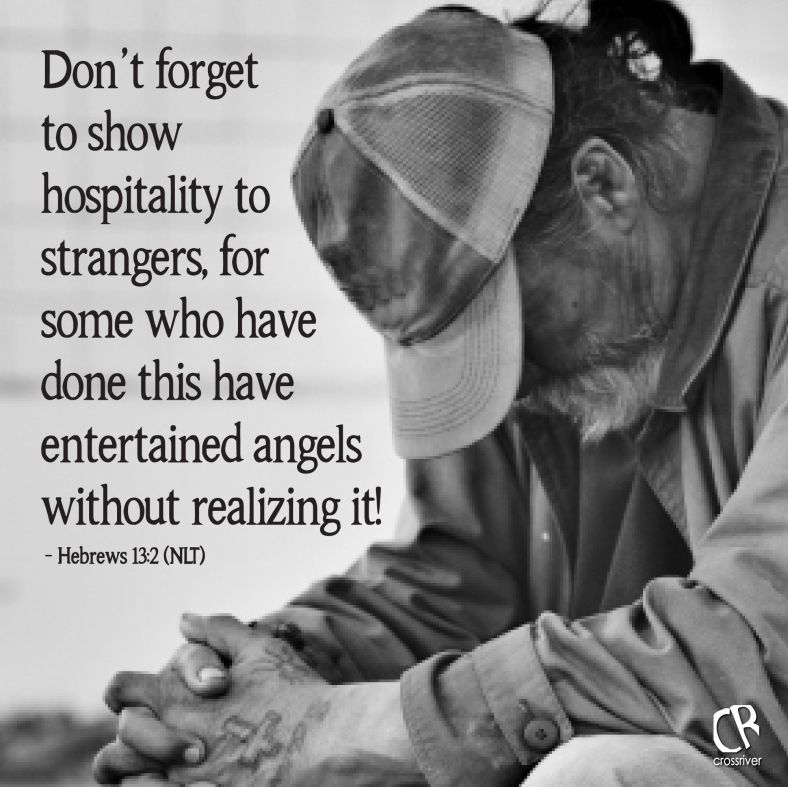
“Let mutual love continue.  Do not neglect to show hospitality to strangers, for by doing that some have entertained angels without knowing it.”  (Hebrews 13:1-2, NRSV)

“The next time you put on a dinner, don’t just invite your friends and family and rich neighbors, the kind of people who will return the favor.  Invite some people who never get invited out, the misfits from the wrong side of the tracks.”  (Luke 14:12, The Message)

Every time I read these texts I think of Eric.  Eric showed up one Sunday night when we were doing Stories, Songs and Supper at Gloria Dei Lutheran Church where I served as pastor for 12 years.  He stood at the church door and asked what was happening as he saw people gathering, greeting each other, laughing, and we told him, “It’s a thing we do called Stories, Songs, and Supper.  We share a meal then sing a bunch of old familiar songs, then someone tells a story, then we sing a little more.”  We invited him to come in and join us. So he did.

I was pretty sure he was unhoused, although to be fair, his clothes were neater and cleaner than most of the other unhoused people who came by the church.  Eric had a gift of gab and while we were eating he told us a bit about himself then told us that this dinner was special for him because it was his birthday.  So we all sang Happy Birthday to him.  After supper, he helped to clear the tables, then joined us in the sanctuary for the singing and storytelling.  

I was more than a little surprised when Eric showed up for our Adult Ed class the next Sunday morning and stayed for worship.  The following Saturday, he joined in with one of our small groups in the volunteer work we were doing with Lutheran Social Services.  

Eric kept showing up for just about everything we were doing at church and in almost no time he became an important part of our little family of faith at Gloria Dei.

 “Do not neglect to show hospitality to strangers,” Hebrews tells us, “for by doing that some have entertained angels without knowing it.”

Well,  Eric was no angel.  But then again, maybe he was.  In ancient times the word angelhad a double meaning.  It could refer to a supernatural being who served God, or it could simply mean a messenger.   Eric was, in and of himself, a message to us—a gift to us all at the little church with a big heart.

We learned a lot from Eric.  We learned a little about life on the streets.  We learned more than we wanted to know about our neighbors’ attitudes toward the unhoused.  We learned how the police and the justice system in our city respond to those who are experiencing homelessness.  We learned about our own attitudes toward those living rough.  Most of all, though, we experienced an energy and vitality that stayed with us for a long time after he left us.  All this because we welcomed one gregarious man into our party on his birthday.

“The next time you put on a dinner,” said Jesus,  “don’t just invite your friends and family and rich neighbors, the kind of people who will return the favor.  Invite some people who never get invited out, the misfits from the wrong side of the tracks.  You’ll be—and experience—a blessing. They won’t be able to return the favor, but the favor will be returned—oh, how it will be returned!—at the resurrection of God’s people.” (Luke 14:12-14, The Message

“You will be—and you will experience—a blessing.”  Eric taught us just how true that is.

Jesus loved sharing meals with people.  Think about all the stories in the gospels that involve eating!  Jesus distributed food to multitudes.  Jesus dined with Simon the Tanner and Zacchaeus.  And, of course, there was that last Passover meal with his disciples.  After the resurrection he broke bread with the Emmaus travelers and cooked fish on the beach for the disciples.  Jesus shared a table with Pharisees even though some Pharisees had criticized him for sharing a table with “the wrong kind of people.”  “This fellow eats with tax collectors and sinners!” they said. There are so many Jesus stories that revolve around eating that some have suggested that his primary work was organizing dinner parties.  

Sharing the table—issuing a wide and inclusive invitation—this was one of the ways Jesus embodied the commonwealth of God’s justice and kindness, the kin-dom of God. 

“The gospel,” said Rachel Held Evans, “doesn’t need a coalition devoted to keeping the wrong people out.  It needs a family of sinners, saved by grace, committed to tearing down the walls, throwing open the doors, and shouting, ‘Welcome!  There’s bread and wine.  Come eat with us and talk.’ This isn’t a kingdom for the worthy, it’s a kingdom for the hungry.”

In the earliest days of what we now think of as the Church, many—maybe most—groups of Jesus followers looked like and operated like dinner-party groups—they organized their fellowship and worship around sharing a table, and everyone brought what they could to the banquet.  We see hints of this in 1 Corinthians 11 when St. Paul chastises the Corinthians for bringing their divisions to the table, but even more sternly for failing to make sure that the have-nots were included in the celebration when the haves were feasting.

“When you meet together,” he wrote, “you are not really interested in the Lord’s Supper. For some of you hurry to eat your own meal without sharing with others. As a result, some go hungry while others get drunk.  What? Don’t you have your own homes for eating and drinking?  Or do you really want to disgrace God’s church and shame the poor? What am I supposed to say? Do you want me to praise you? Well, I certainly will not praise you for this!” (1 Cor 11:20-22, NLT)

The practice of early Christianity was centered around the table.  When it worked it was egalitarian, transformative, and beautiful.  When it didn’t, it descended into another bad example of classism.  But the evidence suggests that most of the time and in most places it worked.  

The table of Christ was the one place in their world where they were all equal.  It was the one place where it didn’t matter if you lived in a mansion or a shack or  sheltered under the eaves of the town hall.  It was the one place where it didn’t matter if you were a slave or a free person.  It was the one place where it didn’t matter if you were male or female—at least not in those earliest days of the Jesus communities.  

At the table of Christ, all were equal and all shared in what was brought to the supper—but most especially, all shared in the bread and the wine of Christ’s presence.

In his book The Forgotten Creed: Christianity’s Original Struggle against Bigotry, Slavery, and Sexism, Stephen J. Patterson has recovered what is believed to be the earliest baptismal creed of the Jesus movement:

“For you are all children of God in the Spirit.

There is no Jew or Greek,

there is no slave or free,

there is no male and female;

for you are all one in the Spirit.”

If that sounds familiar, it’s because St. Paul quotes this creed in his letter to the Galatians with a slight twist at the end.  Instead of saying “for you are all one in the Spirit,” Paul writes, “for you are all one in Christ Jesus.” (Galatians 3:28)

“The creed’s basic claim,” writes Patterson, “is that baptism exposes the follies by which most of us live, defined by the other, who we are not.  It declares the unreality of race, class, and gender: there is no Jew or Greek, no slave or free, no male and female.  We may not all be the same, but we are all one, each one a child of God.”  

In the weekly journal Journey With Jesus, Dan Clendenin described how his daughter’s friend wanted to invite everyone in her church to her wedding but the budget wouldn’t allow it.  So instead of having a fancy wedding meal for just a few family and close friends, they got the police to block off the main street in downtown Waco, Texas.  Guests danced in the streets and ate ice cream from a Baskin Robbins ice cream cart.  The wedding cake was under the gazebo in the park and they cut small pieces so everyone could get a taste.  The groom, a pastor, had worked a lot with unhoused people and many of them showed up for the wedding,  then helped to clean up the streets afterward.  The little African-American girl who lived next door to the bride brought her mother and her grandfather along to the wedding.  The grandfather quickly became the center of attention as he danced to the street music and soon the college girls were lining up to dance with him.  Passers-by strolling on the street were invited to join in the party.  And everyone was welcomed as an honored guest.

This is what the kingdom of God looks like.  A celebration that’s open to everyone.

It’s a family of sinners, saved by grace, tearing down the walls, throwing open the doors, and shouting, “Welcome!  There’s bread and wine.  Come eat with us and talk.

This is what the church of Jesus is supposed to be about:  radical hospitality.   

A kingdom for the hungry.

So let mutual love continue.  

And don’t forget to show hospitality to strangers.

Who knows… they just might be angels.

If Not Now, When?

Luke 13:10-17

Here’s a quick recap of today’s Gospel lesson.  One Sabbath day Jesus is teaching in the synagogue when he sees a woman who has been bent over double for 18 years.  Jesus calls her over to him and says, “Woman, you are released from your weakness.  He lays his hands on her, and instantly she stands up straight, and starts praising God.  But not everybody is happy about this. Now the leader of the synagogue is the one who is getting all bent out of shape.  He thinks healing and/or being healed on the Sabbath is a violation of the law.  “Now is not the time,” he says.  “Come back some other day.”

Why is it that no matter what good thing you’re doing or trying to do, somebody is going to get bent out of shape about it?

When the whole country was bent out of shape with the Great Depression of the 1930s, President Franklin D. Roosevelt tried to straighten things out with a whole package of programs called The New Deal.  This package included the Works Progress Administration to provide jobs in a country where 24.9% of the workforce was unemployed and those lucky enough to have kept their jobs had seen their income cut by 42.5%.  The New Deal package also included Social Security to provide a guaranteed minimum income for retired workers or those too disabled to work.  

The well-off people of Roosevelt’s own social class opposed the New Deal.  They said that it was Socialism and un-American.  They said that putting people to work with the WPA would put the government in competition with private industry.  Other critics, like Huey Long, said the New Deal  didn’t go far enough or do enough.  Voices from a number of quarters said it was too expensive for a country suffering through a depression.  “Now is not the time,” they said.

When President Dwight D. Eisenhower decided to champion the interstate highway system, his critics called it “another ascent into the stratosphere of New Deal jitterbug economics.”  People who were concerned about the stability of the post-war economy said that the country simply could not afford it.  “Now is not the time,” they said.

When President John F. Kennedy declared in his State of the Union address in 1962 that we were going to go to the moon and take on other ambitious goals “not because they are easy but because they are hard” and because they would “organize and measure the best of America’s energies and skills,” he summed up his challenge by asking, “If not now, then when?  If not us, then by whom?”

“If not now, when?  If not us, then who?”  

I can imagine Jesus saying that to the synagogue leader who is upset with him for healing the woman who had been bent over for 18 years by “a spirit of weakness.” 

“You hypocrites!” he says. “You’ll untie your donkey on the Sabbath, you’ll let your ox out of its stall on the Sabbath and lead it out for water, but you don’t think this daughter of Abraham,  your sister, should be released from her bondage on the Sabbath?  What, 18 years bent over in pain isn’t long enough for you?  Now is not the time?  Well, if not now, when?”

“This woman, a daughter of Abraham,” he said “has been held in bondage by Satan for eighteen years.  Isn’t it right that she be released, even on the Sabbath?”  

Held in bondage by Satan.  The implication of what Jesus was saying was that anyone who would oppose her being freed from the “spirit of weakness” that had been keeping her bent over would be collaborating with Satan.  

There’s something evil about prolonging someone’s pain when you have the means and opportunity to provide relief.  

There’s something evil about prolonging someone’s bondage when you have the means and opportunity to set them free.  

More than 100 million people in this country are now dealing with some degree of medical debt.[1]  Eighty percent[2] of those with medical debt had medical insurance when the debt was incurred but found that their insurance did not cover the expensive treatment, meds or procedures they needed.  An estimated 550,000 people will file for bankruptcy this year because of medical debt.[3]  And it’s about to get worse, far worse, because the Great Big Beautiful Bill that congress just passed guts Medicaid which was the medical insurance 72 million people in this country have relied on.  The Congressional Budget Office estimates that somewhere between 8 million and 24 million will lose their coverage either partially or entirely.  All of them will lose some financial security.  Some will lose their homes.  

This is what happens when we are all in bondage to a for-profit medical system.  But when we talk about Medicare for all or some other form of universal health care like the kind every other industrialized country in the world provides for their citizens, the insurance companies all say in unison, “We can’t afford it.  The economy won’t sustain it.  Now is not the time.”  

There’s something evil about prolonging someone’s pain when you have the means and opportunity to provide relief.  

There’s something evil about prolonging someone’s bondage when you have the means and opportunity to set them free.  

We seem to be perpetually caught between factions that want to bring healing to our over-heating planet and forces who are worried about the costs and the changes that would come with fixing the problems we have caused.   As we talk about funding new infrastructure for producing renewable energy, as we talk about ways to make more electric vehicles and make them more affordable so we can reduce the pollution that produces global warming and climate change, as we talk about creating more and better mass transit, there is a chorus of voices saying, “It’s too expensive.  The economy won’t support it.  The technology is not all there yet.  Now is not the time.”

When we talk about how we can address the lingering and malignant nastiness of racism, and antisemitism, we run headlong into people who want to remove the books and curricula that teach about these things from our libraries and schools.  They don’t want their children to feel bad about the way their forbears treated people who were different from themselves.  They don’t want their children to know about our legacy of slavery, and they really don’t want them to know how de-humanizing and violent slavery really was.  They don’t want them to know about Jim Crow laws and segregation.  They don’t want them to know about all the ways that racism is still making life difficult to impossible for people of color.  “They’re just children,” they say.  They’re too young to be exposed to those things.  Now is not the time.”  

Well if not now, when?  If they don’t learn about the ugly hate and violence of our shared past, how will our children know not to make the same horrible mistakes in the future?  How will they understand the hate and violence they still see today?  

And what about the Black children and Brown children and Jewish children and Muslim children who are still living with the challenge of all that racism.  The redlining may be gone on the map but the neighborhoods it created linger on along with their diminished opportunities and services and quality of life.  These children of God have been held in bondage for centuries.  Isn’t it right that they be released?  Isn’t it right that they be freed from the things that have bent their lives out of shape?  Isn’t it right that in the name of Jesus and in the name of our common humanity we should stretch out our hands and help them stand up straight…even on the Sabbath?  If not now, when?  If not us, then who?

How will our children understand how destructive and wrong it is to treat others as something less than human, something less than children of God, something less than their siblings in Christ if they don’t learn about it when they’re still young enough to have some empathy?  How will they understand the brokenness of the world they are inheriting from us if we don’t teach them about the mistakes we’ve made?

Yes, they will feel bad about it.  Yes, it will make them sad.  That’s the point.  That’s how they will be moved to do better.  

Those who don’t want to see us address racism and antisemitism and all the other destructive and violent isms that are tearing our country and our world apart try to disparage and belittle those of us who are trying to create awareness and change things for the better.  They try to dismiss us by saying we’re “woke.”  They say it like it’s a bad thing.  

Do you know what woke means?  It’s a term that originated in the Black community.  Woke means you are awakened to the needs of others.  Woke means you are well-informed, thoughtful, compassionate, humble and kind.  Woke means you are eager to make the world a better place for all people.  Woke means you are aware of the systems we live in and how they can produce unequal opportunities and outcomes.

Jesus told us to be woke.  He told us repeatedly to stay awake.  Jesus told us to read the signs of the times.  Jesus told us to pray for God’s reign of love and respect to become a reality on earth as it is in heaven.  

Jesus himself ran headlong into that all-too-human propensity to defend the status quo.  He was continually challenged by people who were upset because he didn’t play by the rules. “There are six days of the week for working.  Come on those days to be healed, not on the Sabbath.”  But Jesus didn’t think anyone should have to wait for healing or to be set free from bondage.  Not even on the Sabbath.

Today’s Gospel tells us that the things Jesus said to the synagogue leader shamed his enemies.  Nobody likes to be shamed.  But sometimes that’s what it takes to humble us.  Sometimes that’s what it takes for us to learn.  Sometimes that’s what it takes to wake us up.

There is so much that needs the healing, freeing and restoring touch of Christ in our world.  There are so many who need to be freed by the love of God.  When we follow Jesus, we are choosing to do these things “not because they are easy, but because they are hard.”  When we follow Jesus, we are choosing “to organize and measure the best of our energies and skills” for the healing of our relationships, our communities and our world.  When we follow Jesus we are choosing to let the shame of our history move us in a better direction, to follow a more generous and loving Way through our present time and into the future.  When we follow Jesus we are choosing to help a society that is bent out of shape to stand up straight.  

If not now, then when?  If not us, then who?


[1] Consumer Financial Protection Bureau, 2024

[2] Cornell ILR, Scheinman Institute

[3] Ibid

Burning Down The World

Luke 12:49-56

“I have come to throw fire upon the earth, and how I wish it were already ablaze!”  Wow!  This is not “Jesus meek and mild” talking.  This is Jesus under stress.  This is Jesus who sees the cross bearing down on him.  This is Jesus impatient with everyone misinterpreting and misunderstanding him or just plain being dense.  This is Jesus on fire!    

Where did that idea—Jesus meek and mild—where did that idea even come from anyway? Is Jesus gentle?  Often.  Is Jesus compassionate?  Absolutely.  Always.  But meek and mild?  Not in my Bible. 

“I came to set the world on fire and how I wish it was already blazing!”  From the very beginning of his ministry Jesus has been announcing that the kingdom of God, the Commonwealth of God’s justice and mercy, is arriving.  A new reality is breaking into the old world order.  

Jesus did not come to maintain or reinforce the status quo.  He came to show us the heart of God and to share God’s vision of the world as God intended it to be.  He came to transform the world by transforming us. 

Jesus knew that life would be difficult for those who choose to follow him.  He knew that living in the stream of God’s love, proclaiming the radical equality and openness of God’s kindness, freely offering mercy and forgiveness, standing up for the oppressed, speaking for the voiceless, standing in solidarity with the poor and marginalized—he knew that this would create friction in a world that operated by other standards.  He knew that sometimes that friction would begin at home.

Jesus was a realist— he knew that the alternate and better reality he was proclaiming, his Good News initiating the reign of God, was going to cause division— not because he was unclear about it, but because this fire of transformation was going to bring a never-ending cycle of change.  And most people don’t like change.  He knew that conflict would be inevitable because God was entrusting this world-transforming, never-ending mission to everyday human beings— to us— and even on our best days, even when we’re filled with and empowered by the Holy Spirit, even when we think we’re seeing and hearing Jesus as clearly as possible, we can and will find things argue about.  

The church started arguing when it was still basking in the warm afterglow of the flames of Pentecost. Peter argued with James about including Gentiles in the family of faith.  Paul and Peter butted heads over authority and practice.  Paul and Barnabas argued over whether or not John Mark could travel with them and ended up going their separate ways.  In Phillipi, an argument between two important women pastors, Euodia and Syntyche, threatened to sink the congregation so Paul had to plead with them in his letter to the Phillipians, “Please, because you belong to the Lord, settle your disagreement.”  

“Do you think that I have come to bring peace to the earth?” said Jesus. “No, I tell you, but rather division!”

Jesus was so prophetic when he talked about the ways we separate ourselves from each other but I wonder if he ever imagined just how divided we would become.  There are 40 different church bodies in North America, in the US and Canada, that call themselves Lutheran.  There are 45,000 church bodies in the world that call themselves Christian.  And all of them have separated themselves from some other church body at some point in history.  Honestly, I think this makes Jesus weep.

The vision of the kingdom is that we are supposed to build bigger tables, not higher walls.  We’re supposed to open our doors wider, not close them against people who disagree with us.  The message of Jesus is that we’re supposed to embrace each other with love, not take intransigent stands in opposition to each other because of the way we interpret the Eucharist or the way we baptize or how we translate a few things here and there.

Whenever we take our eyes off of Christ and start focusing on other, lesser things— whenever we let those other, lesser things become more important than living in the way of Jesus, we end up fighting and going our separate ways.  When we get heated up about doing the right rite rightly or deciding who is and who is not acceptable in the body of Christ, whenever we start to think that we know who God does and does not like, whenever we start to think that our way is the only right way to read the Bible— whenever we start to think that following Jesus is about preserving the good old days and the good old ways instead of opening the door to the new thing that the Holy Spirit is doing,  the fire between us can flare out of control and become divisive and destructive.  

“I have come to throw fire upon the earth, and how I wish it were already ablaze!” said Jesus.  Here in Southern California we are all too familiar with the destruction and devastation caused by fire.  We know all too well that fire can kill and destroy.  It can turn everything to ashes, soot, and pain. 

But fire can also bring us light and warmth.  Fire can clear the ground and enrich the soil to make way for new life.  There are trees who need fire for their seeds to germinate.  Fire can cleanse and refine and temper things.  

Martin Luther reminded us that “The Word of God comes, whenever it comes, to change and renew the world.” Jesus, the living Word of God, has thrown fire upon the earth, a fire of transformation that brings a never-ending cycle of change. Change can create tension if we’re not all changing in the same way or in the same direction, and tension can generate a lot of heat— but not always a lot of light.  

Change is going to continue because Christ has brought a transforming fire to the earth, a fire that has been burning for more than 2000 years.  For two millennia Jesus has been changing us and changing the world but we haven’t always handled it well.  When we align the story of our life together and the stories of our individual lives with the story of Christ, things move forward with light and warmth and energy.  When our stories diverge, the fire between us can burn us.

“Yet they meet as well as diverge, our stories and Christ’s,” said Frederick Buechner, “and even when they diverge, it is his they diverge from, so that by his absence as well as by his presence in our lives we know who he is and who we are and who we are not.

“We have it in us to be Christs to each other and maybe in some unimaginable way to God too — that’s what we have to tell finally. We have it in us to work miracles of love and healing as well as to have them worked upon us. We have it in us to bless with him and forgive with him and heal with him and once in a while maybe even to grieve with some measure of his grief at another’s pain and to rejoice with some measure of his rejoicing at another’s joy almost as if it were our own. And who knows but that in the end, by God’s mercy, the two stories will converge for good and all, and though we would never have had the courage or the faith or the wit to die for him any more than we have ever managed to live for him very well either, his story will come true in us at last. And in the meantime, this side of Paradise, it is our business (not like so many peddlers of God’s word but as men and women of sincerity) to speak with our hearts (which is what sincerity means) and to bear witness to, and live out of, and live toward, and live by, the true word of his holy story as it seeks to stammer itself forth through the holy stories of us all.”[1]

We align the story of our life together and the stories of our individual lives with the story of Jesus.  When all is said and done it’s important to remember that the story of Jesus is a love story.  He throws fire upon the earth to burn away everything that is not love, to clear the ground and enrich the soil so the seeds of love can germinate and we can grow into “little Christs” for each other.

If there must be fire between us, let it be the fire of love.

In the name of Jesus.


[1] A Room Called Remember; Frederick Buechner

Faith Without B.S. (Bogus Stuff)

Isaiah 1:1, 10-20; Genesis 15:1-6; Hebrews 11:1-4, 8-16; Luke 12:32-40

A pastor was just about to begin his sermon one Sunday when he was handed a note.  He unfolded the paper, looked at it a moment, then said to the congregation, “This says there will be no B.S. tomorrow.”  He paused for a long moment then said, “I’m pretty sure that means Bible Study, but I have to confess that for just a moment there I thought, ‘Oh, that would be nice.’”

Wouldn’t it be nice to have a day scheduled for no B.S.—no Bogus Stuff?  

In the alternate first reading for this morning from chapter one of Isaiah, Isaiah takes the people to task for their Bogus Stuff.  He tells the people quite plainly, “God doesn’t want your bull.”  Well, what he actually says is:  

10 Hear the word of the LORD, you rulers of Sodom!

Listen to the teaching of our God, you people of Gomorrah!

11 What to me is the multitude of your sacrifices? says the LORD;  I have had enough of burnt offerings of rams and the fat of fed beasts; I do not delight in the blood of bulls, or of lambs, or of goats. 

12   When you come to appear before me,  who asked this from your hand? Trample my courts no more.

13 Bringing offerings is futile; incense is an abomination to me. New moon and sabbath and calling of convocation— I cannot endure solemn assemblies with iniquity.

14 Your new moons and your appointed festivals my soul hates; they have become a burden to me, I am weary of bearing them.

15 When you stretch out your hands, I will hide my eyes from you; even though you make many prayers, I will not listen; your hands are full of blood.

Somewhere along the way, the people had substituted the practice of their religion for the ethics of their faith.  They had fallen into the habit of thinking that as long as they performed the right rituals and offered the right sacrifices, as long as they celebrated certain festivals and observed certain holy days in the calendar, then everything would be okay between them and God.  

But Isaiah tells them in plain language, “No.  God thinks all of that is B.S.  Bogus Stuff.  God doesn’t want your bull…or your ram or your goat.”  So what does God want?

Wash yourselves;” says Isaiah, “make yourselves clean; remove the evil of your doings from before my eyes; cease to do evil, learn to do good; seek justice, rescue the oppressed, defend the orphan, plead for the widow.”[1]

The texts assigned for today are all about faith.  They tell us what faith is and what it is not.  

Isaiah makes it clear that faith is not simply worship.  It is not liturgical worship or praise worship or any other form of worship.  Faith may move you to worship God.  Worship is one way to express your faith.  But it is not a substitute for faith.  And worship without faith is meaningless.

Faith is not mere belief.  Faith does not mean you accept or give your intellectual assent to certain propositions or truths about God, about Jesus, about the Holy Spirit.  Faith is not creeds or doctrine or dogma.  Those are tools that may help guide our faith in the same way a map can help you get somewhere you want to go.  But the map is not the journey.  It’s a depiction of the path others have traveled before you.   

So what is faith?

“Faith,” said Martin Luther, “is God’s work in us, that changes us and gives new birth from God… It kills the Old Adam and makes us completely different people.  It changes our hearts, our spirits, our thoughts and all our powers. It brings the Holy Spirit with it. Yes, it is a living, creative, active and powerful thing, this faith… Faith is a living, bold trust in God’s grace, so certain of God’s favor that it would risk death a thousand times trusting in it.”[2]

Faith is trusting God.  That’s Martin Luther’s definition. And that’s not always as easy as it sounds because God’s ways are not our ways and God’s timetable is certainly not our timetable.

Abram trusted God, but that didn’t stop him from complaining.  He had left his home in Ur to find a new homeland that God had promised.   Everywhere he went in the new land he prospered.  He acquired vast parcels of property.  His flocks increased.  Local kings respected and feared him so much that they tried to recruit him as an ally in their territorial wars.  He could have built his own city, but Abram continued to live in a tent because God had told him to keep moving.  But when  long years had passed and he and Sarah had not been blessed with children, Abram complained.

So God took Abram outside to look up into the night sky.  “Look up into the sky and count the stars if you can,” said God.  “If I can make that, do you really think giving you descendants will be a problem?”

Genesis tells us that Abram trusted God, and God regarded Abram as righteous because of his faith.

Faith is trust in God.  

When Jesus was on the road with his disciples announcing that the reign of God, the kin-dom of God is in reach, his followers started to worry about all the things one worries about in daily life.  Jesus turned to them and said, “A person is a fool to store up earthly wealth but not have a rich relationship with God.  That is why I tell you not to worry about everyday life—whether you have enough food to eat or enough clothes to wear. For life is more than food, and your body more than clothing.  Look at the ravens. They don’t plant or harvest or store food in barns, for God feeds them. And you are far more valuable to God than any birds!  Can all your worries add a single moment to your life?  And if worry can’t accomplish a little thing like that, what’s the use of worrying over bigger things?

    “Look at the lilies and how they grow. They don’t work or make their clothing, yet Solomon in all his glory was not dressed as beautifully as they are.  And if God cares so wonderfully for flowers that are here today and thrown into the fire tomorrow, he will certainly care for you. Why do you have so little faith?

   “So don’t be afraid, little flock.  For it gives your Father great happiness to give you the kingdom.”[3]

Faith is trusting God as we follow the Spirit-driven yearning of our hearts toward the better world that Jesus described for us.  It is trust that carries us through this in-between life—living between what life and the world are now and what we hope and dream life and the world will be as we work to transform them.  Faith is a holy restlessness.  A longing.  A hunger.  A desire.  Faith is not a destination, it is the road, the journey.

“Faith,” wrote Debi Thomas, “is the audacity to undertake a perilous journey simply because God asks us to — not because we know ahead of time where we’re going.  Faith is the itch and the ache that turns our faces towards the distant stars even on the cloudiest of nights.  Faith is the willingness to stretch out our imaginations and see new birth, new life, new joy — even when we feel withered and dead inside.  Faith is the urgency of the homeless for a true and lasting home — a home whose architect and builder is God.”[4]

Faith is a holy dissatisfaction with the world as it is.   Faith wants to tear down walls and build bigger tables.  Faith wants to open the doors wider so more can come to the feast.  Faith trusts that there will always be enough for everyone.  Faith trusts that Love is not diminished but multiplied when it’s shared.  Faith shows the reality of what we hope for; it is the evidence of things we cannot see except in our Spirit-inspired imaginations.

When we stand to recite the Creed on Sunday mornings, we begin with the words, “I believe, ” which is the common English translation of the Latin word Credo.  In his book The Heart of Christianity, the late Marcus Borg reminded us that Credo has a richer, deeper meaning than what we are typically thinking when we say, “I believe.” 

Credo does not mean ‘I hereby agree to the literal-factual truth of the following statements.’  Rather, its Latin roots combine to mean ‘I give my heart to.’ . . .As the giving of one’s heart, credo means ‘I commit my loyalty to,’ ‘I commit my allegiance to.’

  “Thus, when we say credo at the beginning of the Creed, we are saying, ‘I give my heart to God.’  And who is that?  Who is the God to whom we commit our loyalty and allegiance?  The rest of the creed tells the story of the one to whom we give our hearts: God as the maker of heaven and earth, God as known in Jesus, God as present in the Spirit. . . 

  “Most simply, ‘to believe’ means ‘to love.’  Indeed, the English words ‘believe’ and ‘belove’ are related.  What we believe is what we belove.  Faith is about beloving God.”

Faith is about trusting God, but more than that, faith is about loving God.  “The only way I know how to love God,” said Richard Rohr, “is to love what God loves.”

Jesus tells us to trust God, to love God, and to travel light.  He tells us to free ourselves from excess everything and give to those in need.  Where your treasure is, he says, that’s where your heart will be.  So, let your heart go out to all those other children of God in the world around you.  Love God.  And love your neighbor as you love yourself.  Be dressed for service.  Keep your lamps burning.  And be ready.  The kin-dom of God is so close…and we don’t want to let Bogus Stuff keep us from getting there.

Have no fear, little flock.  It is your Father’s great pleasure to give you the Kingdom.


[1] Isaiah 1:16-17

[2] An excerpt from “An Introduction to St. Paul’s Letter to the Romans,” Luther’s German Bible of 1522 by Martin Luther, 1483-1546

Translated by Rev. Robert E. Smith from DR. MARTIN LUTHER’S VERMISCHTE DEUTSCHE SCHRIFTEN. Johann K. Irmischer, ed. Vol. 63 Erlangen: Heyder and Zimmer, 1854), pp.124-125. [EA 63:124-125]

[3] Luke 12:22-32 (NLT)

[4] Debi Thomas, Called to Restlessness, Journey With JesusAugust 7, 2022

How Much Is Enough?

Luke 12:13-31

There is an odd little detail at the beginning of chapter twelve in the Gospel of Luke that’s easy to overlook.  It could be utterly insignificant.  But, maybe it’s not.  Jesus had been invited to dinner by one of the Pharisees but it turned out to be a pretty unpleasant time with lots of verbal sparring between Jesus and the Pharisees and scribes.  When Jesus left the Pharisee’s house he discovered that, “the crowd had gathered by the thousands, so that they trampled on one another.”[1]

That’s the odd little detail.  They trampled on each other.   I think this peculiar little note is Luke’s metaphorical way of setting the stage for what Jesus is going to say about greed and hoarding and selfishness.  And fear.  

Someone in the crowd yelled out, “Teacher, tell my brother to give me my share of what our father left us when he died.”  Jesus replied, “Man, who made me your probate judge?” Well, words to that effect. Then he turned to the crowd and said, “Don’t be greedy!  Owning a lot of stuff won’t make your life safe.”  And to illustrate his point, he told them a little parable.

A rich man’s farm produced a huge crop, and he said to himself, “What am I gonna do? I don’t have a place large enough to store everything.”  But then he thought, “Hey, I know! I’ll tear down my barns and build bigger ones, where I can store all my grain and all my other stuff. Then I’ll say to myself, ‘Self, y ou have stored up enough good things to last for years to come. Live it up! Eat, drink, and enjoy yourself.’” But God said to him, “You fool! Tonight you’re going to die. Then who will get all your stuff?” 

Jesus paused for a moment to let that sink in then said, “This is what happens to people who store up everything for themselves, but are poor in the sight of God.” 

So what did this man do wrong, this rich fool in the parable?  Is Jesus saying that we shouldn’t save up for retirement or stash some cash for a rainy day when we get a bit ahead of the game?  

I don’t think Jesus is saying that it’s wrong to be rich, and I don’t think he’s opposed to saving for retirement.  But he’s also not a fan of hoarding wealth and surplus and thinking only about ourselves.  

The rich man talks to himself like he’s the center of the universe.  His surplus is all about himself.  In the culture of the people who originally heard this Jesus story, that kind of attitude would be frowned upon… to put it mildly.  Torah, the Jewish law, had some pretty clear things to say about sharing the wealth.  You didn’t harvest to the edge of your field, you left the margins for the poor.  You didn’t pick up windfall fruit in your vineyard or orchard, you left it for the poor.  And when you did harvest, you gave a minimum of 10% in a tithe for supporting the Levites and the poor.  The rich fool in this parable doesn’t even mention these things.  He only thinks of himself.  And he never asks himself, “How much is enough?”

Kurt Vonnegut, the author of Slaughterhouse 5 was good friends with Joseph Heller, who wrote Catch 22.  When Heller died, Vonnegut remembered a conversation they had once had at a party.  He recorded that conversation as a poem and read the poem at Heller’s funeral.  Here’s what he said:

True story, Word of Honor:

Joseph Heller, an important and funny writer

now dead,

and I were at a party given by a billionaire

on Shelter Island.

I said, “Joe, how does it make you feel

to know that our host only yesterday

may have made more money

than your novel ‘Catch-22’

has earned in its entire history?”

And Joe said, “I’ve got something he can never have.”

And I said, “What on earth could that be, Joe?”

And Joe said, “The knowledge that I’ve got enough.”

Not bad! Rest in peace!”

How much is enough?  

I’ve been asking myself that question for years.  How much is enough?  I like to tell myself that my needs are simple, that I don’t need a lot of stuff, but then I look around my office, my dresser, my closet, my garage and, honestly, I am inundated with stuff.  And a lot of it is stuff I don’t need or even much want anymore.  How did that happen?  

How did I end up with so much stuff?  And it’s not just my stuff.  I have stuff that belonged to my parents and grandparents and my in-laws.  My Beloved Spouse texted me two articles on Thursday on how to declutter.  So I guess we’ll be doing that soon. . . 

On the Sermon Brainwave podcast this week, Professor Rolf Jacobson told us that his grandmother used to say, “Possessions are their own punishment.”  Yep.  Possessions are their own punishment.

We cling to our stuff, and, it seems like our stuff clings to us.  Back in 1981 the late George Carlin had a whole standup routine about all our stuff.

“I bought a house,” said Carlin. “I needed a place to keep all my stuff.  That’s all your house is, a place to keep your stuff. If you didn’t have so much stuff, you wouldn’t need a house. You could just walk around all the time. A house is just a pile of stuff with a cover on it. You can see that when you’re taking off in an airplane. You look down, you see everybody’s got a little pile of stuff.  All the little piles of stuff.  And when you leave your house, you gotta lock it up. Wouldn’t want somebody to come by and take some of your stuff. They always take the good stuff… All they want is the shiny stuff. That’s what your house is, a place to keep your stuff while you go out and get…more stuff!”

What George Carlin said in 1981 is just as true today.  Maybe even more so.  Many people don’t have enough room in their houses for all their stuff, so one in 20 households rent extra space for their stuff!  Last year there were 52,301 self-storage facilities in the U.S. according to the Self-Storage Almanac.  That’s right, the stuff storage industry has its own publication.  The Almanac is projecting that in the U.S. alone, the market is expected to grow from $44.37 billion to $49.88 billion by 2029.  We can’t seem to create enough affordable housing for all our people, but we’re going to make sure we take care of all our stuff.  And it’s weird when you think about it because eventually you’re going to die.  And then who’s going to get all your stuff?  And do they even want it?    

How much is enough?  

As a culture, it seems like there’s no end to our desire for more stuff. . .or more money.  Which is really just a more portable kind of stuff.  Congress just recently passed what they called the One Big Beautiful Bill which will give the country’s estimated 900 billionaires a tax break of $60 billion dollars in federal taxes over the next two years.[2]  That averages out to more than $66 million per billionaire!  Nice.  If you’re a billionaire.  But the Congressional Budget Office also estimates that those tax breaks will add $3.4 trillion to the federal deficit by 2034.  And, of course, the bill gutted Medicaid and SNAP benefits to pay for all this largess to wealthiest among us which means that millions of the poorest among us will be without medical coverage or adequate food.

Mahatma Gandhi said that the world provides enough for all our need, but not for all our greed.

Thomas Hendricks, a psychologist who writes for Psychology Today said, “Most people, I believe, would agree that selfishness is not the basis for a healthy, sustainable society.”[3]  He’s got a point.

Stephen Hawking, the physicist, said, “We are in danger of destroying ourselves by our greed and stupidity.” 

You want to try a fun little exercise?  Put the words “Greed and Fear” in the Google or whatever search engine you use.  Ninety percent of the results will talk about financial markets, and a lot of them will refer to the Greed and Fear index, a graph they use to tell us if Greed or Fear is driving the stock market right now.  But here’s the thing—what they don’t tell you is that Greed is rooted in fear. 

Greed is rooted in a fear of scarcity, loss, or not having enough, a fear that can drive us in a relentless pursuit of wealth or material possessions.  Greed is driven by a subconscious belief that our worth as persons is somehow tied to how much we have, and if we don’t have much, then we’re not worth much.  That is a story our culture often tells us in many not-so-subtle ways.  Some go so far as to say, “Greed is good.”  That was the unforgettable message of Gordon Gekko, played by Michael Douglas in the 1987 movie Wall Street.  But the idea that greed is good doesn’t only appear in fiction.  More than a few politicians and financial commentators, Milton Friedman for instance, have talked about greed as a necessary and driving force in the economy.  

Maybe.  But one thing that is for certain is that greed is one of the ways we trample on each other.

“Take care!,” said Jesus. “Be on your guard against all kinds of greed for one’s life does not consist in the abundance of possessions.”  The Contemporary English Version simplifies it this way: “Don’t be greedy. Owning a lot of things won’t make your life safer.”[4]  It doesn’t get much clearer than that.

The letter to the Colossians tells us that greed is a kind of idolatry.[5]  It’s worship of a false god.  Martin Luther would whole-heartedly agree. “Show me what you trust,” said Luther, “what your heart clings to, and I will show you your god.”[6]

So. . .what do you trust?  What does your heart cling to?  How much is enough?  These are “come to Jesus” questions, are they not?

“I tell you not to worry about your life!” said Jesus. “Don’t worry about having something to eat or wear.  Look at the crows!  They don’t plant or harvest, and they don’t have storehouses or barns.  But God takes care of them!  You are more important than any birds.  Can worry make you live longer?  If you don’t have power over small things, why worry about everything else?”[7]

I hear Jesus say these things and I think, “Yeah, Jesus, I hear you.  I get what you’re saying.  That would be a nice way to live.  But the cost of living keeps going up.  And Elon Musk monkeyed around with the IRS so I haven’t got my tax refund yet.  And we’re still paying for our last vacation. . . And what if one of the cars needs new tires or the water heater blows or the dishwasher floods the kitchen or one of us gets sick or any one of a dozen other expensive things happens?

And then Jesus says this:  “Only people who don’t know God are always worrying about such things.  Your Father knows what you need.  So put God’s work first, and these things will be yours as well.”

Only people who don’t know God are always worrying about such things.  

So I guess that means that if I’m worrying about such things then I don’t know God as well as I think I do.  I guess that means that I need to get to know God better.  To spend more time with God.  To listen to God more carefully. To trust God more.  To love God more fully and freely.

“Do not be afraid, little flock,” said Jesus, “for it is your Father’s good pleasure to give you the kingdom.”  

So, I guess what it all boils down to is we need to trust God.  We need to trust that God will see to it that we have enough.  Maybe we could simplify our lives.  Maybe we could make do with less and learn that that’s enough.  And, of course, we should try not to trample on each other.


[1] Luke 12:1

[2] What The Big Beautiful Bill Really Means for Billionaires; Martina Di Licosa; Forbes,  July 9, 2025

[3] Hendricks, Thomas, Ph.D.; Greed and Fear; Psychology Today, August 3, 2017

[4] Luke 12:15 (Contemporary English Version)

[5] Colossians 3:5

[6] Luther’s Large Catechism

[7] Luke 12:22-26 (CEV)

A Prayer for Us

A Prayer for Us

Luke 11:1-13

How do you pray?  How do you talk to God?  What name or practice opens your heart to deep communication with the Maker of all things, the heart of Life and Love?    

Once, when Jesus was praying, one of his disciples said, “Lord, teach us to pray as John taught his disciples.”  John the Baptizer had apparently taught his disciples a special prayer for their community.  Jesus responded to this request by teaching his disciples the prayer that we’ve come to know as The Lord’s Prayer, or, if you’re Catholic, the Our Father, but I can’t help thinking Jesus would prefer for us to think of it as Our Prayer.  He gave it to all of us, after all.

The Lord’s Prayer was originally taught and transmitted orally, so it would naturally be remembered with some slight variations from community to community.  That’s probably why the version in Luke differs slightly from the version in Matthew, and both of them differ from the version in the Didache, the late first-century manual on how to do church.  

The most common version used today in English speaking communities is based on the wording that first appeared in The Book of Common Prayer in 1549.  That version was based on William Tyndale’s translation of the Gospel of Matthew from 1526 which is the only translation, by the way, where you’ll find “forgive us our trespasses” in Matthew 6:12 instead of “forgive us our debts.”[1]

I could talk all day about difficulties and variations in translation and transmission of the prayer.  It has even been a centerpiece of controversy a time or two in church history, but for now let’s use Luke’s version to take a deeper look at the meaning of this amazing prayer that Jesus has given to us.

“When you pray,” said Jesus—and the “you” is plural here—so, “when all y’all pray, say: Father, may your name be revered as holy. Your kingdom come.  Give us each day our daily bread.  And forgive us our sins, for we ourselves forgive everyone indebted to us.  And do not bring us to the time of trial.”  

We usually start a conversation by getting the other person’s attention. We often do that by simply by saying their name or title.  For example, my grandsons call me Pono.  When I hear one of the say, “Pono,” I know they want to talk to me about something or ask me something or sometimes just come sit with me—which is one of my favorite things in life.  It’s the same when we begin the Lord’s Prayer saying, “Father…”  We’re letting God know we would like to have a conversation.  Or that we’re ready to listen.

The word “Father” acknowledges that we have a personal relationship with God.  It’s supposed to help us feel like we’re sharing our hearts with a warm, nurturing, loving parent.  That’s the kind of relationship Jesus had with God and that’s what he would like for us to have, too.  

But the Father image, or for that matter the Mother image doesn’t work for everybody.  Some people have experienced abuse or conflict with their father or mother or both, so parent imagery isn’t inviting for them.  When that’s the case, it’s perfectly okay to address God in some other way.

In her book Help, Thanks, Wow: The Three Essential Prayers, Anne Lamott wrote, “Nothing could matter less than what we call [God].  I know some ironic believers who call God Howard, as in ‘Our Father, who art in Heaven, Howard by thy name.’  

“Let’s not get bogged down on whom or what we pray to.  Let’s just say prayer is communication from our hearts to the great mystery, or Goodness, or Howard; to the animating energy of love we are sometimes bold enough to believe in; to something unimaginably big, and not us.  We could call this force Not Me. . .  Or for convenience we could just say ‘God.’”

Anne Lamott’s advice to call on God with whatever name opens your heart and draws you closer to God might seem contradictory to what comes next in the Lord’s Prayer: “may your name be revered as holy,” or to translate it directly from the Greek, “Let it be sacred, the name of you.”  So, are we treating God’s name as sacred if we call on God as Howard or some other name?  Well, I think that depends entirely on your attitude when you use that name. 

Devout Jews often address God as Hashem in their prayers.  Hashemmeans “the name,” and addressing God as Hashem gives them a way to address God by name, sort of, without actually saying God’s name, which they believe is too holy to be spoken.  In effect, Hashem becomes a name they use for God in much the same way that Pono is the name my grandsons use for me.  

Devout Jews avoid speaking God’s name, the name God spoke to Moses from the burning bush, as a way to ensure that they don’t break the commandment against taking God’s name in vain.  Taking God’s name in vain means a lot more than just saying God’s name at the wrong time or in the wrong way or saying “Oh my God” as an expletive.  

Taking God’s name in vain means using the name or authority of God in a way that draws ridicule.  It can mean claiming the authority of God for purposes that have nothing to do with God’s sovereignty or God’s desires.  It can mean using God’s name or authority to further your own ideas or agenda, to reinforce your own authority, or simply using God’s name or authority for show.  

When we say “hallowed by your name,” we’re saying, “Let it be sacred, Hashem, let it be sacred, the name of you.” When we pray this, it’s a way of saying, “Keep us humble in your presence and keep us honest, God.”

And now we come to the part of the prayer that is truly the most challenging if we really think about what we’re saying.

“Your kingdom come.”  I think sometimes that if we took this petition seriously our knees would buckle.  When we pray “your kingdom come,” we are volunteering to help build a civilization grounded in justice, kindness and love.  

This petition is where the Lord’s Prayer becomes subversive in the best possible way.  When we pray “your kingdom come,” the Lord’s Prayer can no longer be regarded as merely a nice religious artifact or a litany of devotion.  And if anyone wants to suggest that Jesus is telling us to pray for the establishment of God’s heavenly kingdom at the end of time, then I would suggest that they haven’t really read the gospels or understood the teaching of Jesus.  Jesus was not crucified because he talked about heaven; he was executed for proclaiming that the dominion of God was within reach and, in fact, had already begun. 

Your kingdom come is a declaration that we are in favor of radical changes in the way the world operates.  When we pray your kingdom come, we are asking God to work through us to make significant changes in economics, politics, religion and society in order to bring the justice and shalom of God to our everyday lives.  When we pray your kingdom come we are volunteering to live here and now in God’s shalomand also to do whatever we can to bring God’s shalom to others and to all of creation.

Shalom is what the Lord’s Prayer is all about.  Shalom is a Hebrew word that means peace, but it’s not merely a peace based on the absence or suppression of hostility.  The word Shalom comes from the Hebrew root shalam, which literally means “make it good.”  It is a word used to describe completeness and wholeness.  And, while it’s good for us to seek our own inner shalom, the real shalom of God’s dominion happens in community.  The Shalom of God’s kin-dom is a peace that recognizes that we are all interconnected and interdependent.  Shalom is built on justice and fairness and desires peace and well-being for everyone, not just for ourselves.  

Cherokee theologian Randy S. Woodley describes it this way:  “Shalom is communal, holistic, and tangible. There is no private or partial shalom. The whole community must have shalom or no one has shalom. As long as there are hungry people in a community that is well fed, there can be no shalom. . . . Shalom is not for the many, while a few suffer; nor is it for the few while many suffer. It must be available for everyone.”[2] 

When we pray Your kingdom come, we are praying for shalom in our homes, in our towns, in our churches, in our nation and throughout the whole world.  We are praying for peace and justice and fairness for everyone.  And that brings us naturally to Give us each day our daily bread, because in the commonwealth of God’s justice and kindness, in God’s shalom, everyone is fed and no one goes hungry. 

Give us each day our daily bread.  There are some variations in the ancient Greek manuscripts here.  Many of them have this petition exactly the way we’re used to hearing it or saying it: give us today our daily bread.  However, the insightful Jewish New Testament scholar Amy-Jill Levine, suggests that a more useful understanding comes from the manuscripts that say give us today our bread for tomorrow.  

In most households in Jesus’s day, the dough for the next day’s bread was prepared the evening before and allowed to rise during the night.  If you were going to have bread tomorrow, you needed to have the ingredients today.  So, “give us today our bread for tomorrow” is a way of asking for something very practical.  We’re asking God to save us from at least a little anxiety by giving us today what we will need tomorrow.  

This part of the prayer reaches beyond our family table.  It echoes a traditional Jewish table prayer called the motzi: “Blessed are you, Lord our God, ruler of the universe, who brings forth bread from the earth.”  It reminds us that God doesn’t just magically put bread on the table. God uses the generosity of the earth and the labor of the whole community to put bread on the table.  

When we pray give us today our bread for tomorrow, we are asking God to care for the land where the grain grows.  We’re asking for clean and gentle rains so the crops can grow.  We are asking God to guard and protect the farmers who plant and care for and harvest the crops.  We are asking God to care for those who transport the grain and mill it into flour.  We are asking God to care for the hands that make the dough and knead it.  We are asking for fuel for the fire in the ovens that bake the bread.  

Bread on the table depends entirely on the well-being of the community and on our relationships within the community.  God brings forth bread from the earth, but it is a team effort.  When we pray for both today’s bread and tomorrow’s we are once again praying for the shalom of God’s kin-domThe next time you hold a piece of bread in your hand, or any piece of food for that matter, think of all the hands that labored to bring it to your hand.

Shalom is what makes it possible for us to have our daily bread.  But sometimes things we do or say disrupt our peace and fracture the cooperation and mutuality of shalom.  Sometimes our sins or the sins of others rupture relationships and forgiveness is needed to restore those relationships.  And that’s why Jesus taught us to pray Forgive us our sins, for we ourselves forgive everyone indebted to us.  

Luke says “forgive us our sins.”  Matthew says, “forgive us our debts.”  In both Aramaic and Hebrew, “debt” was another way to talk about sin. This petition reminds us that there is a reciprocity involved in forgiveness.  As Jesus said in Luke 6:37, “Do not judge, and you will not be judged; do not condemn, and you will not be condemned. Forgive, and you will be forgiven.”  Once again it’s about relationships all the way down, which means that this petition is also about God’s shalom.

But let’s go back to the language about debts and forgiving debts. Remember that Jesus was a Jew and he was teaching this prayer to his Jewish disciples.  This language about debts would have been a reminder to them of everything the Torah and the prophets had to say about economic justice.  Jesus is reminding them and us that we are called to live in an economically ethical way.  When we don’t, it’s a sin.  We accrue a spiritual debt.

Living a life of faith as a follower of Jesus means that sometimes we face difficult questions. Sometimes it feels almost as if we’re being tested. And so we pray do not bring us to the time of trial.  

When the Book of Common Prayer was revised in 1604, the phrase “lead us not into temptation” in that version of the Lord’s Prayer caused a huge controversy. The Puritans were quick to point out that the Book of James says, “No one, when tempted, should say, ‘I am being tempted by God’; for God cannot be tempted by evil and he himself tempts no one.” (James 1:13)  This was only one of several complaints they had about the Book of Common Prayer, but it was one they were not willing to compromise.

They had a point.  What the Greek says in both Luke and Matthew is “do not bring us into a peirasmon.  Peirasmon is a time or place of testing, trial or examination.  Temptation may be a kind of test, but not every test is a temptation.  In this petition, we are asking to be spared from any kind of catastrophe or stress, or any situation that would put our faith to the test. 

The Lord’s Prayer, Our Prayer, this prayer that Jesus gave us, is not only one of the great treasures of our faith, it’s also, in its way, a call to radical discipleship.  In this prayer we are asking God to empower us, guide us, and walk with us as we embrace a new way of life with new values and a new vision of what the world can be.  It really is, in six simple lines, a kind of manifesto for life as a follower of Jesus.

In this prayer we are asking for peace, health, and  wholeness for ourselves and for our community.  We are asking God to help us live in the shalom of the commonwealth of God’s justice and kindness here and now.  We are asking God to help us live in the Way of Love.  When we say “Amen,” we are not only saying “Make it so,” we are saying we will do whatever we can to live in that vision and make it a reality for others.  In Jesus’ name.


[1] I’m very grateful to Brian Stoffregen for this bit of history and other insights in his weekly Exegetical Notes.

[2] Shalom and the Community of Creation; Randy S. Woodley

Triangulating Jesus

Luke 10:38-42

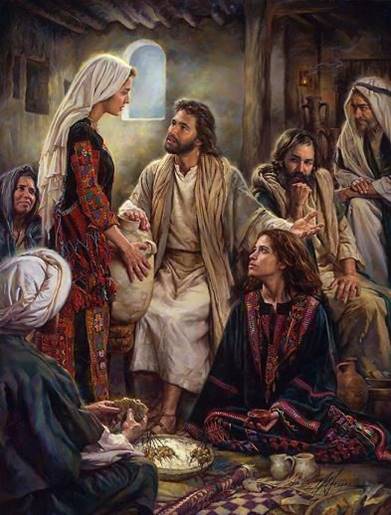
So. . . this one time Jesus was on the road and he stopped into a certain village and a woman named Martha welcomed him, which means she invited him into her home, which was a very nice and generous thing to do since Jesus probably had an entourage travelling with him and it would be rude not to include all of them.  

That village may have been Bethany if this is the same Martha that is mentioned in the Gospel of John as the sister of Mary and Lazarus.  Luke doesn’t tell us the name of the village and Luke doesn’t mention Lazarus, so it may have been some other village and a different Mary and Martha altogether. 

For ages it was assumed that the Mary and Martha of this brief episode in Luke are the same Mary and Martha from chapter 11 in the Gospel of John, the Mary and Martha who lived with their brother, Lazarus in Bethany, about three miles from Jerusalem.  And maybe it is the same Mary and Martha.  But maybe not.  Some scholars are convinced that these two sisters in Luke’s story are not those two sisters in John’s story and that this village is not Bethany.

A few years ago an astute Bible scholar named Elizabeth Schrader Polczer was taking a very close look at some very ancient manuscripts of the Gospel of John as part of her doctoral work and she noticed some odd little smudges and scrapes and overwriting in the text in the papyrus she was examining.  It looked like someone a long, long time ago—like maybe in the 2nd century—had inserted Martha into the Lazarus story.  

Whoever did this long-ago editing may have assumed that Martha had accidently been left out of John’s account.  That’s one theory.  On the other hand, maybe Martha was inserted to downplay the importance of Mary the Magdalene—Mary the Tower.  Mary Magdalene, who is almost certainly also Mary of Bethany, the sister of Lazarus, was a very popular and important apostolic figure in the early church before the patriarchy boys club tried to diminish her influence by tarnishing her reputation.  That whole business about her being a lady of easy virtue?  No basis in fact.  Just some bad patriarchic exegesis with malice aforethought.  I’m looking at you, Gregory the Not-So-Great.

Anyway, another reason why this Mary and Martha in Luke are probably not Mary and Martha of Bethany is that Bethany is very close to Jerusalem, and there is no indication in the 10th chapter of Luke that Jesus was anywhere near Jerusalem or even going in that direction.  At the beginning of the chapter he was denouncing towns in Galilee and in the chapter before that he was in Samaria.  

Another thing to consider is that Mary and Martha were two of the most common names for women in that part of the world at that time.  There are, for example, no less than six different women named Mary in the New Testament.  And while there aren’t so many Marthas mentioned, it’s not much of a stretch to think there could be at least two.

And none of this has anything to do with this particular story.  So let’s get back to the story.

So. . . Martha invites Jesus and probably his ride-along disciples into her home then gets busy providing hospitality.  This was important.  Hospitality was serious business in their culture.  It was a holy obligation backed up by scripture.  Sodom and Gomorrah were destroyed with fire from heaven for failing to provide hospitality.  Well, that and also for sexually assaulting the travelers who came through town.  But that counts as a failure of hospitality, right?

In a culture where so many people, even some wealthy and important people, were nomadic, hospitality was one of the most important cultural virtues.  When you invited someone into your home, the very least that was expected was that you would provide a good meal.  So suddenly Martha has a ton of work to do to cook some dinner for Jesus and his companions.  And maybe she needs to work out some sleeping arrangements.  And maybe she’s checking the pantry to make sure she has enough flour to make more bread and dried figs and parched grains to give them all a good breakfast.  The point is, Martha isn’t just busy for the sake of being busy.  She’s doing her best to be a good hostess and to fulfill an important social obligation.  Her busyness is honorable busyness.  Necessary busyness.  

Anyway, Martha’s got her hands full with all the hostess things and she looks across the room and sees her sister, Mary, just sitting there on the floor listening to Jesus.  

Just sitting.  

Listening to Jesus.

Martha tries to get Mary’s attention and gestures toward the food prep in progress on the table, but Mary doesn’t take the hint.  Martha picks up the water jug and tilts it toward the door, pantomiming that she would like Mary to make a quick trip to the well.  Mary doesn’t even see her because she is so caught up in what Jesus is saying.

Finally, Martha has had enough.  She storms across the room to Jesus (as politely as possible) and says, “Lord, don’t you care that my sister has left me to do all the work by myself?  Tell her to come and help me!”

I wonder how she felt when Jesus said, “Martha, Martha! You are anxious and bothered about so many things, but only one thing is necessary. Mary has chosen what is best, and it will not be taken away from her.”

Oof.

So. . . Are you a Mary or a Martha?   Wait, don’t answer that.  The fact is, one of the things I really don’t like about this text is that far too often it tempts us to ask questions like that.  We turn a story of two good people doing two good things into a kind of binary contest with a winner and a loser and we make Jesus sound all judgy in the process.  

Let’s look again at what’s actually happening in this little drama in five verses.  Jesus arrives.  Martha gets busy to provide good hospitality.  She is fulfilling her expected role, what she believes is required of her.  Mary, on the other hand, sits down with Jesus, and listens to him.  She is giving him her time and attention which is also an important social duty.  

Notice that Jesus doesn’t say anything about what either of the sisters is doing—he doesn’t say anything critical to Martha or anything affirming to Mary—until Martha drags him into the middle of the tension between the two sisters.  That’s called triangulating.  

Triangulation happens when a person complains about another person to a third person instead of addressing the issue directly. Triangulation is very common in families, especially among siblings.  In its worst forms it can be abusive.  In its most common forms its used in particular moments or situations to establish or maintain dominance, to confirm who is in charge at least for the moment.

How often do we try to triangulate with Jesus?  How often do we try to draw Jesus in on our side of a dispute?  How often do we assume that Jesus is on our side in a disagreement with our siblings in Christ?  That’s something worth thinking about, so maybe jot that down in your notebook of Spiritual Growth Questions.  It’s a good one for keeping us honest.

When Jesus says to Martha that she is anxious and bothered about many things he is very subtly stepping out of the triangle she tried to rope him into.  He isn’t criticizing her, he is merely describing her state of mind to her.  Unfortunately, that kind of  truth often sounds like criticism, especially if we’re feeling the least bit defensive.  

When Jesus tells Martha that Mary has chosen what is best, he is, again very subtly, telling Martha to stop trying to control her sister, and he is reminding her that giving a guest time and attention is at least as important as all the hospitality duties that Martha thinks are so culturally crucial.  To emphasize this, he makes it clear to Martha that he will not allow Mary’s moment of spiritual communion with him to be taken away for the sake of housework or social propriety.  

These things Jesus says to Martha can sound a bit harsh until we remember that Martha also was free to stop and sit at the feet of Jesus any time she wanted from the moment he entered her house.  The lesson for her and all Marthas might be “before you get busy with all the things, take a moment to be with all the people.”

There were very clear social conventions in their world about hospitality and meals, but Jesus was already famous for disregarding or even criticizing these kinds of conventions, so  Mary and Martha had options.  

I think this little story in Luke wants us to think about our options so we don’t accidentally create tension and anxiety and open the door to triangulation, especially at times when we want to be welcoming and hospitable.  For instance, Mary could have stepped up to help Martha right from the beginning so they could get things prepared faster and then both sat down to a conversation with Jesus.  They could have asked Jesus when he first arrived if he wanted to eat first or sit together and talk first.  Better than that, any and all of them could have stepped in and pitched in when they saw that Martha was determined to fulfill her traditional role as a hostess. And, of course, Martha could have sat with Mary and listened to Jesus and then asked Mary—and maybe also Jesus and his crew, why not?—to pitch in and help make supper.  

There is no really satisfying ending to this very brief story in Luke.  There is no easy moral to take home here.  You can’t just say “be a Mary and not a Martha.”  We need Marthas.  Marthas make things happen in the world, and especially in the church.  Every Sunday when you come in and sit down to worship a crew of volunteer Marthas has already been hard at work.  Marthas chose the hymns and practiced the music.  Marthas prepared and printed the bulletin.  Marthas checked the sound system and the cameras for online streaming.  Marthas made sure there would be bread and wine for communion.  Marthas prepared the altar and lit the candles.  And Marthas made the coffee and snacks for the fellowship time after worship.

We need Marthas.  And we need Marys.  We need the people who listen attentively and ponder what they’re hearing.  We need people who hear the words of Christ, internalize them, and pass them along to others.  We need the teachers and counselors and preachers and theologians who keep us faithful and in tune with the heart of Jesus. 

The fact is that almost every one of us has been a Martha at one time or another and almost every one of us has been a Mary at one time or another.  Both were doing good things.  Both were serving, just in different ways.  Still, when Martha tried to triangulate Jesus into the unspoken tension with her sister, Jesus does say that Mary made the better choice. 

So maybe the message is this: before you get all caught up in the necessary busyness of life, take time to sit at the feet of Jesus.  Listen to what he says.  Internalize his Word.  Breathe in his Spirit.  Then your necessary busyness, and especially the busyness of hospitality, will be motivated by the Spirit of serving and the love of Christ that crosses all boundaries and welcomes all guests.

Oh, and maybe don’t triangulate Jesus into criticizing your siblings.

Inattentional Blindness

Luke 10:25-37

Have you ever experienced inattentional blindness?   Sometimes it’s called familiarity blindness or perceptual blindness.  Almost everyone has experienced it at one time or another—that condition where you are so familiar with something that you actually stop seeing it.  The upshot of it is that the next time you do take a hard look at that familiar whatever it is, you see all kinds of things that you hadn’t noticed before.  

In my office at home I have a black and white photograph of my grandparents—my mother’s mom and dad.  That picture was taken the year I was born, so I’ve been seeing it my entire life.  My grandmother, the woman in that picture, died nine days after my first birthday, so a lot of my impression of her came from that photograph.  As a kid, I always thought she must have been kind of stern and austere—that was how the picture struck me.  But one day I took a moment to look at it again from a slightly different angle and I realized that she is actually smiling ever so slightly, and her eyes look very loving, gentle and understanding.  Now that I was really looking at her picture, I also realized that there was something strikingly familiar about her eyes, and then it dawned on me that I was seeing my mother’s eyes in this picture of her mother.  That smile, those gentle eyes had always been there in the photograph, but I hadn’t seen them because of inattentional blindness.

I think it’s fair to say that many of us have a kind of perceptual blindness with the parables of Jesus in general and this one we call The Good Samaritan in particular.  Several years ago I read a remarkable book by Amy-Jill Levine called Short Stories by Jesus.  Dr. Levine is a Jewish Professor of New Testament studies, and in this amazing book she revisits the parables of Jesus to help us understand how the first-century Jews who first heard these stories understood and interpreted them. 

Short Stories by Jesus helped me realize that I had a bad case of familiarity blindness where the parables of Jesus are concerned.  The fact is, when we put aside what we think we know about the parables and try to hear them the same way the original audience heard them, we begin to hear these familiar stories in an entirely new way.

For instance, in the very first line of the dialogue that leads up to this story about a man robbed and beaten by bandits there are two details that I never paid much attention to, but they really are kind of important because of the way they frame the rest of the story.  

“An expert in the law stood up to test Jesus.”  

The first thing to notice is that it’s a lawyer asking the question.  Luke’s original readers would have understood that this is not just your everyday scribe, this is a person with expertise in both religious and civil law.  He knows the scriptures.  And he’s testing Jesus.  He’s using a trick question as he tries to trap Jesus in a mistake of some kind.

But Jesus turned the tables on him with a trick question of his own, then amplified it with an even more important question. “What is written in the Law?” he asked the lawyer.  “How do you read it?” Some translations render that second question as “What do you read there?” but “How do you read it?” is a better translation.

That first question, “What is written in the Law,” was a red herring.  Torah, the Law, doesn’t say anything at all about eternal life.  The Law of Moses is not interested in life after death but it is vitally concerned with how we live here and now.  The really important question, though, is the second one Jesus asks the lawyer: How do you read it?   That question is just as important for us today as it was then.  Maybe even more so.  How do you read it?  What preconceptions to you bring with you when you read the scriptures?  How do you read it?

The lawyer knew that there was no good answer to the first question—the Torah doesn’t say anything about inheriting eternal life—but he felt like he needed to say something, so he responded to Jesus by quoting a mashup of the Shema from Deuteronomy and the Golden Commandment from Leviticus: “You shall love the Lord your God with all your heart, and with all your soul, and with all your strength, and with all your mind; and your neighbor as yourself.”  “That’s correct,” said Jesus, “Do that and you will live.”

The bottom line, here, is love.  Love God, and love your neighbor as you love yourself.  Do that and you will live.  Love is the key to an abundant and fulfilled life.

It sounds so simple.  The problem, though, is that this commandment to love is all-inclusive, and there are some people we really just don’t want to love.

I think the lawyer in this story is honest enough to realize that about himself.  He knows there are some people—you know, “those people”—that he will never love, and he suspects that this is true for everyone standing there listening to Jesus.  

Luke says he wanted to justify himself.  He wanted to make himself look right in the eyes of all those listening.  But he also wanted to maybe find a loophole.  Surely Jesus can’t mean that he has to love everybody, because, you know, there are some people—thosepeople—who have clearly demonstrated that they are not on our side—they are not worthy of our love.  Are we supposed to love them?  

So he asks another question:  “Well… who is my neighbor?”

In the context of law, the question about who is a neighbor has legal merit.  After all, good fences make good neighbors.  But in the context of love the question is irrelevant.  

Jesus wants to take this beyond the law. 

So Jesus redirects with a story.

A man travelling on the road from Jerusalem down to Jericho is violently assaulted by robbers.  They don’t just rob him, they strip him and beat him so badly that he’s half dead. So there he is, naked and half dead at the side of the road.  A priest happens by and does nothing to help the poor victim who is lying there bleeding.  He passes by on the other side of the road.  He gives the wounded man a wide berth.  Next a Levite comes by.  He also passes by on the other side of the road and does nothing to help the wounded stranger.

At this point, the people originally listening to Jesus tell this story would have been shocked and the lawyer had to be wondering where this was going.  For them, it was unthinkable that a priest and a Levite would pass by without helping.  The Law is very clear on this.  They are required to help!  That would be their duty according to the law, and it would take precedence over any other duty or obligation.  Even if the wounded man turned out to be dead, they had a responsibility to care for his body.  That was the law.

The people listening to Jesus were shocked.  But they were about to be utterly scandalized.  Because the hero of the story that Jesus is telling turns out to be… a Samaritan.  

It’s hard for us to imagine how much the Jews hated the Samaritans.  And vice versa.  The antagonism between Jews and Samaritans went back centuries and was all the more intense because they were so closely related.  

We traditionally call this parable the story of the Good Samaritan, but in the minds of those who were listening to Jesus, the words “good” and “Samaritan” would never find themselves in the same sentence.  It was an oxymoron.  Samaritans were the enemy.   The people listening to Jesus as he tells this story might have thought, “If I were the man in the ditch, I would rather die than admit that I was saved by a Samaritan.”  In their minds, Samaritans were something less than fully human.  

So how did things get to be so antagonistic between the Jews and the Samaritans?  Where did all that bad feeling come from?  

Well, centuries before Jesus, in the time of Jacob, Samaria was called Shechem, and it was a Prince of Shechem who raped Jacob’s daughter, Dinah.  In the time of the Judges, the false judge Abimelech, who murdered all his rivals, came from Shechem.  For a time, Shechem became part of the united kingdom of Israel under David and Solomon.  But after Solomon died, the Northern Kindom of Israel—which had been Shechem—broke away and a kind of low-grade civil war broke out that continued for generations.  When the Assyrians swept in and conquered the Northern Kingdom which was now called both Israel and Ephraim, they brought in people from other conquered kingdoms to resettle and then renamed the land Samaria after the capital city.  That’s also when the people of Judah began to refer to Samaritans with a kind of racial slur, calling them “the people with 5 fathers.”  But the thing that the people of Judah found absolutely unforgiveable forever and ever amen, was that when they returned to Jerusalem after their time of captivity in Babylon, Sanballat, the governor of Samaria, joined forces with other people in the region and attacked them to try to stop them from  rebuilding the city wall and the temple.

For their part, the Samaritans called themselves the Shamerim, meaning “guardians” or “observers” of the Law.  They had built their own temple on Mt. Gerizim and they had their own version of Torah, which they insisted was the “true” version.  They believed that only Torah—their Torah, of course—contained the word of God and they did not include the Psalms and other writings, or the books of the prophets among the books they regarded as holy.

For Jews, Samaritans were the ultimate “other,”  so for Jesus to cast the Samaritan as the benevolent hero was almost beyond belief.  It would be like an ultra-orthodox Jew being saved by a Hamas Palestinian.  To bring it closer to home, it might be like one of the Proud Boys being saved by someone wearing a Black Lives Matter tee shirt.  

Who would it be for you?  Who is that ultimate “other” who, in your mind, only just barely qualifies as a real person?  Who is it who, in your mind, seems to be so radically different from you that there’s really no point in even talking to them?  Or maybe there’s someone who sees you that way.  How would you feel if it was one of those people who pulled you out of the ditch?

The lawyer had asked Jesus, “Who is my neighbor?”  Jesus reframed his question.  Jesus wants us to understand that the question is not “who” merits my love or even “from whom” should I expect love.  As Amy-Jill Levine wrote, “The issue for Jesus is not the ‘who,’ but the ‘what,’ not the identity but the action.”  Love—loving God, loving your neighbor, loving yourself—is revealed in action.  Love does not exist in the abstract; it must be enacted.

The Priest and the Levite did not act in love even though their law and duty commanded that they should.  

Shortly before he was assassinated, the Rev. Dr.Martin Luther King, Jr. preached a sermon on this parable.  He had an interesting explanation for why the priest and the Levite did not stop to help the wounded man at the side of the road.  “I’m going to tell you what my imagination tells me,” said Dr. King.  “It’s possible these men were afraid… And so the first question that the priest and the Levite asked was, ‘If I stop to help this man, what will happen to me?’ … But then the Good Samaritan came by, and he reversed the question:  ‘If I do not stop to help this man, what will happen to him?”

The Samaritan gave first aid to the man at the side of the road.  He put him on his donkey and took him to the nearest inn where he could receive more help.  He paid the innkeeper two days wages to take care of the wounded man and then gave him a promise that amounted to a blank check.  “Take care of him,” he said, “and when I come back, I will repay you whatever you spend.”

“Which of these three,” Jesus asked the lawyer, “was a neighbor to the man who fell into the hands of the robbers?”  

The lawyer couldn’t even bring himself to say, ‘the Samaritan.’  He couldn’t let the word sit in his mouth.  That’s how much the Jews despised Samaritans.  I imagine there was a long pause before the lawyer finally said, “The one who showed him mercy.”

Mercy.  It’s an important detail here at the end of the parable,  a well-chosen word.  In both Greek and Hebrew, the word we translate as mercy can also mean “kindness.”  It is a covenant word in Hebrew.  Hesed.  It signifies a shared bond of common humanity in the eyes of and under the Law of God.  It is an acknowledgement that we “are of the same kind.”  

The Samaritan showed mercy.  Kindness, a word that takes us back to the prophet Micah:  “God has told you, O Mortal, what is good.  And what does the Lord require of you but to do justice, and to love kindness…mercy…kindness, and to walk humbly with your God.”

“Go and do likewise,” said Jesus to the lawyer.  Go and do likewise Jesus says to us.  

In our country today, we find ourselves living in a culture scarred by cycles of division, antagonism, generations of animosity, racism and conflict and even violence.  In this parable, Jesus is telling us that these spirals of perpetual antagonism can be broken with kindness.  The question that Jesus wants us to wrestle with is this: Can we learn to treat even our enemies, the “Samaritans” in our lives, in ways that acknowledge their humanity? Can we dare to see them in ways that acknowledge their potential to do good?  Can we can bind the wounds of those “others” and dare to imagine that they would do the same for us?    

When we encounter each other on the road full of bandits and other dangers, will we be blinded to each other by our familiar stereotypes, or will we find the courage and imagination to step outside of the roles we’ve cast for each other so we can give and receive kindness and be the good neighbor?  

Yes, this is a parable about helping those in need.  That’s what good neighbors do.  But more than that, it is a story about learning to see our common humanity in those we have always been tempted to dehumanize.  

Do justice. Love kindness—we are of the same kind.  Walk humbly with God.

Image: The Good Samaritan by Stephen Sawyer; http://www.art4god.com

A People Possessed

Luke 8:26-39; Mark 5:1-10

So, one day Jesus decided to take his disciples on a little trip across the lake.  Why?  Because that’s where the Gentiles and Hellenized Jews lived—you know, those “other” people—and Jesus wanted them to know about the kingdom of God, too.  He wanted his disciples to understand that the Commonwealth of God’s justice and kindness is not just for Judeans and Galileans.  It’s for everyone.  So they set out across the lake. But no sooner had their boat touched the shore than they were accosted by a naked demon-possessed man who apparently already knew who Jesus was.  “When he saw Jesus, he cried out and fell down before him, shouting, ‘What do you want with me, Jesus, Son of the Most High God?  I beg you, do not torment me.’”  

Just to be clear, there is no record of Jesus ever tormenting anyone, although he has been known to make people uncomfortable with very pointed questions—the kind of questions that can make your soul itch.  So maybe that’s what the demoniac was afraid of.

Jesus paused the exorcism and asked the demon his name.  “Legion,” said the man, “for many demons had entered him.”

Legion.    In a Jewish story that was written in Greek, that Latin word sticks out like a bowling ball on a tennis court.  Legion.  It had only one meaning in their world at that time—a  division of Roman soldiers.  And that gives us a clue that, while this is an exorcism story and a miracle story, it is also a political story—a story about how the oppressive practices of the Roman occupation drove this poor man insane and caused his community to live under a cloud of fear.  

Living under a system where the Romans and the local nobility and the wealthy got the first and the best and the most of everything and got richer on the backs of the poor people who did all the work and took all the risks was more than this poor soul could take.  He didn’t dare to speak out against the multiple injustices that shadowed their daily life because doing so would bring swift and brutal punishment from the soldiers who patrolled the streets, punishment that would be directed not only at him but also at his neighbors.  With no safe outlet for his rage and his pain, he turned them inward on himself.

The late Paul Hollenbach put it this way: “The tension between his hatred for his oppressors and the necessity to repress this hatred in order to avoid dire recrimination drove him mad. He retreated to an inner world where he could symbolically resist Roman domination.”  By casting out the demon, said Hollenbach, Jesus “brought the man’s and the neighborhood’s hatred of the Romans out into the open, where the result could be disaster for the community.”[1]

This is not just a story about how Jesus brought peace to a tormented man in ancient times, it is also very much a story for us in our time.   In an editorial remembrance of Minnesota State Representative Melissa Hortman and her husband Mark who were killed last week in a political assassination, ELCA pastor and author Angela Decker wrote, “American democracy, borne in slavery, enriched in colonialism and genocide, tested in ill-advised overseas wars, is now writhing and twisting, beset by internal illness and self-inflicted wounds.”[2]

If that assessment seems too harsh, consider these events from just this month:

  • On June 8, disregarding the authority and advice of Governor Newsome and Mayor Bass, President Trump deployed 2,000 National Guard troops to Los Angeles to quell “riots” which were, in reality, mostly peaceful protests against the administration’s continuing raids on undocumented immigrants by Immigration and Customs officers. On June 10, the president deployed 700 U.S. Marines to Los Angeles in violation of the 10th Amendment to the Constitution and the Posse Comitatus Act which forbids the use of the military for domestic law enforcement.  On June 17, he deployed an additional 2,000 National Guard troops.  According to The Guardian, these troops “have told friends and family members they are deeply unhappy about the assignment and worry their only meaningful role will be as pawns in a political battle they do not want to join.”[3]
  • On June 10, New Jersey Congresswoman LaMonica McIver was arrested and indicted for interfering with ICE officers who were arresting Newark Mayor Ras Baraka outside a federal immigration detention facility in her state.  Both Congresswoman McIver and Mayor Baraka were there as part of to their official duties.
  • On June 13, United States Senator Alex Padilla was wrestled to the floor and handcuffed by security officers when he tried to ask Homeland Security Secretary Kristi Noem a question at her press conference.
  • On June 17, New York City Comptroller Brad Lander, who is also a candidate for mayor, was arrested by ICE agents at a Manhattan immigration court while escorting a defendant out of the courtroom.  He had come to the court in an effort to observe hearings and promote legal services for immigrants.
  • On June 14, Flag Day, Minnesota State Representative Melissa Hortman and her husband Mark were shot and killed by a man posing as a police officer.  Their assailant then drove to the home of State Senator John Hoffman and shot him and his wife, Yvette.  Fortunately, they survived.  Later that same day, the president would watch a poorly attended military parade while more than five million people attended No Kings protests all across the country to protest the policies of his administration.
  • June 12 marked the 9th anniversary of the Pulse Nightclub mass shooting in Orlando, Florida in which 49 people were killed and another 68 were injured.
  • June 17 was the 10th anniversary of the racially motivated killing of 9 people who were attending a Bible study at Mother Emmanuel AME Church in Charleston, South Carolina.  
  • In a related note, as of June 20, there have been 37 mass shootings in the US this month alone, bringing the total to 199 so far for the year.

Now add on to all of that the rising international tensions which threaten to involve us, the ongoing war between Russia and Ukraine and the increasingly violent conflict between Israel and Iran—which as of yesterday afternoon with the bombing of Iran ordered by President Trump now actually does involve us—and  it’s no wonder that politics is having a profoundly negative effect on our collective sense of well-being and our understanding of who we are as a people. 

According to the American Psychological Association, political polarization and a seemingly endless series of national crises have become a significant source of stress for the American people and that stress is taking its toll.  Seventy-seven percent, nearly 8 in 10 adults, report that worrying about the future of our country has become a serious source of anxiety causing symptoms that range from insomnia to depression.  Forty-one percent, nearly 2 in 5 adults, have considered moving to a different country.   

As I read the Gospel for this week with all these things echoing in my heart, I couldn’t help but think that we, the good old US of A, we are the demon-possessed man. We are the man made crazy by fears and anxieties and bigotry and scapegoating.  We are the man howling among the tombs and battering ourselves with blind rage and unreasoned hatreds.

We are the man with a hopelessly divided mind, made bipolar and schizophrenic by a cacophony of opposing inner voices—entrenched political parties with no common ground—conservatives vs. liberals and ne’er the twain shall meet even in the cause of common sense, putting our party identity and our ideology ahead of everything else that’s supposed to define us, making even our faith subservient to our chosen place on the ideological spectrum. 

We are so blinded by the ideological lenses we wear that we see only what we want to see. And since our biases rarely completely align with or truly resonate with the Gospel, our cognitive dissonance creates the first and most stubborn degree of our madness.

Oh, we have our moments of clarity.  But then the rage wells up in us and we explode in violence.

For most of us the violence doesn’t go beyond rhetoric and posturing, but words and attitude can open the door for those who would turn it into horribly tangible violence, death and destruction.

Even among the most enlightened among us, our suppressed  racism, or our discomfort with sexualities that are different from our own, or our anxieties about other religions—all these things creep out in unguarded words or microaggressions, or, most often, simply in awkward silence—a failure to speak, a silence which gives permission to the violence that is always waiting to happen.  We breed the craziness.

We cloak our prejudices in our religions or our patriotism. We project our own disquiet, our own fears and anxieties and hatred onto the most vulnerable and marginalized, scapegoating them with some reasonable sounding rationale to support our bigotry and give us permission to treat them horribly.  We are so blinded by our own warped and fearful reasoning that we can’t see children of God standing right in front of us—especially if the color of their skin or their language or their religion or their sexuality isn’t the same as ours.

We are caught in an epic struggle between love and hate, a struggle that is almost entirely of our own making.

Can you see that if you’re not actively and passionately on the side of love then you are at least passively on the side of hate? 

Can you see that if you are not actively generating the transformational light of cultural metanoia—a radical change of heart and mind—then you are passively brooding in a moonless night of cultural assumptions?

And can you see that we are not just the bedeviled man raving among the tombs?  We are also the craven townspeople afraid of our own shadows, afraid to stand against the madness even as we recognize the insanity of our own inconsistencies.   We penalize the voices that cry out against injustice.  We lock them up and bind them with chains, both real and metaphorical, even though we know, deep down, that silencing them will not bring us peace.

And even when God works a miracle and restores one of us to our senses we respond with more anxiety because that is just so different from our usual experience, and because anxiety has become our go-to reaction for almost everything.

Can we find a way out of all this madness?

Can we learn how to put aside our politics, our ideologies, our biases and prejudices?  Can we learn how to silence the less savory internal voices of our childhood, our inclination for self-protection, our fear of the “other,” our anxiety about a constantly changing world—can we put aside our own demons long enough to see the person in front of us as someone who God deeply loves and cares for?

Can we learn to see each other the way Jesus sees us? 

Instead of a woman with an unsavory reputation, can we learn to see a daughter of God who has been beaten down by the world and had to make desperate choices in order to survive?  Instead of an unhoused nutjob venting his rage on the corner or among the tombs can we learn to see a son of God bedeviled and enslaved by the legion insanity and heartlessness of the world around him?

Can we learn to see that in Christ we are all children of God, that in Christ there is no Jew or Greek, slave or free, male or female, gay or straight or trans or bi—no documented or undocumented?   No us or them?

Can you see that we are all going to have to learn to see differently?

No, we can’t afford to be stupid. No we can’t afford to be blind to real threats.  But can you see that first we are going to have to learn to recognize and deal with the real threats that arise from our own hearts and minds and souls?

Can we learn how to stop listening to all the voices that divide us and pit us against each other? Can we find the heart to switch off the news channels and radio voices and web feeds and political voices that want to tell us how awful or dangerous those other people are, who want to tell us that “they” are not the real “us”?

Can all of us, each of us, muster enough humility to have at least one “come to Jesus” moment so he can remove the lenses of our preconceptions and cast our demons into the sea of God’s love?

Can you see that the only way out of our madness is for us to learn to love our neighbors with the love of Christ?  Can you see that the love exemplified and perpetually renewed by Jesus—whether you know that’s where it comes from or not—is our only hope of ever being able to sit down with each other calmly and in our right minds?

If we can learn to see each other the way Jesus sees us, then maybe we can live to see the promise of Isaiah 32 fulfilled:

Then everyone who has eyes will be able to see the truth,

                  and everyone who has ears will be able to hear it.

         Even the hotheads will be full of sense and understanding.

                  Those who stammer will speak out plainly.

         In that day ungodly fools will not be heroes.

                  Scoundrels will not be respected.[4]

Hasten the Day, Lord Jesus.


[1] Hollenbach, P.; Jesus, Demoniacs, and Public Authorities; 1981, JAAR, p. 573; quoted in Meyers, Ched; Binding the Strong Man, p. 192

[2] Minnesota Star Tribune, June 19, 2025

[3] https://www.theguardian.com/us-news/2025/jun/12/los-angeles-national-guard-troops-marines-morale

[4] Isaiah 32:3-5, Contemporary English Version

The Power of Three

Have you ever noticed how many things come in threes?   Our constitution, for instance, give us a government of, by and for the people, with three balanced and equal branches, the executive, the legislative and the judicial.  Well, they’re supposed to be balanced and equal.

Our lives depend on the environmental threesome of land, water and air.  The plants that feed us are dependent on the trio of soil, rain and sunlight.  Native Americans learned long ago to plant a triplet of crops together corn, beans and squash.  They called them the Three Sisters because they worked together in a way that made all three healthier and more robust.  The corn provided a natural pole for the beans to climb.  The beans fixed nitrogen into the soil to fertilize the corn and squash, and the squash spread out its leaves and vines around the roots of the corn and beans to provide shade and preserve moisture in the soil. 

Our planet is composed of three kinds of rock: igneous, sedimentary, and metamorphic and the elements that compose the stuff of the universe come to us in a triad of solid, liquid and gas.  The nearly infinite variety of colors we see are all built from the three primary colors, red, blue and yellow.

We describe our passage through the day as a journey through morning, noon and night, and as we drive through the city streets our stopping and going is controlled by a troika of green, yellow and red lights.  When we’re on the go, we often refuel with the gastronomic trinity of fast food—a burger, fries and a shake, then we decide who will pay the bill with a quick game of rock, paper, scissors.

When we relate to each other thoughtfully, we realize that the human person we’re conversing with is a complex triplex of intellect, physicality and emotion.  Freud tells us that our psyches are a gordian knot of id, ego and superego.  And in broader, more ancient terms we understand ourselves as body, mind and spirit. 

Jesus told us that he is the Way, the Truth and the Life, and St. Paul told us that Faith, Hope and Love abide, which are the three things we need most as we confront the evil triad of greed, sexism and racism.

Aristotle said that everything that comes in threes is perfect.  Omnes trium perfectum, a statement that may have had some influence on the bishops of the early Church who gathered at the Council of Nicaea.

Today is Trinity Sunday, the one day in the Church year dedicated to a doctrine, the first doctrine adopted by the Church, the doctrine that tells us that God the Father, Jesus Christ and the Holy Spirit exist eternally as three persons but also as one God.  In his book, The Divine Dance, the Trinity and Your Transformation, Richard Rohr says that the Trinity is the fundamental reality of the universe, a perfect balance of union and differentiation, and a model for human relationships—God for us, God alongside us, God within us.

It’s not always easy to wrap our heads around this idea.  Martin Luther once said that denying the Trinity might imperil your soul but trying to understand it could imperil your sanity.  The truth is that the infinite God cannot be boxed into our very finite minds.  The limitless God cannot be corralled by our limited understanding.  “’Circling around’ is all we can do,” says Richard Rohr. “Our speaking of God is a search for similes, analogies, and metaphors. All theological language is an approximation, offered tentatively in holy awe. That’s the best human language can achieve. We can say, ‘It’s like—it’s similar to…,’ but we can never say, ‘It is…’ because we are in the realm of beyond, of transcendence, of mystery. And we must—absolutely must—maintain a fundamental humility before the Great Mystery. If we do not, religion always worships itself and its formulations and never God.”[1]

The Holy Trinity, the unity of the Father, the Son and the Holy Spirit, three distinct persons living as one God, is not a puzzle to be solved.  It’s a mystery in which to immerse ourselves.  Frederick Buechner described the Trinity as the Mystery beyond us, the Mystery among us, and the Mystery within us.  You don’t solve mysteries, you explore them.  You enter into them.  You participate in them.  Maybe instead of calling this day Trinity Sunday, we should call it Mystery Sunday.

Richard Rohr said that when something is a mystery, especially when it’s a God mystery, that doesn’t mean it can’t be understood, it means that it can be understood endlessly.  There is always more to see.  There is always more to relate to.  There is always more to understand.  There are always new steps in the dance.

And it is a dance—or at least that’s, historically, one of the best descriptions we’ve ever had of the Trinity.  But how did we come to have the Doctrine of the Trinity in the first place?  There is no passage in the Bible that specifically describes or defines God as Trinity, though there are some passages that hint at it.  The closest we come to a full statement of Trinitarian theology is at the end of Matthew when Jesus tells his disciples to baptize new disciples in the name of the Father, the Son and the Holy Spirit.  And St. Paul ends his second letter to the Corinthians with Trinitarian language when he says, “The grace of the Lord Jesus Christ, the love of God and the union of the Holy Spirit be with all of you.” As my colleague Heather Anne Thiessen once said, the Trinity isn’t spelled out in scripture, but it’s there in kit form.  

Early followers of Jesus had a problem.  Like the Jews—and remember, the very first followers of Jesus were Jews—these early Jesus followers believed that there is only one God.  But they also believed—or at least most of them did—that Jesus was divine and that he was somehow completely one with God whom he called Abba or Father.  On top of that, they had received the Holy Spirit—the very breath of God, who they also experienced as a divine person because the Spirit often seemed to exist and act independently of Jesus and Abba.  At the baptism of Jesus, though, all three seemed to have been present: Jesus coming up out of the water, the Spirit, descending in the form of a dove, and Abba, speaking like thunder.  So how do you reconcile three divine persons but hang onto the idea that there is only one God?

Well, you don’t, said one group of Jesus people.  These people were called Arians because the main proponent of their theology was Arius of Alexandria.  The Father is God, said Arius.  Jesus, the Son is a slightly lesser god.  He was created by the Father in the first millisecond of creation and all his authority and power comes from the Father, but he is separate in substance and stature.  And the Spirit is a slightly lesser god than Jesus, the Son, and also of an ever-so-slightly lower stature and substance.  What the Arians were saying, more or less, is that there are really three gods and, while they are eternally united, the Father is the first and most important God, the one with all the power and authority.   

Hang on a minute, said the Trinitarians.  Jesus said, “The Father and I are one.  You who have seen me have seen the Father.”[2]  He also said, “All authority in heaven and on earth has been given to me.”[3]  After the resurrection, Jesus breathed the Holy Spirit into the disciples.  The Spirit is in his breath.  It’s his Spirit that flows in us.  When the prophets would say, “The Spirit of the Lord is upon me”  they were talking about the Father’s Spirit.  So, the Three have to be One.  But they are also Three.  And they are still One.  Three persons, One God.

This disagreement the Trinitarians and the Arians had started to become violent and threatened to completely and irreparably divide the church which had only recently really begun to come together in a meaningful way.  So 1700 years ago last month, in May of the year 325, the Emperor Constantine, who had recently declared himself to be a follower of Christ, decided that this question had to be settled for the good of the Church and the good of the empire.  He called for a Council and ordered all the bishops to meet at Nicaea to debate the matter.  After much argument, Constantine declared that the Trinitarians had won the debate and ordered the bishops to formulate an official statement to describe the Doctrine of the Trinity.  

This was the very first official doctrine of the whole Church, by the way, and the bishops and presbyters argued heatedly over the words they would use.  They argued about whether the Father and the Son were made of the same substance (as if anybody could possibly know that) and whether they had the same nature.  They knew they were standing at the edge of an enormous Truth about God and they felt it was vitally important to get all the details exactly right even though there was no possible way for them to know or even see all the details.  In some ways, they were like children who stand on the beach and think they can fully describe the breadth and depth and power of the ocean and all the life contained in it.  

The bishops created the first draft of what we now know as the Nicene Creed and decided that adherence to this statement of faith would determine if someone was a true Christian or not.  Ironically, their very useful insight about the all-loving, all-relating God who exists eternally in the expansive community and relationship of the Trinity led them to formulate a faith statement that would be used to exclude people from the community and the embrace of the Church.

The doctrine of the Trinity continued to confuse a lot of earnest Christians, and, truth be told, it was not universally accepted everywhere even though the Emperor had declared it to be the official stance of the church.  For many people it was just too confusing to figure out how one plus one plus one could equal one.  Fortunately, about 50 years after Nicaea, the Cappadocian Fathers, Basil, the bishop of Caesarea, his younger brother, Gregory, the bishop of Nyssa, and Gregory Nazianzen, the patriarch of Constantinople came up with a better description of how the three persons of the Trinity exist as one God.  

The model they used was a circle dance, and the fancy theological name they gave their idea is perichoresis, a Greek word which more or less literally means circle dance.   The Father, the Son, and the Holy Spirit, they said, exist as one in an eternal circle dance of love.  The Trinity is an eternal, joyful, radiant manifestation of love, loving, and being loved.  The love that endlessly flows between, in and through the Father, Son and Holy Spirit creates and sustains the universe.

One of the beautiful things about this idea is that there is no hierarchy in it.  The Father, Son and Holy Spirit are equal in their eternal love for each other and for their creation, which includes us.  Another wonderful thing about this idea is that it describes God as always in motion.  God as a verb, and not as a static noun, exists as an endless flow of love.  But perhaps the most powerful thing about this idea, at least as far as we are concerned, is that we are invited into their dance.  We are invited to participate in the endless flow of love, loving, and being loved.  The Holy Spirit, who dwells within us, carries us into the loving embrace of the Father and the Son and invites us to learn the steps of the dance.

We are called to embody this trinitarian flow of love, loving and being loved to carry it out into the world, loving God, loving our neighbor and being humble and vulnerable enough to let ourselves be loved.

In the name of God the Father, in the authority and authenticity of Jesus, and in the power of the Spirit, we are called to practice in what the late Walter Brueggemann called prophetic imagination.  As we are embraced by the wholeness and balance of the Trinity, we are called to speak out, to proclaim the inbreaking of the kingdom of God, to speak truth to power, and to live out God’s definition of goodness—to do justice and to love kindness and to walk humbly with God and with each other.

In his book Interrupting Silence: God’s Command to Speak Out, Walter Brueggeman said, “The church has a huge stake in breaking the silence, because the God of the Bible characteristically appears at the margins of established power arrangements, whether theological or socioeconomic and political.”  He went on to say, “Since we now live in a society—and a world—that is fitfully drifting toward fascism, the breaking of silence is altogether urgent.  In the institutional life of the church, moreover, the breaking of silence by the testimony of the gospel often means breaking the silence among those who have a determined stake in maintaining the status quo.”

We are called to remind the world that God is inherently just.  God’s justice is inseparable from the love, kindness and grace that flows endlessly in the circle dance of the Three-in-One, and from the Triune God to us and through us.  If we live in the trinitarian flow of love, loving and being loved, we cannot remain silent and inactive in a hurting world.  


[1] Richard Rohr, The Divine Dance: The Trinity and Your Transformation

[2] John 10:30; John 14:9

[3] Matthew 28:18