Filling the Brackets

Luke 3:21-23, 31-38

Every week I send out the texts for the coming Sunday to our online worship production team.   A few days ago, Bob Siemer sent me an email saying he wanted to confirm a couple of things.  One of the things he wanted to confirm, in his words was, “You really are going to read the genealogy as part of the Gospel text (yawn).”

Well, I have to confess that when I first glanced at the gospel text that Wilda Gafney has given us for this week in the Women’s Lectionary, I felt pretty much the same as Bob.  Yawn.  But then I took a closer look at what Professor Gafney had done in translating this text from Luke.  When I looked more closely, I noticed the brackets.  

Luke and Matthew each give us a genealogy of Jesus.  For what it’s worth their genealogies don’t entirely agree, but each of them felt it was important to give us a picture of Jesus’s family tree.  Matthew starts with Abraham then takes the lineage forward in time until he gets to Jesus.  Luke starts with Jesus then takes the lineage backwards until he gets to Adam. And Eve.  Except that Luke didn’t mention Eve.  Or Ruth.  Or Rahab.  Or Tamar. Or Leah. Or Rebekah.  Or Sarah.  And that’s where Professor Gafney’s brackets come in.  In every instance in Luke’s genealogy where the women ancestors are known from the Old Testament stories that feature them, Wilda Gafney has inserted their names in brackets.  

Even though Luke doesn’t mention their names, these women whose names are in the brackets are also part of the human heritage of Jesus.  Their stories are part of his life just as much as the men who are named.  In some instances, their stories are more interesting than the men who are noted as their husbands, and yet they just got written out of the story when Luke was naming the ancestors of Jesus.

All this got me thinking…  How well do I know my own ancestors?  I have spent a bit of time on the website familysearch.org and have followed the my patrilineal line back to Sir Roger John Beckham, an English nobleman who lived from 1350 to 1386.  But I realized when I thought about Wilda Gafney’s brackets in Luke’s genealogy of Jesus that there is an enormous part of my own gene pool that I have entirely overlooked.  I haven’t filled in the empty brackets in my own heritage.

Nancy Ida Curtis.  Susan Elizabeth Casey.  Priscilla Phoebe Whiteley.  Rachel Ellen Daniels.  Harriet Owen.  Nancy Jane Moody.  Edith Elizabeth Davidson.  Emma Malmgren.  Hanna Maria Carlson.  Karolina Aurora Andersdotter.

I am directly descended from these women, yet most of their names were new to me.  I didn’t know about them until I traced things back through my grandmothers instead of my grandfathers.  My surname may have traveled down the line through my forefathers, but every bit of my mitochondrial DNA came from my foremothers.  If I don’t know about them, I know less than half of my own story.

It isn’t news that our culture and our church have been dominated by a male perspective since…well, forever.  History in general and church history in particular has been told primarily as a story of men.  Faithful, devout, and sometimes heroic men.  But from the very beginning there were also faithful, devout and sometimes heroic women, too.  It’s just that their presence and their roles have often been overlooked, which is really odd when you consider the fact that it was women who stuck by Jesus at the crucifixion.  It was women who first experienced the empty tomb.  It was women who first encountered the risen Jesus and it was women who first announced the resurrection to the men.  Who were in hiding.

In Sunday School and Bible studies we learn about King David.  And if we’re willing to read a little more deeply, we’ll learn about David’s great grandmother, Ruth.  Ruth was not even Jewish.  She was a Moabite.  But she loved her mother-in-law and stuck with her even after her husband died. She traveled back to Israel with her mother-in-law and became loyal to Israel’s God and three generations later her great-grandson became the king of Israel.  Luke tells us that Jesus was of the house and lineage of David.  This is his Jewish bona fides.  But if Jesus was of the house and lineage of David, King of Israel, then he was also of the house and lineage of Ruth, a woman of Moab.

The story becomes richer and more interesting when you follow the women.  Ruth married Boaz.  His mother was Rahab, a Canaanite woman.  She was the prostitute who hid the Israelite spies in her house in Jericho when Joshua was first preparing to attack the city.  She helped the spies escape by lowering them over the city wall in a basket.   The Jewish Women’s Archive (www.jwa.org) describes Rahab as “a woman triply marginalized—a Canaanite, woman, and prostitute [who]  moves to the center as bearer of a divine message and herald of Israel in its new land… She is remembered in Jewish tradition as the great proselyte, as ancestress of kings and prophets, and, in the New Testament, as ancestress of Jesus.” 

Why don’t we learn more about these fascinating women of the Old Testament?  Why don’t we know more about Deborah and Huldah and Hannah and Abigail, just four of the seven women prophets?   Did you know there were seven women prophets?

Why don’t we pay more attention to the astonishing women in the New Testament? How did we lose the story of Joanna, also known as Junia?  St. Paul refers to her as an apostle,[1]after all!  She travelled with Jesus and helped support his ministry.  She was a witness to both the crucifixion and the resurrection.  She crossed paths with and corresponded with Paul. Some scholars think she may even be the author of the Letter to the Hebrews.

Lydia of Phillipi, Phoebe of Cenchrae, Chloe of Corinth, Priscilla of Pontus, Thecla of Iconium.  All these women were partners in ministry with the Apostle Paul but we know so very little about them. 

We read and learn about St. Augustine, a great theologian and Doctor of the Church, but it was his mother, St. Monica, who steered him toward the church when he wanted nothing to do with it, then kept him in constant prayer, and finally  introduced him to St. Ambrose who could answer all his questions.

We celebrate Saint Patrick’s day every year, but why don’t we have parades for St. Brigid of Kildare, the mother saint of Ireland?  She founded several convents and monasteries, including Kildare which was a community where men and women could live together with equal status and equal responsibilities.  She had a tremendous influence on Celtic theology and Celtic liturgy. Because she oversaw several monasteries, she was regarded as a bishop.  Believing that the arts were an important expression of faith and devotion, she established a school of the arts at Kildare.  Much of what we know as classic Celtic art and illumination was either preserved or created by her artisans.

Why don’t we know more about Kassia of Constantinople?  She was a Byzantine-Greek composer, hymn writer and poet.  She is the only woman whose music is included in the Byzantine liturgy.

Why don’t we see more about St. Scholastica of Nursia in the church history books?  Her brother, St. Benedict, gets a lot of ink for establishing the Benedictine order and writing the Rule of Benedict, but she did the same thing at the same time establishing the Benedictine order of nuns.

Katharina von Bora, the wife of Martin Luther is fairly well known, as she should be.  But why don’t we hear more about Argula von Grumbach, the Bavarian noblewoman and writer who promoted and defended Luther and Melancthon with her essays, letters and poems?  Why do we not know more about how she challenged the University of Ingolstatdt’s faculty when they arrested a student on the charge of being “Lutheran?”

With all the Norwegian Lutherans, why don’t we hear more about Lady Inger Ottesdotter Romer, the powerful Norwegian noblewoman who promoted and financed the Lutheran Reformation in Norway and helped usher the Reformation into all of Scandinavia?

I could do this all day—naming women who have had a tremendous role in the scriptures and in the history of the church of Jesus Christ.  I could spend the rest of my life inserting brackets into the story of the Church.

I don’t know if we will ever be able to undo all the damage of patriarchy.  I doubt that we’ll ever be able to insert all the brackets that are needed to truly balance the history and understanding of our faith.  But I know we should try.

We say that Jesus is both fully human and fully divine.  One of the great things about that is that when we look at his human lineage we see a few people who were devout and heroic, but we also see a good number who were flawed and feckless.  In other words, human.   In the list of Jesus’s forebears, it was often the women, the people in the brackets who were the strongest, smartest, and most heroic.  Their strength and wit was part of the human heritage of Jesus.  They were part of who he would become and who he is.

Luke takes his genealogy of Jesus all the way back to Adam and notes that Adam was the child of God.  But so was Eve.  If we’re not listening to and learning the stories of all our grandmothers and mothers and sisters in our long lineage of faith, then we are learning less than half of the story.  

The 27th of January, just a few days ago, was the day the Church commemorates Lydia, Dorcas, and Phoebe.  In observing that commemoration, Guy Erwin wrote this:

It’s fitting, after a day in which we commemorated three male leaders of the early church, that today we think about three extraordinary women mentioned in scripture as important in their Christian communities. Within the social conventions of the ancient Mediterranean world, the public role of women was more circumscribed than that of men, but that didn’t prevent them wielding considerable influence, and even exercising some power within communities. Of course class and economic status intersect; wealth made women both freer and more restricted, as social convention often mattered most to the elite.

Lydia and Dorcas are both mentioned in the Acts of the Apostles: Lydia as a wealthy matron, active in her community in Macedonia; Dorcas as a helper of the poor in Joppa. Phoebe, who was part of a congregation near Corinth, is referred to by Paul with great respect. Historians know that what we know about the past is strongly shaped by who recorded the events and people, and that it’s important to look beyond that for other signs of those who are missing from or less regarded in the narrative. That’s often the case with the women in these stories. But we also don’t know much about many of the people on the sidelines, even the three male saints from yesterday.

The point for me is that it isn’t just the principals in the story, but the whole community that is part of the Christian story—not just those with names, but all the saints both named and unnamed. The story belongs to all of us, believers of every kind. We’re still making church history every day, and we stand in line with Lydia, Dorcas, and Phoebe. 

We stand in line with Lydia, Dorcas and Phoebe.  We are joined in communion with Kassia and Scholastica and Argula and Inger…and all the saints, named and unnamed.  The story belongs to us now.  Let’s try to live it and tell it in such a way that no one in the future will need to insert any brackets.


[1] Romans 16.7

Plague

Thoughts Along the Way…

In the year 165, Roman soldiers returning from their victory over the Parthians brought an unwelcome guest home with them.  As they battled the Parthians and camped in the borderlands, many of them contracted a highly contagious and lethal virus.  It began to decimate their ranks as they marched homeward.  The disease was probably smallpox and it spread through the empire like wildfire. It claimed the life of the emperor, Lucius Verus, in 169.  His co-regent, Marcus Aurelius also contracted the disease but survived.

That first Roman pandemic came to be known as the Antonine Plague and it lasted the better part of 20 years, sweeping across the empire in surges and waves.  Medical historians think there were at least two variants of the virus.  At its height, it is estimated that the plague was causing 5,000 deaths a day.  When it broke out again in 189, Cassius Dio documented a death toll of 2,000 a day.   Over a 23 year period, the Antonine plague claimed somewhere between 7 and 10 percent of the entire population.  In the army and in the densely packed cities, the rate was between 13 and 15 percent.  Cassius Dio wrote that caravans of carts loaded with bodies could be seen leaving the city every day, taking the dead to the countryside for burial or burning.

Needless to say, a plague with such a devastating mortality rate had a tremendous impact on every aspect of life in the Roman world.  Civic building projects, one of the primary engines of the Roman economy, came to a complete halt between 166 and 180.  On the other hand, Marcus Aurelius, in an effort to curry favor with the gods, sank enormous amounts of money into rebuilding and refurbishing the temples and monuments of the pagan deities of Rome.  On the whole, though, the empire’s economy tanked.  People avoided crowds.  Marketplaces languished.  Supply systems became disrupted and often there would be shortages of food and other goods.  There was a chronic shortage of workers, even slaves.  The mortality rate was so high in the army that Marcus Aurelius ordered the drafting of slaves and gladiators to fill the ranks.  Since the plague didn’t spare Patricians, their numbers thinned so much that the emperor decreed that the sons of freed slaves could fill administrative positions that had previously been reserved for the higher born. 

Christian communities changed, too.  For one thing, they began to grow in size at a steady pace.  People living in fear and confronted by mortality were much more ready to consider options in their understanding of things divine.  People also noticed that the Christians cared for each other when illness struck.  That was an attractive feature in an empire with no official provision for health care.  As they grew, the Christian communities became better organized and more cohesive.  Communication between communities increased as elders and bishops wrote to other elders and bishops about church practice and understanding of scriptures.  Infant and child baptism, which had been rare, became more common and widespread as anxious parents sought to ensure the eternal well-being of their children.  

The Antonine Plague changed everything in the Roman world.  As it dragged on, year after year, wave after wave, surge after surge people wondered if things would ever go back to the way they had been before.  And while things did eventually return to something more like normal, too many things had changed for their world to ever again be what it had been before the plague. 

Structures and functions of government had changed.  The military had changed.  The status of many people had changed.  Commerce had changed.  Christianity was more present, stronger, and more well-represented in the social mix of the empire.  None of these changes could have been imagined when the virus first marched in Rome with the homecoming soldiers. 

In this third year of our pandemic with Covid 19, I think it’s important to take stock of how this virus has changed us.  I think it’s important for us to make note of how living in a pandemic has changed our economy, changed our politics, changed out basic institutions, and challenged our infrastructure and supply chains.  Those things all affect us, and not just in practical ways.  Those changes can have a profound effect on how we understand our lives and how we live them.  

It’s also important to assess the impact that Covid has had on us psychologically and spiritually.  Especially spiritually.  How has it changed us?  How has it changed the way we respond to news and truth we don’t want to hear?  This virus has taken the lives of more than 860,000 of us in the U.S. alone.  How has it changed the way we value—or don’t value—life, especially the lives of others, the lives of people we don’t know or are not close to?  

In describing the meaning of the commandment You Shall Not Kill, Martin Luther wrote this: “We are to fear and love God, so that we neither endanger nor harm the lives of our neighbors, but instead help and support them in all of life’s needs.”  How are we doing with that?  In a time of pandemic when some rebel against the simple measures of wearing a mask properly, getting vaccinated, and avoiding in-person gatherings in enclosed spaces,  I think we need to take Luther’s understanding more to heart.  Are we doing everything we can so that we neither endanger nor harm the lives of our neighbors?   On some future day when the Covid pandemic is over, what will we think of the way we handled ourselves and our relationships in our own time of plague?

When God Sings

There’s a song I used to sing to our kids when they were younger.  Sometimes I would sing it to them simply because I would have one of those moments when I would look at them and just be filled with joy from the simple fact that they exist.  It just made me happy that they were there. So I would sing this silly song to them.  But sometimes, more often, really, I would sing the song because they were in a snit about something and being pouty and cranky and not their real, better selves.  So I would sing.

Look at that face, just look at it, look at that fabulous face of yours!

I knew first look I took at it this was a face that the world adores.

Look at those eyes as wise and as deep as the sea!

Look at that nose!  It shows what a nose should be.

As for your smile, it’s lyrical, friendly and warm as a summer’s day.

That smile is just a miracle, where would I ever find words to say

The way that it makes me happy, whatever the time or place.

I’ll find in no book what I find when I look at that face.[1]

Did anyone ever sing over you?  To you?  About you?  It’s hard to remain gloomy if someone is singing to you.  

Most of the Book of Zephaniah is full of doom and gloom.  For two long chapters, the prophet makes it abundantly clear that God is mightily upset with idolatry, the ways the rich are taking advantage of the poor, and the way justice is being perverted.  But then suddenly at the end of his long, angry poem, the prophet changes his tune.  Suddenly his song about the end of the world becomes a song of grace and forgiveness. 

Sing aloud, daughter of Zion; shout, all Israel!

Rejoice, daughter, and exult with all your heart, daughter of Jerusalem!

The Judge of All Flesh has taken away the judgments against you…

The sovereign of Israel, Creator of the Heavens and Earth, 

is in your midst, daughter; no longer shall you fear evil.

The Ageless One, your God, is in your midst, daughter,

a warrior who will deliver salvation;

who will rejoice over you with gladness, daughter,

God will renew you in love, daughter,

God will exult over you, daughter, with loud singing.

Zephaniah had been telling the people that God was about to erase them from the face of the earth, but then he stops and says, “No, that’s not what God’s going to do at all.”  God forgives you.  God loves you.  God is with you, next to you.  God claims you as a daughter.  So let’s sing!”

It’s a kind of resurrection.  Zephaniah had declared them as good as dead.  But then… grace! Forgiveness!  Joy!

God will renew you with love. 

God will exult over you with singing. 

Loud singing.

Can you imagine God exulting over you?  

Can you imagine God singing about you?  

The Gospel of John tells us that Jesus is the Word who became flesh and lived among us, full of grace and truth, but maybe we could also see Jesus as the Song that God sings to us, the embodiment of the music of all creation who was and is in our midst bringing grace, restoration, and resurrection.  

That’s what the gospels are about, you know.  They are songs of restoration and resurrection.  

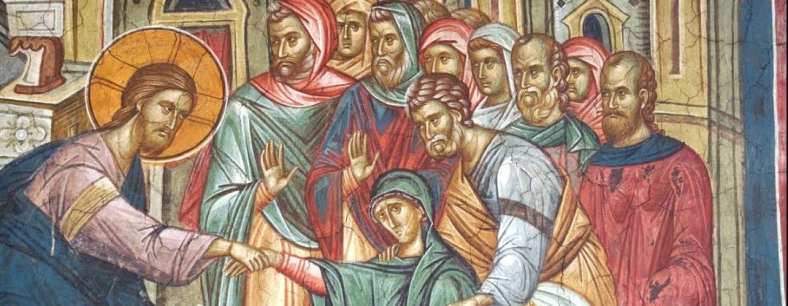
At the beginning of the Gospel of Mark, right after Jesus has cast out an unclean spirit in the synagogue, he goes to the home of Peter and Andrew, accompanied by James and John.  There he discovers that Peter’s mother-in-law is ill with a fever.  Jesus takes her by the hand and lifts her up and the fever leaves her.

When Jesus has restored Peter’s mother-in-law, Mark tells us that she served them.  We tend to bristle at that.  Personally, I like Wilda Gafney’s translation here.  She says that Peter’s mother-in-law “ministered to them.”  The verb in question is diakoneo and it can mean both to serve and to minister to.  That’s the verb that’s used in Mark 10:45 when Jesus describes himself as one who came not to be served, but to serve.  He tells the twelve that “whoever wishes to be first must be last and servant of all”  and “whoever wishes to become great among you must be your servant.”  

Serving is the mark of faithful discipleship.  It’s what followers of Jesus are supposed to do, and at the end of Mark’s gospel, we see that it is the women who followed Jesus who really understood about serving.  They were the ones who remained faithful to the end.  It’s entirely possible that Peter’s mother-in-law was among those women.  She rose to serve.  And maybe she just kept on serving Jesus all the way to Jerusalem.

Jesus took her hand and lifted her up.  What it actually says in the Greek is that he raised her up.  It’s the same language that is used in Mark 16 when the startled women at the empty tomb are told that Jesus has been raised up. Mark wants to understand that resurrection wasn’t just the end of the story, it was part of the daily ongoing story of Jesus.  The verb egeiro, to raise up, is used repeatedly in Mark’s healing stories.  In Mark 2:9, it’s the verb Jesus uses when he tells the paralytic to rise up.  In Mark 3:3 he tells the man with a withered hand to rise up and come forward.  In Mark 5:41 it’s the word he uses when he takes Jairus’s daughter by the hand and tells her to rise up.  In Mark 9:27, when a boy who has had a seizure is lying on the ground “as if dead,” Jesus takes him by the hand and tells him to rise up.

So often we yearn for Jesus to take us by the hand and give us the strength to rise up.  When it feels like life has just knocked us flat—when we get some bad news, when our most important relationships seems to be high on tension and low on love, when we feel alone and beset by one dang thing after another, when life feels like a small death and a series of tragedies, we yearn for Jesus to take us by the hand and raise us back to life.  We yearn for a small, everyday resurrection.

We all know that need.  We all know that feeling, that yearning for the hand of Jesus.

Thomas A. Dorsey wrote a powerful song about it.  It was Martin Luther King’s favorite song and he asked Mahalia Jackson to sing it at civil rights rallies.  Leontyne Price sang it at the state funeral of President Lyndon Johnson.  Aretha Franklin sang it at Mahalia Jackson’s funeral.  It’s a song about our yearning for everyday resurrections.

Precious Lord, take my hand,
Lead me on, let me stand,
I am tired, I am weak, I am worn;
Through the storm, through the night,
Lead me on to the light:

Take my hand, precious Lord,
Lead me home.

When my way grows drear,
Precious Lord, linger near,
When my life is almost gone,
Hear my cry, hear my call,
Hold my hand lest I fall:

Take my hand, precious Lord,
Lead me home.

This is Jesus’s ministry of resurrection.  Everyday resurrections.  Time after time in the gospels, time after time in our own lives, he takes our hand, lifts us up and sings us back to life.

Christ sings us back to life so we can rise up and serve each other and carry the song of resurrection, the song of new life, the song of God’s great love to the rest of the world.  Jesus takes us by the hand and raises us up out of our feverish troubles and pain so we can raise up others out of their feverish troubles with the outstretched hand of Christ and the promise of Zephaniah.  God is in your midst.  Christ is with you.  

Rise up.  God will renew you with love.  And God will exult over you with singing.  Loud singing.


[1] From The Roar of the Greasepaint, the Smell of the Crowd, Leslie Bricusse and Anthony Newly

The Right Thing To Do

Matthew 3:1-6, 11-17

Large crowds were coming out to hear John preach and to be baptized by him.  His preaching was pretty pointed.  He called the Pharisees and Sadducees a “brood of vipers” and he publicly rebuked Herod Antipas for stealing his brother’s wife.  His fiery preaching was probably one of the things that drew the crowds—that and the fact that he dressed and lived like a wild man of the desert, but the main attraction was clearly the baptisms.  Matthew says “the women and men of Jerusalem and all Judea were going out to him, and the whole region of the Jordan, and they were baptized in the river Jordan by him, confessing their sins.”

It never really struck me before, but all these people going down to the river?  It’s  kind of remarkable.  What was it that made them feel a need to go out to the wild man at the river to confess their sins and be baptized?  Something made them all feel that they needed to clean house and have a fresh start.  I think we’ve all known that feeling at one time or another.

Their religious institutions with sin offerings and a Day of Atonement apparently didn’t seem to offer enough relief for the sense of not-rightness were feeling.  Watching a priest slaughter a poor animal on their behalf or send one wandering out into the wilderness didn’t give them the catharsis they were craving.  They wanted an experience that told them body and soul that they were washed clean inside and out—that their sins were forgiven and it was a new day. So they came to the wild man at the river.  It seemed like the right thing to do.

There is something deeply, powerful and symbolic about going into the water, whether it’s a baptistry, a swimming pool, the ocean, a lake, a river or stream—or even just the shower or bathtub.  It speaks to the body, mind, and soul all at once.  That’s what all those people coming to John at the Jordan were looking for—something that spoke to them body and soul.  They wanted that deeply personal, powerful feeling of being washed clean and made new, and at the same time a feeling of being part of a community of others who had the same experience.  

John made it clear that his was a baptism of repentance for the forgiveness of sins.  And that raises a question: why did Jesus come to John to be baptized?  He didn’t need to repent of anything.  In Matthew’s telling of the story, John, himself recognized this and said to Jesus, “I can’t baptize you!  You should be baptizing me!”  

Jesus tells John, “Let it go now; for this way is proper for us to fulfill all righteousness.”  Basically, he tells John it’s the right thing to do.  But what does he mean by that?  Why is it the right thing to do?

Could it be that Jesus came to be baptized not because he needed something from the baptism, but because he wanted to give something?  

In his baptism, Jesus gives a gift of affirmation.  When he enters the water of the Jordan, he affirms the ministry of John.  He affirms the power and importance of confession.  He affirms the power of forgiveness, redemption and renewal.

When Jesus goes into the water, he affirms all those others who have come to John for a new start.  He acknowledges that he is one of them—one of us—and that he will do whatever is right and necessary so that they—and we—have no doubts about him being one of us.  He declares his solidarity with them, with us, with all humanity.  He inaugurates a fresh start for all of us.

When Jesus goes into the water, he affirms the goodness of water—the waters of the Jordan and all the waters of the earth.  He affirms creation, itself.  When he immerses himself in the water he is acknowledging the God-made goodness of the created, material world and showing us, if we have eyes to see it, that God is deeply present, immersed in this creation.

When Jesus was baptized by John at the Jordan, he was immersing himself into all the beauty and intricate complexity of the earth and at the same time into both the astonishing meanness and surprising generosity of humanity.  He immersed himself into all the joys and sorrows of daily life with all its battles and triumphs and defeats. He immersed himself in life as we experience it.  And so doing, he blessed it and affirmed it.

At the Jordan, Jesus affirmed the goodness and sacredness of all that God has made.  And that includes you…and me.  When he immersed himself in our world, our lives, Jesus affirmed that those words, “This is my child, my beloved with whom I am well pleased” were spoken for us, too.

When Jesus immersed himself in the Jordan, he affirmed the power of grace and the bravery of new beginnings.  He affirmed our desire to turn things around and make things new when it’s the right thing to do.

We forget sometimes that this is exactly what Jesus has called us to do.  We forget that in our baptism the Holy Spirit has given us the power to  turn things around and make things new.  We forget sometimes that with a word we can bring the light of Christ to the bleakest places and situations.  

Elizabeth Gilbert, the author of Eat, Pray, Love tells a story about someone who did exactly that on a cross-town bus during rush hour.  

“Some years ago,” she writes, “I was stuck on a crosstown bus in New York City during rush hour. Traffic was barely moving. The bus was filled with cold, tired people who were deeply irritated with one another, with the world itself. Two men barked at each other about a shove that might or might not have been intentional. A pregnant woman got on, and nobody offered her a seat. Rage was in the air; no mercy would be found here.

“But as the bus approached Seventh Avenue, the driver got on the intercom. ‘Folks,’ he said, ‘I know you have had a rough day and you are frustrated. I can’t do anything about the weather or traffic, but here is what I can do. As each one of you gets off the bus, I will reach out my hand to you. As you walk by, drop your troubles into the palm of my hand, okay? Don’t take your problems home to your families tonight, just leave them with me. My route goes right by the Hudson River, and when I drive by there later, I will open the window and throw your troubles in the water.’

“It was as if a spell had lifted,” wrote Gilbert. “Everyone burst out laughing. Faces gleamed with surprised delight. People who had been pretending for the past hour not to notice each other’s existence were suddenly grinning at each other like, is this guy serious?

“Oh, he was serious.

“At the next stop, just as promised, the driver reached out his hand, palm up, and waited. One by one, all the exiting commuters placed their hand just above his and mimed the gesture of dropping something into his palm. Some people laughed as they did this, some teared up but everyone did it. The driver repeated the same lovely ritual at the next stop, too. And the next. All the way to the river.”

Gilbert goes on to say this: “We live in a hard world, my friends. Sometimes it is extra difficult to be a human being. Sometimes you have a bad day. Sometimes you have a bad day that lasts for several years. You struggle and fail. You lose jobs, money, friends, faith, and love. You witness horrible events unfolding in the news, and you become fearful and withdrawn. There are times when everything seems cloaked in darkness. You long for the light but don’t know where to find it.

“But what if you are the light? What if you are the very agent of illumination that a dark situation begs for?  That’s what this bus driver taught me, that anyone can be the light, at any moment. This guy wasn’t some big power player. He wasn’t a spiritual leader. He wasn’t some media-savvy influencer. He was a bus driver, one of society’s most invisible workers. But he possessed real power, and he used it beautifully for our benefit.

“When life feels especially grim, or when I feel particularly powerless in the face of the world’s troubles, I think of this man and ask myself, ‘What can I do, right now, to be the light?’ Of course, I can’t personally end all wars, or solve global warming, or transform vexing people into entirely different creatures. I definitely can’t control traffic. But I do have some influence on everyone I brush up against, even if we never speak or learn each other’s name. 

“No matter who you are, or where you are, or how mundane or tough your situation may seem, I believe you can illuminate your world. In fact, I believe this is the only way the world will ever be illuminated, one bright act of grace at a time, all the way to the river.”[1]

When John asked Jesus why he wanted to be baptized, Jesus replied, “Because it’s the right thing to do.”  It was the right thing to do to remind us that by our actions we do have influence on each other. It was the right thing to do to show us that he was calling us to immerse ourselves in each other’s lives and in the life of the world.  It was the right thing to do to show his compassion for us, to show that he understands that sometimes we all need to take our troubles down into the water and let them be swept away.  It was the right thing to do to show us how we are constantly refreshed and renewed so that we can shine as children of the light, created in the image and likeness of God.  It was the right thing to do to show us how we can illuminate the world “one bright act of grace at a time, all the way to the river.”


[1] Elizabet Gilbert, posted by St. Alban’s Episcopal Church

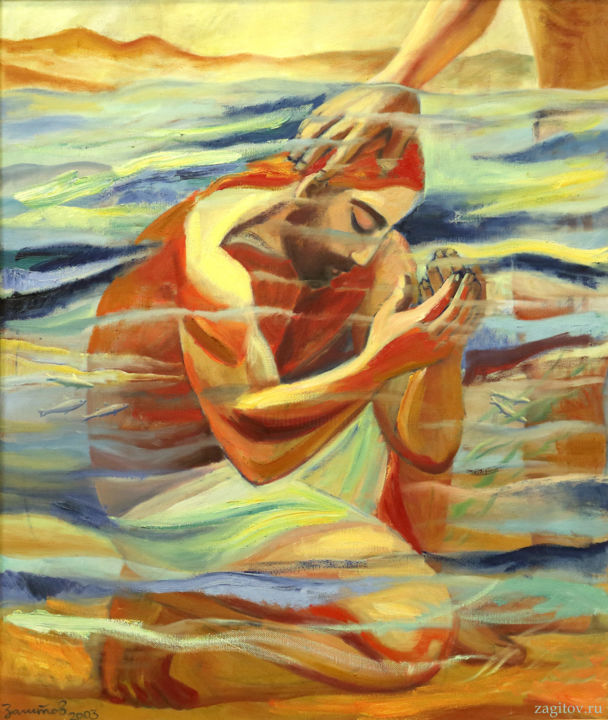
Painting: Baptism of Christ by Vladimir Zagitov

God Gets Physical

John 1:1-14

This past week, NASA launched the James Webb Space Telescope, a remarkable remote observatory that will travel 1.5 million kilometers, about 3.9 times the distance to the moon, before it parks itself in a Lagrange point—a kind of neutral zone in the tug-of-war between the sun’s gravitational pull and Earth’s gravitational pull.  There it will unfurl its highly polished mirrors made of gold-plated beryllium, and begin to stare deep into space—deeper than we have ever seen before with any other instrument.  As it peers into the depths of space it will also be looking back in time because the light it sees was generated billions of years ago.  It will be able to see celestial events that happened before the earth was formed.

The astrophysicists, astronomers, and engineers who designed and programmed the Webb Space Telescope have given it four primary missions:

  • to search for light from the first stars and galaxies that were formed in the universe after the Big Bang;
  • to study the formation and evolution of galaxies;
  • to study the formation of stars and planetary systems;
  • to study other planetary systems to see if they can tell us anything about the origins of life.

The writer of the Gospel of John didn’t have a telescope, but in a poetic way John did have a clear view of the beginning of all things.  In the beginning was the logos he said.  The Word.  The Blueprint.  The Narrative.  The Story.  The Content.  The logos was with God.  The logos was God.  All things came into being through the logos, and not one thing that came into existence came into existence except through the logos.  

Here in the prologue of John’s gospel, the logos is another term for Christ.  John is telling us about the Cosmic Christ who existed before all things, who is present in, with and under all things because all things came into being through the Christ.  Christ, the logos, is that aspect of the Divine Presence where Spirit intersects with matter.  Christ is in those distant stars and galaxies that the Webb telescope will show us.  Christ is in the giant nebulae and dust pillars that Hubble has shown us, those columns of interstellar dust and gas where stars are born.  Christ is in the quasars and pulsars, the black holes and gravitational waves and dark matter.

But Christ, the logos, is not just in the macrocosm. Christ is also in the microcosm.  Christ is in the strings of string theory.  Christ is in the strange interactions of quantum mechanics where quite literally anything and everything is a possibility.  Christ is in the anomalies of quantum flux. 

The writer of John goes on to tell us that Christ was not only in the inorganic dance of chemistry and physics, but that through the logos, through Christ, life came into being. Through Christ nitrogen and hydrogen and carbon and oxygen came together to form amino acids.  Through Christ amino acids formed long chain proteins which then formed protein blocks which then evolved into single-celled organisms.  Through Christ single-celled organisms bonded to form symbiotic colonies which then evolved to become multi-celled organisms.  Through Christ life began to take on more and more diverse forms.  Plants, ants, beetles, fish, mice, dinosaurs, cats and dogs, monkeys, apes, humans.  

John tells us that Christ was the origin of life.  In the logos was life, and that life is the light of all humanity.  I suspect that’s because humanity not only lives life, but we also seek to understand it.  

In an age when we have figured out so much about the essential structure of things in physics and the intricate functions of things in biology, an age when we have delved deep into the geology of our own world and have begun to poke into crust of other planets, it’s tempting to think we can explain esoteric things like existence without God in the equation.  But one of the beauties of real science is that the more we learn, the more we realize there is so much more that we don’t know.  Those who dive deepest soon realize there is no bottom, no stopping point, because they have thrown themselves into the mystery of existence.  As Werner Heisenberg said, “The first gulp from the glass of natural sciences will turn you into an atheist, but at the bottom of the glass God is waiting for you.” 

The word Christ, Christos, means anointed.  John is telling us that through the logos,through Christ, all of creation is anointed with, infused with the presence of God.  As Saint Paul said, God is never far from us because “in him we live and move and have our being.”[1]  Saint Patrick understood this intimate and inescapable presence of Christ when he prayed: 

“Christ with me, Christ before me, 

Christ behind me, Christ in me, 

Christ beneath me, Christ above me, 
Christ on my right, Christ on my left, 
Christ when I lie down, Christ when I sit down, 
Christ in the heart of everyone who thinks of me, 
Christ in the mouth of everyone who speaks of me, 
Christ in the eye that sees me, 
Christ in the ear that hears me.”[2] 

Then entire physical universe is where God hides…but it’s also where God is revealed.  God is not “up there” somewhere—well, not only “up there”—God is right here.  Christ is in you.  Christ is in me.  That is what Jesus, the Christ is all about.  Jesus came to show us that God is with us.  In us. Working through us.  “We spend so much time trying to get “up there,” says Richard Rohr, “we miss that God’s big leap in Jesus was to come “down here.” So much of our worship and religious effort is the spiritual equivalent of trying to go up what has become the down escalator.”[3]

Once we really accept the idea that through Christ God is present in all of creation, the world becomes “home, safe, enchanted, offering grace to any who look deeply.”[4]  The Webb Space Telescope will be looking deeply. It may even be able to see as far as the dawn of creation. There’s no telling what we will learn.  But whatever it shows us, it will simply be telling us more about Christ, in whom we live and move and have our being.


[1] Acts 17:28

[2] Prayer of St. Patrick, 5th century

[3] Richard Rohr, The Universal Christ: How a Forgotten Reality Can Change Everything We See, Hope For and Believe

[4] Ibid. 

A Table Set For All

As I write this it is evening on the third day of Christmas.  Earlier today was family time—opening gifts and eating our traditional Christmas breakfast of eggs scrambled with cream cheese, little smokies, bacon, chocolate waxy donuts, and orange cinnamon rolls.  Last night we had the best rib roast ever, courtesy of P.A., our son-in-law, along with Yorkshire pudding, and for dessert Brooke and P.A. made a Bouche de Noel that was to die for.  

I love Christmas.  All twelve days of it.  I love the way the house is decorated.  I love the music.  I love the giving.  I love the tree.  Most of all, though, I love it that this is a time when our family comes together.  We make time for each other, not out of obligation, but because we all genuinely like each other.  We love each other, yes, but more than that, we really like each other. And I think the reason we have always liked each other so much is that we’ve always accepted each other just as we are.  

So much of the joy we’ve experienced as a family has been around the table.  There is something about eating together that makes the conversation flow.  

I’ve been reading a fascinating book called After Jesus Before Christianity: A Historical Exploration of the First Two Centuries of Jesus Movements written by Erin Vearncombe, Brandon Scott, and Hal Taussig for The Westar Christianity Seminar.  Westar is the same organization of scholars who brought us the controversial Jesus Seminar a few years ago, so I’m reading it …carefully.  These scholars are highlighting the enormous diversity and variety among the various communities who called themselves Jesus followers—they rarely used the word Christian to describe themselves, and those who used it to talk about them often used it as a pejorative.  

Despite significant differences in their practices and in how they understood Jesus and his teaching, most of these groups had a few central things in common.  Most of them understood themselves to be engaged in a movement of resistance to the Roman Empire.  Rome ran on violence from top to bottom, so these groups resisted with nonviolence.  And humor.  They resisted by seeing themselves not as subjects of the Roman Empire, but rather as citizens in the Empire of God.  One of their chief acts of resistance—and almost all the groups did this—was to meet together every week for a meal.  Some of the Jesus-follower groups, in fact, were basically supper clubs!  

At these meals they could enjoy each other’s company freely.  They were all equal in status—there was neither slave nor free, Jew nor gentile.  They would sing.  They would dance.  Yes, they danced.  The Empire believed that they existed solely in order to enrich the Empire one way or another.  They themselves, on the other hand, believed that God had created them to enjoy life in all its fullness (John 10:10).  So they would gather to share a meal, to share stories about Jesus, and to enjoy each other’s company.  Gathering together, enjoying each other’s company, and encouraging each other were acts of resistance against an Empire that saw them as mere tools.  In an empire that systematically disintegrated the families of the poor through slavery, these Jesus followers formed new families.  In an empire that didn’t regard them as fully human, they found ways to be humane and reinforce each other’s sense of dignity and humanity. 

It occurred to me that the worship of these early communities of the Anointed would have looked a lot more like our family’s Christmas feasting than what we typically do in church.  And that got me to wondering…what would church be like if we were starting over from scratch?  If we didn’t have liturgy and a building and hymnals, if all we had was a desire to be together, to share each other’s company and tell stories about Jesus, how would we do it?  If we did find a space to meet in, how would we arrange it?  What if we had tables and chairs instead of pews?  What if there were no walls between the kitchen and the gathering place?  What if all the furnishings were movable so that they could be put aside to make room for dancing?

What would it be like if we simply focused on following Jesus and loving and supporting each other and welcoming others to the feast?  Wouldn’t that be a good way to resist all the forces of modern life that try to dehumanize us? 

We are entering a new year and all indications are that the Church is entering a new era.  No one knows what that’s going to look like.  There’s an old saying: I do not know what the future holds, but I know who holds the future.  I wonder, though…maybe God in Christ isn’t so much holding the future as leading the way into it and inviting us to dance along.  Maybe, as we have said in some of our songs, in Christ there is a table set for all.

Wishing you a Merry Christmas and a blessed New Year,

Pro Gloria Dei,

Pastor Steve

What’s in a Name?

What’s In A Name?

Matthew 1:18-25

In Act II, scene II of Romeo and Juliet, Juliet is on the balcony lamenting the long-running feud between her family, the Capulets, and Romeo’s family, the Montagues.  Some ancient grudge that no one remembers keeps the two families at each other’s throats.  If you are born a Montague, any Capulet is your enemy.  And vice versa.  Their names are at war.  So Juliet, mooning over Romeo, protests to the night air:

‘Tis but thy name that is my enemy;

Thou art thyself, though not a Montague.

What’s Montague?  it is nor hand, nor foot,

Nor arm, nor face, nor any other part

Belonging to a man.  O, be some other name!

What’s in a name? that which we call a rose

By any other name would smell as sweet;

In one sense, of course, Juliet is absolutely right.  If you took away their warring surnames they would still be basically the same people—a couple of infatuated adolescents making bad decisions.  

In another sense, though, she’s absolutely wrong.  A rose by any other name might smell as sweet, but its name has power.  If I ask you to imagine a flower, you might imagine a daisy or a carnation or any number of other flowers.  But if I ask you to imagine a rose, you will not only see a rose in your mind’s eye, you might even smell its fragrance.  Names have power.

Do you have a nickname?  Most of the time—certainly not always—but most of the time we’re kind of fond of our nicknames.  A good nickname is a kind of gift.  You can’t make up your own nickname.  You really can’t even ask for one.  Nicknames just sort of happen, organically, or spontaneously.  One day friends or family just start calling you Goober or Dobie or Winkie or Duke and it just sort of sticks.

Nicknames are often descriptive in some way or have a story behind them.  And very often the use of that nickname is reserved for a certain circle of people.

My sister has a nickname.  It’s the name we in the family have always called her, in fact I sometimes have to think twice to remember her actual name.  All her close friends from high school and college know her by that nickname, but everybody else just knows her given name.  Her business name.  A couple of weeks ago she was Facetiming with her best friend from high school and one of her work colleagues overheard her friend call my sister by her nickname.  The colleague said, “Oh!  That’s a great nickname!  I’m going to call you that from now on.”   This left my sister in a quandary.  On the one hand, she likes this colleague well enough, but on the other hand, she’s not “that kind of friend.”  She’s not part of the circle that uses that name.  That nickname belongs to a particular group of people from a particular time in her life.  That nickname belongs to family and certain long-standing friendships that are almost family.

Names don’t just label us as individuals, they can also socially locate us.  They carry context.  My dad, for instance, was known to everyone in his work life and social life as John or J.B.  But his brothers and sisters and all his nieces and nephews called him Norman or Uncle Norman.  He was always known by his middle among family and among all the people who lived in rural area of the Ozarks where he grew up.  But the military and the government and the business world don’t make allowances for people who are known by their middle names.  All the standard forms that you have to fill out at one time or another ask for first name and middle initial.  Those forms essentially renamed my dad.  In doing so, they not only changed his official identity, they changed his self-understanding.

The names people use for us can shape us.  They say something about how we relate to each other, about who we are and what we do in the world.   My wife’s students call her Dr. B.  Her grandsons call her Nani.  Same person, different roles, different contexts.  

Titles are something like nicknames.  If I talk about Professor Studious or Doctor Pokenprobe or Senator Foghorn or Judge Fairheart,  for instance, their titles immediately tell you something about them.  If nothing else, you know something about their role and function in society.  It’s interesting that both officially and in common practice, the title becomes attached to the name and can even function as the name.   

Messiah is a title.  So is Christ—and let’s be clear, Christ is not Jesus’ last name.  Originally Messiah and Christ meant the same thing.  Anointed.  Messiah is Hebrew and Christ is Greek.  

Some of the oldest Greek manuscripts of Mathew 1:18 read, “This is how the birth of Messiah happened…”  These older manuscripts don’t include the name of Jesus at this point, but everyone understood that Jesus is who the writer was talking about.  Ever since Peter’s confession, those who followed Jesus knew him as Messiah or Christ.  The Messiah, the Christ, is Jesus.  When Matthew introduces this story with the title of Christ or Messiah he is not only telling us that this is a story about the birth of Jesus, but that it’s also a story about God’s mission in the world through the person of Jesus and those around him.  It’s a story of how God works through people like us—people with doubts, fears, misgivings, but also hope and grace and a willingness to trust, even if it means suspending disbelief to believe the unbelievable.  The name Messiah, Christ, carries all that weight.

This is how the birth of Messiah happened.  Mary was betrothed to Joseph.  It was named a betrothal, but it was in fact a marriage.  It just hadn’t been consummated yet.  “But before they came together,” Matthew tells us,  “she was found to have a child in her womb from the Holy Spirit.”  Mary is pregnant but she’s a virgin.  And that circumstance gave her a new name.  She will be known forever as Virgin Mary, and just saying her name brings the whole birth story of Jesus to mind.

Because the marriage isn’t consummated, Joseph plans to divorce her quietly and privately so as not to expose her to all the cruelty, ridicule and meanness that she might experience if he were to denounce her publicly.  Certainly it’s his right in these circumstance to shame her and her family along with her.  That would be regarded as perfectly righteous and just according to their law, tradition, and culture.  According to the law, she could even be stoned to death—although that was almost never actually done.  But Matthew tells us that Joseph is a just man.  A righteous man.  And now Joseph has another name:  Joseph the Just.  Fortunately for both Mary and Jesus, Joseph understands that there is more to being just and righteous than simply adhering to the letter of the law or meticulously observing cultural traditions.  Joseph understands that real justice, real righteousness requires compassion and mercy. 

The fact that he is unwilling to expose Mary to public shame says something really touching about his affection for her.  What he decides to do is, in fact, an act of love in its own way.  He decides to divorce her—to release her—but quietly.  Privately.  He doesn’t want to see her punished. 

It’s a good plan.  A grace-filled plan, but before Joseph can act on it, an angel intervenes in a dream and tells him to go ahead with the marriage because the child Mary is carrying was conceived by the Holy Spirit.  So now the unborn child has an additional name, a title:  Holy.

Joseph agrees to proceed with the marriage as instructed.  But the angel wants more from Joseph than just his forbearance.  The angel tells Joseph to name the child.

Naming a child is an act of adoption.  Even before the baby is born, the instruction to name the child creates a new relationship between the boy and Joseph.  Joseph will be his adoptive father.  The baby will be Joseph’s adopted son.

Joseph is told to name the boy Jesus.  Yeshua.  Which means God Saves.  That name will guide his destiny.  That name will define his relationship to all who follow him throughout history.  God saves.  Jesus saves.

What’s in a name?  Identity.  Relationships. History.  Even destiny.  Messiah is the long-awaited liberator who fulfills the hopes of the Jewish nation.  Christ is the savior of all humanity but also the very presence of God in, with and under all things in creation.  Jesus bears in his very name the message that God saves.

But Mary’s child, Joseph’s adopted son, has yet another name, and that name may be the most important one for all of us who long for the presence of God.  Matthew tells us that he will be called Emmanuel, which means “God with us.”  

To my mind, there is no name more meaningful, no rose as sweet as that one.  Emmanuel.  God with us.

A Song of Defiance

Luke 1:46-56

Fortunate Son by Credence Clearwater Revival.  Blowin’ in the Wind by Bob Dylan.  The Times They Are a Changin’ also by Bob Dylan.  For What It’s Worth by Buffalo Springfield.  Ohio by Crosby, Stills, Nash and Young.  Get Up, Stand Up by Bob Marley and the Wailers.  Redemption Song, also by Bob Marley.  What’s Goin’ On by Marvin Gaye.  This Land is Your Land by Woody Guthrie.  Strange Fruit by Billie Holliday.  Brother Can You Spare a Dime? by Yip Harburg and Jay Gorney.   Imagine by John Lennon.  Born In The USA by Bruce Springsteen.  Talkin’ Bout a Revolution by Tracy Chapman.  A Change is Gonna Come by Sam Cooke.  Big Yellow Taxi by Joni Mitchell.  9 to 5 by Dolly Parton.  

What do these songs all have in common?  They’re all protest songs.  If you type “Protest Songs” into your search engine, you’ll find every one of these songs on at least one of the many lists that will pop up.  

You might be surprised that some of these are regarded as protest songs.  9 to 5, for instance, has such an energetic, positive-sounding melody that it’s easy to just bop along to the music.  Yet because of the way its lyrics addresses the inequities of the workplace, it has become a kind of worker’s anthem, especially for women.  

If you don’t know the context, Blowin’ in the Wind sounds like just an innocuous 1960s folk song.  “How many roads must a man walk down before you call him a man?” sounds like a universal philosophical question until you remember that when Dylan wrote this song, African-American men were marching in the streets carrying signs that said “I Am A Man” to assert their identity and humanity in a segregated and racist culture that discounted and diminished  them by calling them “boy.”  Suddenly that philosophical question has sharp edges.

Many people have a fondness for This Land is Your Land as an almost patriotic song, a piece of classic Americana.  They forget that Woody Guthrie, who wrote that song, was regarded as a radical leftist and blacklisted by the infamous House Committee on Un-American Activities.  One of the verses of that beloved song that gets overlooked and is almost never actually sung is about poverty and hunger:  In the shadow of the steeple I saw my people/ By the relief office I seen my people/ As they stood there hungry, I stood there asking/ Is this land made for you and me?

Some protest songs try to awaken awareness.  Some name and describe social situations and injustices.  Some are simply songs of lament for the way things are.  Some remind us of the ways we are failing to live up to our ideals.  And some invite us to imagine how things could be better. 

All of these protest songs moved people to one degree or another and made them think.  But none of them hold a candle to the Magnificat by Mary, Mother of Jesus in the Gospel of Luke.

This song that Mary sings in chapter one of Luke is a radical protest song.  In an Advent sermon in 1933, Dietrich Bonhoeffer said, “The song of Mary is the oldest Advent hymn. It is at once the most passionate, the wildest, one might even say the most revolutionary Advent hymn ever sung. This is not the gentle, tender, dreamy Mary whom we sometimes see in paintings.…This song has none of the sweet, nostalgic, or even playful tones of some of our Christmas carols. It is instead a hard, strong, inexorable song about the power of God and the powerlessness of humankind.”

Archbishop Oscar Romero prayed the words of Mary’s song every day.  He drew inspiration from her song to continue preaching for justice and economic opportunity for the poor of El Salvador.  He heard Mary singing as one of the poor and, in a country where only 14 families controlled all the wealth, he proclaimed, “You have to be poor to really know the power of the good news.”

Poor and oppressed people throughout the world have been uplifted and empowered by Mary’s song, so much so that oppressive governments have banned it at various times.  In India, during the time of British rule, singing of the Magnificat in church was prohibited for fear it would encourage rebellion.  In Guatemala in the 1980s, the Magnificat became a favorite song among the impoverished masses, inspiring them to believe that God was on their side and change was possible, so the Guatemalan government banned any public singing or recitation of Mary’s song.  In Argentina, the Mothers of the Plaza de Mayo whose children had been disappeared during the Dirty War, placed the words of the Magnificat on posters throughout the capital.  In response, the military junta banned any public display, recitation, or performance of the Magnificat.  They saw how it gave the people courage and reminded them that God was on their side.

The poor and oppressed identify with Mary.  They don’t just see her as “holy Mary, Mother of God,” they see her as one of their own, a peasant girl, in difficult circumstances, but defiant and empowered.   Carolyn Sharp of Yale Divinity put it this way: “Don’t envision Mary as a radiant woman peacefully composing the Magnificat.  Instead, see her as a girl who sings defiantly to her God through her tears, fists clenched against an unknown future.”  Dr. Sharp goes on to say that if we can see her this way, “Mary’s courageous song of praise [becomes] a radical resource for those seeking to honor the holy amid the suffering and conflicts of life.”

God has shown the strength of God’s own arm;

and has scattered the arrogant in the intent of their hearts.

God has brought down the powerful from their thrones,

and lifted up the lowly;

God has filled the hungry with good things,

and sent the rich away empty.

Mary’s song makes it clear that God is initiating a new social order, that the world is about to turn.  Her song announces that Christ’s coming is a world-transforming event.  Her song proclaims that Christ is coming to challenge the structures of sin and death, evil and oppression.  

Her song echoes the song of Isaiah 61 which her son, Jesus, will someday read in the synagogue to initiate his ministry:

The spirit of the Lord GOD is upon me,

                  because the Holy One has anointed me;

         God has sent me to bring good news to the oppressed,

                  to bind up the brokenhearted,

         to proclaim liberty to the captives,

                  and release to the prisoners;

         to proclaim the year of the God’s favor,

                  and the day of vengeance of our God;

                  to comfort all who mourn;

         to provide for those who mourn in Zion—

                  to give them a garland instead of ashes,

         the oil of gladness instead of mourning,

                  the mantle of praise instead of a faint spirit.

Mary’s song resonates with the songs of God’s liberation throughout the ages.  In Exodus 15, Miriam sings of God’s mighty acts in saving the people from Pharoah’s pursuing army.  In 1 Samuel 2, Hannah prophesies about God turning the tables on behalf of the poor when she sings, “Those who were full have hired themselves out for bread, but those who were hungry are fat with spoil.”  

Mary’s song rings with the prophetic reminder that God is at work in every age to rebalance the scales.  She reminds us that God will not allow oppression, injustice, negligence and inequity to go on forever.  The reign of God has been announced.  The vision proclaimed and described.  In a world where things have not been operating according to God’s plan, Mary has told us that change is underway and invited us to be on the right side of it.  And just so we know which side that is, she has given us a song.

*Image by Linda Donlin

The Keys of Heaven

The Keys of Heaven

The body of the old man lay stretched out upon the table, prepared according to custom and covered with a shroud.  The priest, who had been gazing out the window, or perhaps deep into his own thoughts, broke from his reverie, stood up, and removed a papyrus scroll from the folds of his robe then moved to the body lying on the table and gently, reverently, lifted the edge of the shroud and took something from the right hand of the old man lying beneath it, and lifted it high in the lamplight for all to see.  Everyone reacted to the familiar object dangled before them.  Some smiled wistfully, a few nodded in recognition, one woman buried her face in her scarf and wept.  It was a plain thing, a simple leather thong suspending ten stones, seven smaller, three larger, each separated from the others by a knot in the leather.  They did not catch the light in any particular way.  They did not glow or sparkle.  There was no mystic aura about them.  But the faithful people in that gathering would not have traded those stones for rubies or diamonds or sapphires or pearls. “The Keys to Heaven,” said the priest.  With care bordering on ceremony he handed the odd artifact to the Deaconess who stood at the feet of the old man’s corpse.  She continued to cradle the leather strip and its stones in her hands so all could see it in the soft glow of the oil lamps.   The priest unrolled the scroll and began to read.

By vocation the priest was the chief reader at a busy scriptorium.  Six days of the week he would read aloud to a phalanx of copyists—reading slowly, distinctly, and loudly enough to be heard at the back of the room yet fast enough to keep up with the demands of the business, to meet its deadlines and keep it profitable.  The qualities that made him so very good at his job also made him an excellent public lector, a role which added to his income.  This talent also served him well, of course, in his role as priest in this small community of the faithful.  But now, as he began to read his dear friend’s last will and testament, he put aside his professional voice and tried to find in himself the deep wells of strength and gentleness that characterized his departed friend; he did his best to summon his friend’s voice for his friend’s words.  This is what he read:

My dear friends, my brothers and sisters, grace to you and peace in the name of the One we follow, who was, who is and who is to come.  Amen.  I pray you know how much you are loved.   I have so very little to leave to you in the way of earthly things.  My little house and my poor purse I entrust to this community.  Perhaps they may be used to benefit a widow or two.  Let the Deaconess administer these things as she is most capable.  Let the tools of my trade go Nathaniel, my apprentice.  I have no other possessions except the Keys to Heaven.  These I bequeath to you all for your common use and good, but I must tell you how I came to have them.

I think that almost every one of you, most when you were children, but some when you were older, have asked me, “Andreas, what are those stones hanging from your belt?” and I would say, “They are the Keys to Heaven and I am giving them to you.”  Then you would say, “When can I have them?”  And I would say, “When you can tell me how they are made!”  So now, I will tell you their story.

For all the years I have lived among you, you have known me as Andreas the Leatherworker.  That was not always my name.  For that matter, working leather was not always my trade, but that is of no importance.  When I was much younger and full of anger at the world I did some dangerous and stupid things.  One thing in particular was even evil, though I did not think so at the time.  As a consequence, I found myself on the run, hiding from the patrols of soldiers that seemed to be everywhere on the road.  I cut my hair and shaved my beard.  I stole the tunic, mantle and belt of a tradesman while he was bathing in the river and left my very fine and costly clothes in their place.  Then I fastened a sword to my belt and kept on running.

Three nights later, just at nightfall, I saw a man sitting by a campfire just to the side of the road.  Half mad with hunger and exhaustion, I moved toward him, drew my sword and said, “Give me your food and your money.”  I meant to growl it out in a menacing way but my throat was so parched I must have croaked like a raven.  “We will gladly share our food with you,” said the man, “but what money we have with us is not ours to give.”  I started to move toward him with my sword when his words pierced the fog of my hunger.  We.  He had said “we.”  I blinked, looked again, and could not believe I had not seen them the first time—four other men. Two of them were some small distance behind the man by the fire but were now walking briskly toward us.  Another man was emerging from the brush carrying an armload of wood for the fire, and another with a water skin was just coming up from the stream.  Five men altogether.  Even if I were not nearly dead from hunger and thirst I could never take on five men.  My head began to swim, my knees gave out and I fell, unconscious.

I awakened to find one of the men bathing my forehead with a cool, wet cloth while another was bandaging my arm.  Apparently I had cut it with my own sword when I fell.  The man I had first seen, the one I had threatened and tried to rob, lifted a cup of cool water to my lips but urged me to drink it slowly.  As soon as I was able to sit up one of the men gave me a piece of bread and a piece of dried fish which I devoured immediately without a word. 

I didn’t know what to expect next and I was too weak to try to run.  When the big man, the first man I had seen by the fire, picked up my sword I half expected him to kill me with it. Instead he laid it in front of me in the dirt.  “This is yours,” he said, “though I think you might be better off not to keep it.  That’s a Roman Gladius.  A soldier’s sword.  And you don’t strike me as a soldier. I think maybe that sword has already brought you trouble and if I were you I would just bury it here at the side of the road.”  

I was dumbstruck.  That sword had been nothing but trouble.  That sword and my hot temper were the whole reason I had had to flee for my life.  

I looked at the big man.  He was smiling at me, and I realized, looking at him, that there was no fear in him.  No anger.  “You must still be hungry,” he said.  “I tried to rob you!” I said, incredulous.  “I threatened you!”  “Yes.  You did,” he said.  “I forgive you.”  “But I…”  I started.  “Let it go,” he said, quietly.  “I have.  What you bind on earth is bound in heaven.  What you release on earth is released in heaven.  I release it.  I release you.  Let it go.”

I sat staring at the ground for a long time, confused, not knowing what to think.  

I heard him chuckle, looked up and saw him smiling at me.  He leaned over and picked up a smooth agate pebble from the ground, walked over and placed it in my hand.  “Here,” he said. “Keep this.  This is the first Key to Heaven.  Forgiveness.”  “I don’t know if I can be forgiven.” I said.  His expression became reflective and he gazed into the fire for a long moment. “I felt that way once,” he said at last. “I betrayed my best friend…my teacher…my master.  I betrayed him three times in one night to save my own skin.”  “What happened?” I asked.  “They crucified him,” he said simply.  “But I got away because I pretended that I didn’t know him. Three times in one night someone accused me of being one of his companions and three times I denied it.  And I didn’t think I would ever be forgiven for that.  But he forgave me.  And he helped me forgive myself.  He released me from my sin and he helped me let go of my sin—helped me to stop clinging to it..”  “Wait a minute,” I said, “I though you said they crucified him.”  “They did,” he said.  “Well then how…when did he forgive you?”  The way he looked at me I could tell he was trying to decide something and it was another very long moment before he said, “That’s another story and if you would like to travel with us I will gladly tell it another day.  For now,” and here he smiled again, “hold on to that little piece of forgiveness and let that be enough for today.”

And that, my beloved brothers and sisters is how I came to have the first of the Keys of Heaven, the Key of Forgiveness.  Having nowhere else to go and nothing to lose, I became a travelling companion of Petrus, the Fisherman, who taught me the ways of his Master and baptized me into a new life with a new name.  And along the way he gave me the Keys of Heaven and taught me how they are made, or where they can be discovered, so that each of us can have them and carry them with us and unlock Heaven around us wherever we are.  

The first key is Forgiveness.  The Second is Gratitude.  The third is Generosity.  The fourth is Compassion. These four open your heart to the world God made, the world God loves.  The fifth key is Integrity.  The Sixth is Thoughtfulness.  These two open the soul and mind to look beyond yourself and deal fairly with all others.  The seventh is Be Not Afraid.  This key gives you the presence of mind to remember that you have all the others at your command and it helps you to use them wisely.

Then there are the three larger keys.  These give the first keys their power.  At the same time, the first keys can unlock the power of these three.  They are Faith, Hope and Love.

So, my beloved friends, these are the Keys to Heaven.  I hope you can see that I spoke the truth all these years when I said, “I am giving them to you.”  I hope and pray that in my life you saw forgiveness, gratitude, generosity, compassion, integrity and thoughtfulness.  I hope you saw me live without fear.  I pray that you are gathering these keys for yourself by the example of our Master.  May you all continue to grow in Faith, Hope and Love until we are reunited in the Life to Come.

Peace be with you.

I am always your brother,

Andreas

The small assembly sang a hymn.  The priest pronounced a benediction.  The Deaconess replaced the Keys of Heaven in the old man’s hand, and in the dim lamplight they reverently carried his body to its place of rest.