This is the Time

“You know what time it is.” – St. Paul

It’s time.  

Time to get out the boxes with the special decorations, each one with its own story and all of them together part of the bigger story.  It’s time to deck the halls, to fill the home with light and music.  It’s time to dig out recipes and to bake.  It’s time to prepare.

I loved Christmas as a kid.  I still do.  What I didn’t realize for years, though, was how much I loved Advent.  I loved all the preparation. I loved the anticipation.  I loved the way the house looked when it was all decorated.  I loved the way the kitchen smelled when it was full of baking and roasting.  I loved how everyone, even though they were a bit frazzled, still managed to be in a pretty cheery mood. 

I love the honesty of Advent.  I love the sense of longing in the texts and prayers.  “Stir up your power, Lord Christ, and come.”  And yes, Christ has already come to us, but no, Christ has not yet returned, and we surely do feel sometimes like he’s overdue.  There is an honest yearning for things to be better, especially in this year when everything has been scrambled and turned sideways by an election that feels like a step backward, and not in a good way.  “Oh that you would tear open the heavens and come down!”  Isaiah shouts for us.  We’re in over our heads.  “Restore us, O God of hosts; let your face shine, that we might be saved!” the Psalmist cries out for us.  But we also hear, “Comfort, O comfort my people, says your God… Every valley will be lifted up.  Every mountain and hill made low.  The uneven ground shall be made level and the rough places a plain.”  Things will be smoother.  Something better, something brighter is coming.  Help is on the way.  A new day will dawn.  

I love the way that Advent, if we pay attention to it, sets the scene for Christmas by reminding us that we are not the first ones to live in a time of shadows hoping for light.  “During the rule of King Herod of Judea…” we read in the first chapter of Luke.  This is the same King Herod who, in Matthew’s gospel, murdered all the male babies in Bethlehem under age two.  This is the Herod who killed two of his own sons because he suspected them of plotting against him, the Herod who killed his wife Mariamne, the Hasmonean princess, along with her brother and her mother.  This is the Herod who replaced the High Priest in the temple with a Sadducee who would be more inclined to do things the way he wanted them done.  This is the same Herod who as he lay dying, according to Josephus, ordered that one member of every family in Judea should be slain so that the whole country would be in mourning when he died. Fortunately that order was never carried out, but the people never forgot that he had issued it. 

This is the time, Luke reminds us, when Quirinius is appointed legate of the expanded Roman province of Syria with the specific mandate to carry out a census, something forbidden by Jewish law, so that Tiberius can impose a new tax.  This is a time when Rome’s domination of Judea is iron-clad and iron-fisted with no velvet glove to make it less harsh.  This is a time when work is hard, taxes are heavy, and freedom is limited.

But this is also the time when an angel appears to an aged childless couple, Elizabeth, whose name means “God keeps promises” and to Zechariah, whose name means “God remembers.”  The angel promises them that they will have a child and that they are to name him Yochanan, John in English, which means “God is gracious.” The angel tells them that many will rejoice because of him and he will be filled with the Holy Spirit.

This is the time when a kinswoman comes to visit Elizabeth, a young, unmarried kinswoman named Mary, who is also pregnant with a miraculous child.  And when Elizabeth sees her, her unborn child leaps in her belly.  This is the time when Mary sings a prophetic song of joy and rebellion that has been bringing hope to people on the margins for two thousand years.  My soul magnifies the Lord and my spirit rejoices in God my Savior, for he has looked with favor on the lowliness of his servant… He has scattered the proud in the thoughts of their hearts.  He has brought down the powerful from their thrones, and lifted up the lowly; he has filled the hungry with good things, and sent the rich away empty…”

This is the time to sit with the candles of hope, peace, joy, and love.  This is the time to remember.  And to look forward.  This is Advent.  And soon, Christmas.  This is the time of remembering our dreams of a better world.  This is a time of anticipating better things to come.

The King shall come when morning dawns and light triumphant breaks, when beauty gilds the eastern hills and life to joy awakes.

The Light of Hope

Isaiah 2:1-5; Romans 13:8-14; Matthew 24:36-44

“When the end of the world comes,” said Mark Twain, “I want to be in Kentucky.  They’re twenty years behind on everything.”

Our Gospel text for this first Sunday in Advent, the first Sunday of a new church year, comes from a section near the end of the Gospel of Matthew that centers on the coming of the Son of Man. The fragment we read this morning comes hard on the heels of Jesus predicting the destruction of the temple with the implication that this will be the beginning of the “end times.”  The disciples, of course, want to know more.  “Tell us, when will this be,” they ask, “and what will be the sign of your coming and of the end of the age?”

The answer Jesus gives to “when will this be?” is “God only knows.” 

This section of Matthew and its parallels in Mark and Luke are sometimes called “the little apocalypse.”  The word apocalypse comes directly from Greek and only drops one small syllable on its way into English.  Apokalypsis  in Greek becomes Apocalypse in English.  The literal meaning is “an uncovering” or “unveiling.”  It originally meant a disclosure, a revelation.  

The word can also describe a particular kind of literature.  That’s the first meanings in Merriam Webster’s dictionary:

one of the Jewish and Christian writings of 200 b.c. to a.d. 150 marked by pseudonymity, symbolic imagery, and the expectation of an imminent cosmic cataclysm in which God destroys the ruling powers of evil and raises the righteous to life in a messianic kingdom.

Webster also gives what it calls the “Essential Meaning”:

a great disaster a sudden and very bad event that causes much fear, loss, or destruction.

In more common usage, apocalypse is often used as shorthand for “the end of the world.”

From disclosure to disaster.  That’s quite a shift in meaning—although it makes sense.  When things that are covered up are suddenly revealed it often creates a lot of anger and instability.  

I’ve often wondered why we are so fascinated with the idea of The Apocalypse, the End of the World.  What is it about the human psyche that wants to immerse itself in “end of the world” thinking and stories?  And why has our interest in this topic been growing? 

If you take a look at Wikipedia’s list of Apocalyptic films, it paints an interesting picture.  Before 1950, there were only 4 apocalypse movies.  The first one was a Danish film made in 1916 called, prosaically enough, The End of the World.  And then we went fifteen years before anyone made another apocalyptic movie.  That one was a French film made in 1931, also titled The End of the World.  American filmmakers got into the Apocalypse business in 1933 with Deluge from RKO Pictures, and then the Brits took a turn in 1936 with a United Artists picture called Things to Come, written by H.G. Wells.  So in the whole first half of the 20th century, only 4 apocalyptic movies are listed.  Four.  

And then they stopped.  That’s probably because the whole world was at war in the 1940s.  People were living through an apocalypse, and they wanted their movies to give them hope, to tell them there was a brighter day coming, that there would be a time of rebuilding.  

Apocalyptic films reappeared in the 1950s, but they were still sporadic enough that it would be stretching things at that point to call them a genre.  From 1950 to 1959 there are eleven apocalypse movies on Wikipedia’s list, but things would pick up significantly in the 1960s.  

From 1960 to now there have been 378 apocalyptic movies. That’s 378 films about the end of the world in a period of 65 years.

So back to the original question: why are people so fascinated by apocalypse?  Why is there such a big market for dystopia and humanity’s grand finale? 

I don’t know what the social psychologists would say about that, but I do know what Biblical scholars and theologians say.  They tell us that apocalyptic literature appears—and movies are a form that—when a people is oppressed, under great stress, and experiencing persecution, or when the world in general becomes so dystopian that problems seem unsolvable.  

The Book of Ezekiel, with its strange visions and imagery, appears during the time of the Babylonian conquest of Judah to give hope and courage to captive and enslaved people who had seen their nation not just defeated but destroyed.  The Book of Daniel was written to give hope and courage to the Jewish rebels fighting against Antiochus IV Epiphanes, the cruel Greek Seleucid ruler who desecrated Yahweh’s temple by setting up an altar to Zeus and sacrificing a pig on it.  John’s Apocalypse, which we call the Book of Revelation, was written to give hope and courage to followers of Jesus in Asia Minor who were being oppressed and persecuted by Rome.

Hope and courage for people in dire straits.  That’s what all the ancient apocalypses are really all about when you wade through all the fascinating imagery.  They use imagery as a kind of code because the people writing them and reading them are living in dangerous circumstances.  If the empire is breathing down your neck, it’s not safe to say “The Emperor is a gluttonous, greedy, selfish pig who bullies the people and forces nations to hand over the best of everything while the rest of us are sucked dry.”  So instead you write about a harlot who sits on seven hills.  You can’t say that the emperor is a monster, so you write about a monster, a dragon with seven heads, and trust that people will read between the lines.

The writers of the apocalyptic works in the Bible, and the Holy Spirit who guided them, never intended to be giving a coded timeline of the end of all things.  That’s not why they were written.  They were written to give a simple clear message:  “Hang in there.  Yes, these are scary times.  But God is on your side. Nasty empires and oppressive regimes don’t last forever.  They either exhaust themselves, or somebody conquers them, like when Darius the Mede brought new management to Babylon; or enough people finally get tired of their rubbish and rise up to throw them out on their ear, like the Maccabees did with Antiochus Epiphanes; or they overindulge themselves to death and collapse from internal squabbling and rot.  That’s what happened to Rome.  Once more for emphasis: Hold on to hope.  Have courage. God is on your side.  And God wins in the end.

This “little apocalypse” from Jesus in the Synoptic Gospels is radically different from other apocalyptic writings in one major point.  Other apocalyptic writings—those included in the Bible like Daniel and Revelation, extra-biblical books like 1 Enoch and 4 Ezra, and the apocalyptic pamphlets that circulated throughout Palestine during the Jewish war—all focused on the basic universal apocalyptic message: hang tough, God is with you, hope and courage, fight the good fight.  But this homily from Jesus has one important departure from the formula.  Ched Myers and other scholars suggest that Jesus is telling his followers to abandon the temple.  He is telling his followers to resist, but not to join in the rebellion.  He urges them not to be led astray from their path of nonviolent resistance by charismatic leaders with messianic claims, and patriotic swords and spears.

Jesus calls us to a different pathway of apocalypse.  This is not the pathway of Judas Maccabeus picking up his sword to fight the Greeks.  This is not the pathway of Simon bar Giora, claiming to be the new King David as he leads guerilla bands in surprise attacks.  This is not Mad Max with a sawed-off shotgun.  

Jesus is telling his followers that armed rebellion is not the pathway to the kingdom of God.

 The pathway of Jesus is the Way of nonviolence.  The way of critiquing the bad by doing the better.  The rebellion is not the kingdom. But the kingdom is a rebellion…done a different Way.

In the gospels, the kingdom of God, as it is embodied by Jesus, is revealed to us as a nonviolent rebellion against business as usual, economics as usual, politics as usual, government as usual, and religion as usual.  It is also very much a rebellion against rebellion as usual.  The entire mission of Jesus in the gospels is, in its way, an apocalypse.  A revealing.  It pulls back the veil to show us the serious flaws in our ways of doing things.  It critiques the bad by giving us a vision of the better.  

It reminds us that the day will come in God’s own good time when, as Isaiah promised…

Out of Zion shall go forth instruction,

                  and the word of the LORD from Jerusalem.

He shall judge between the nations,

                  and shall arbitrate for many peoples;

         they shall beat their swords into plowshares,

                  and their spears into pruning hooks;

         nation shall not lift up sword against nation,

                  neither shall they learn war any more.

O house of Jacob,

                  come, let us walk

                  in the light of the LORD!

Yes, in a way Jesus does predict the end of the world.  The world as it is  ends when it is gradually, nonviolently reimagined and replaced heart by heart, mind by mind, one person at a time until the commonwealth of God’s justice and kindness becomes our everyday reality on earth as it is in heaven.  How’s that for an apocalypse?

Advent is the time when we remember that Isaiah’s hope, that ancient hope, is our hope.  Advent is a time when we light the candle of hope to remind us that Jesus has called all of us to walk in the light of the Lord.  It is a time when we remember that just as Jesus came to teach us the Way of love and truth, the Way of cooperation and companionship, the Way of kindness and justice, he will come again when the time is right to remake and renew the world.  

When will that be—the Second Coming of Christ?  God only knows.  The only thing we can know for certain is that each day brings us one day closer.  As St. Paul says, “You know what time it is.  Now is the moment for you to wake up.  For salvation is nearer to us now than when we became believers;  the night is far gone, the day is near.”  

Salvation—our remaking as a whole and healthy world—is  closer to us now that it was when we got up this morning.  So watch.  And hope.  And be ready.  In the meantime, O house of Jacob, O house of Jesus, come, let us walk in the light of the Lord.  

Thanksgiving

Have you noticed that the Church calendar and the secular calendar often seem to be at odds with each other?  The secular calendar flat-out ignores some rather important Church holidays.  You don’t see many Ash Wednesday greeting cards in the store.  And nobody’s playing Maundy Thursday carols for weeks before that important day.  I’ve never seen a Pentecost Fireworks display.  I mean, that one would be a natural, wouldn’t you think?  

Even when the secular calendar does tip its metaphorical hat to Church festivals it does so in a decidedly worldly way.  St. Patrick’s Day could be a terrific day to ponder Celtic Spirituality but its sacred possibilities have been paraded out of awareness and drowned in a flood of green beer.  All Hallows Eve would be very meaningful as a meditative pause to reflect on what we’ve learned and what we have been given by the faithful who came before us, but that singular opportunity was long ago surrendered to the immensely popular pagan festival and Halloween has never missed a trick or treat since. 

Christmas and Easter are the most prominent stars of the Church calendar, of course, but between Santa Claus, the Grinch, Rudolph and the Easter Bunny the not-Church culture sometimes seems to have forgotten the origins of these beloved holidays.  In our secular society the Miracle on 34th Street has eclipsed the Miracle in Bethlehem.  So it goes. 

There is one holiday, however, where things were turned the other way around, sort of—a secular holiday that was given a patently religious backstory.  Thanksgiving. 

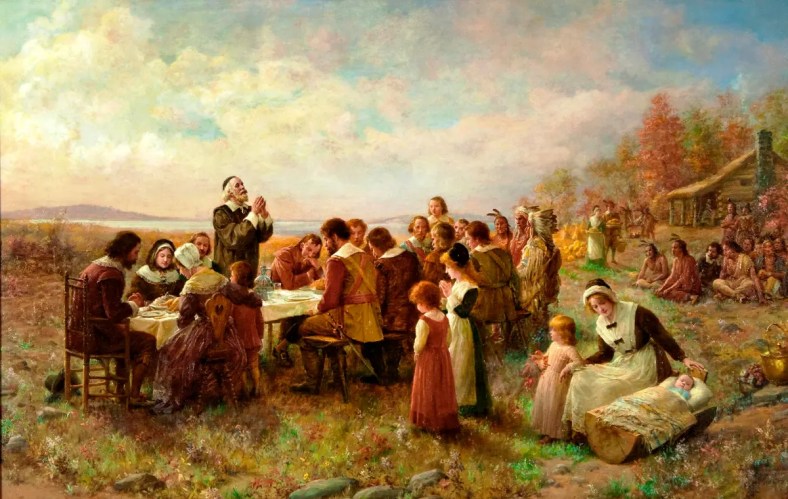
The traditional Thanksgiving story that we all learned as kids told of the grateful, faithful Christian Pilgrims who took a day to share a feast with their Native American friends whose good will and knowledge of this strange new land had helped them survive a harsh first year.  That story anchored the day in faith, cooperation and good will.  All good things.

Unfortunately, that pious story was, like so many things we learned when we were younger…embellished.  A lot.  The Pilgrims did hold a 3-day gathering to celebrate a successful harvest in the Fall of 1621, and they did invite a few friendly members of the Wampanoag tribe to join them.  

In the 1830s the idea for a Fall feast of Thanksgiving became popular throughout New England, and organizers reframed the Pilgrim gathering of 1621 as a precedent for a broader observance and celebration.  Those same organizers borrowed the name “Thanksgiving” from a proclamation by John Winthrop, the governor of the Massachusetts Bay Colony, who proclaimed a Day of Thanksgiving in 1637 to celebrate the Mystic Massacre, in which English colonists and allied Native forces attacked and burned a Pequot village, resulting in the deaths and enslavement of hundreds of Pequot men, women, and children.  That’s why, in 1970, Native American leaders designated Thanksgiving as a National Day of Mourning for indigenous peoples.  

As long as we’re deconstructing popular history here, we should probably also note, for what it’s worth, that the Plymouth Rock Pilgrims did not come to the New World for religious freedom.  They had that in Holland.  They came here to establish a theocracy in which there was a lot of religion but not much personal freedom.  They were staunch Calvinist Separatists, after all.  Heavy on the staunch.  

But don’t let all this debunking unstuff your turkey.  Thanksgiving is still a good idea.  A GREAT idea.  Abraham Lincoln certainly thought so.  That’s why he declared it a national holiday in 1863.  

It’s a good thing for us to take a day to remind ourselves about the power of gratitude.  It’s a good thing to take a day to remember all the ways that God has been good to us.  It’s a good thing to take a day to simply be thankful that we have survived another year, even if it’s been a tough year.  God is good and the stories of our own lives remind us of God’s goodness when we take time to reflect on them.  

“Gratitude unlocks the fullness of life,” said Melody Beattie.  “It turns what we have into enough, and more.  It turns denial into acceptance, chaos to order, confusion to clarity.  It can turn a meal into a feast, a house into a home, a stranger into a friend.”   

David Steindl-Rast, the Benedictine monk who founded Grateful.org said, “Everything is a gift. The degree to which we are awake to this truth is a measure of our gratefulness, and gratefulness is a measure of our aliveness.”

In her book Grateful: the Subversive Practice of Giving Thanks, Diana Butler Bass wrote, “Gratitude is resilience of sorts, the defiance of kindness in the face of anger, of connection in the face of division, and of hope in the face of fear…Gratitude empowers us.  It makes joy and love possible.” 

“Gratitude is not about stuff,” she continued.  “Gratitude is the emotional response to the surprise of our very existence, to sensing that inner light and realizing the astonishing sacred, social, and scientific events that brought each one of us into being. We cry out like the psalmist, ‘I am fearfully and wonderfully made!’

“Gratitude is, however, more than just an emotion,” she went on to say.  “It is also a disposition that can be chosen and cultivated, an outlook toward life that manifests itself in actions—it is an ethic.”

Anne Lamott is a little more plainspoken about gratitude in her book Help, Thanks, Wow: The Three Essential Prayers. “Gratitude” she writes, “begins in our hearts and then dovetails into behavior. It almost always makes you willing to be of service, which is where the joy resides. It means that you are willing to stop being such a jerk. When you are aware of all that has been given to you, in your lifetime and the past few days, it is hard not to be humbled, and pleased to give back.”

“Most humbling of all,” she writes, “is to comprehend the lifesaving gift that your pit crew of people has been for you, and all the experiences you have shared, the journeys together, the collaborations, births and deaths, divorces, rehab, and vacations, the solidarity you have shown one another. Every so often you realize that without all of them, your life would be barren and pathetic. It would be Death of a Salesman, though with e-mail and texting.”

“Giving thanks,” said Garrison Keillor, “is the key to happiness.”

In my own experience, I’ve learned that grateful people tend to be friendlier and kinder people.  So by all means let us be thankful.  “Enter his gates with thanksgiving, and his courts with praise. Give thanks to God, bless his name,” says the Psalmist (100:4).  It’s a wonderful way to end the Church year and begin a new one.  Because gratitude unlocks the fullness of life. And being thankful is the key to happiness.

What Kind of Kingdom?

Luke 23:33-43

Today is the last Sunday of the church year, Christ the King Sunday or Reign of Christ Sunday.  This is a fairly new addition to the church calendar—it was added only 100 years ago—and frankly, not everyone is happy about it.  

In 1925, the world was trying desperately to put itself back together in the aftermath of World War I and it wasn’t going well.  Pope Pius XI was gravely concerned by the growing tide of secularism and ultra-nationalism in Germany, Italy and elsewhere, and, of course, the rise of Communism in Russia.  In response he issued an encyclical called Quas Primas—“That Which is First.” Interestingly, it can also be read as a question, “What is First?”.  In this encyclical, he established The Solemnity of Our Lord Jesus Christ, King of the Universe or, as it came to be commonly known, the Feast of Christ the King.  

Pope Pius was trying to restate and reinforce the idea of the sovereignty of Christ over, well, everything.  He wanted to make it clear that our deepest and most profound allegiance should be to Jesus Christ above and beyond every other allegiance.  But in doing it in this way, was he, maybe, missing the point of what Jesus was actually saying when he talked about the kingdom of God?

The image of Christ as King is problematic for us in a number of ways.  First of all, it’s hard for us to relate to even the idea of a king.  There aren’t very many real monarchs left in the world, and most of the ones who are still here wield a power that is primarily symbolic or ceremonial.  As a case in point, King Charles III ascended to the throne of Great Britain three years ago after the long reign of his mother, Queen Elizabeth, but neither the world nor Great Britain have seen any significant changes in the governance of the United Kingdom as a result.  That’s because whatever power the throne still has is very strictly circumscribed by a democratic parliament. 

Another problem with the imagery of Christ the King is that, unfortunately, Christianity doesn’t have a very good track record with kings.  Too often in history Christianity has found itself either colluding with or coopted by the oppressive forces of empire instead of the liberating and restorative teaching of Jesus and the movement of the Holy Spirit.

In her book A Beautiful Year: 52 Meditations on Faith, Wisdom and Perseverance,  Diana Butler Bass said, “The word king is so problematic.  It is wedded to social privilege and pyramids of wealth and power and invested with centuries of inequities and fairy-tale fantasies.”[1]  Our experience of kings stands in stark contrast to the egalitarian vision Jesus was describing when he announced that the basilea of God was within reach.

Basilea.  That’s the Greek word in the gospels that we translate as kingdom.  It’s a word that the empire used to describe the domain of Caesar and also the territory governed by Herod and other client kings.  And even as Jesus was proclaiming the arrival of the basileaof God, it was a word that was both too small and too loaded to really capture the new reality that Jesus was describing.

The word Kingdom implies boundaries. Boundaries imply limitations and location.  You are either inside or outside.  Even the synonyms for kingdom make it sound territorial. 

The word Kingdom also implies power, usually and especially coercive power. Constantine and later Christian emperors and kings readily embraced the concept of the Kingdom of Christ because it was an image they could use in exercising their own power.  They could claim that they were appointed by Christ and were ruling under his authority, which meant that they could spin just about anything they did as justifiable because they were acting on Christ’s behalf.  Convert people at the point of the sword or by torture?  No problem.  We’re doing it for Jesus.  

Today, Christian Nationalism and other authoritarian movements appropriate the language of Christ the King to imagine Jesus as a muscular monarch, kicking tail and taking names.  Under the auspices of Christ the King, they want to establish a restrictive theocracy, but in embracing that idea they completely miss the new reality that Jesus was calling us to embrace.

Kingdom, realm, reign, sovereignty—none of these terms are really a good fit for what Jesus was describing when he announced that the basilea tou theou –which we translate as The Kingdom of God—is arriving, is at hand, is within reach. 

George Orwell was a guy who knew a thing or two about language and how we use, abuse, twist and misuse it.  Orwell said, “There is a huge dump of worn-out metaphors which have lost all evocative power and are merely used because they save people the trouble of inventing phrases for themselves.”[2]

Christ the King is one of those worn-out metaphors.  We keep using it because we haven’t come up with a better phrase to describe the vision of God’s all-pervading influence that Jesus was proclaiming or a way to describe our belief that God in Christ is the ultimate power that moves the universe through love, compassion, creativity, grace and cooperation.  

On the plus side, Christ the King does make us ask ourselves some important questions. What do we mean when we say that Christ is sovereign?  How do we understand the kingdom of God, the reign of God?  How do we understand the power of God?  How do we understand power in general?  How do we use power?  Do our values reflect the values of empire or the values of Jesus?  What kind of kingdom do we belong to?  And what do we do when our allegiance to Christ and the values of Jesus are in conflict with the values and practices of the other powers that hold sway in our lives?

The kingdom of God, as Jesus described it, was and is a resistance movement.  To say that Christ is king is a resistance claim.  It is a challenge to the way power is coercively used most of the time in our world.  Jesus is a different kind of king.  The crucifixion is his coronation.  He surrenders to the coercive power of empire to show us its naked violence, but also to show us the greater power of love and nonviolence.

Pontius Pilate understood that Jesus was all about resisting the empire’s coercive power but also the empire’s imagery.  When Pilate asked Jesus straight out, “Are you the king of the Jews?” Jesus simply replied, “You say so.  Those are your words.”[3]  The soldiers crucifying Jesus mocked him saying, “If you are the king of the Jews, save yourself!” Pilate mocked both Jesus and the Jewish people by having a board nailed above his head with the inscription, “This is the King of the Jews.”  These were people who understood power in only one way.  Control.  Coercion.  Power over.

But the reign of God that Jesus was describing is a cooperative world.  The reign of God doesn’t force itself on anyone or try to control anyone.  Christ, as king, pervades, persuades, encourages, nudges and asks us to live up to a vision of our better selves. 

 The commonwealth of God’s justice and kindness is a world where generosity, grace, compassion and mercy prevail.  It is a world driven by and governed by love.  It is a world where everyone’s needs are met and no one goes hungry.  It is a kingdom that opens pathways through every kind of border, boundary and barrier.  It is a world where the only control is self-control.  Its central values are to do justice, to love kindness, and to walk humbly with God. Its only law is love: love God, and love your neighbor as yourself.  

The kingdom that Jesus was describing is a world moving toward the vision of Isaiah when we will beat our swords into plowshares and our spears into pruning hooks, when nation shall not lift up sword against nation nor shall they study war anymore.[4]  The kingdom that Jesus proclaimed is the world where God walks with us as Ezekiel envisioned, a world where God shepherds us, where Christ seeks out the lost and brings back the strays, where through us, Jesus binds up the injured and strengthens the weak and feeds us all with justice.[5]

The reign of God is a realm in which the poor are blessed and the hungry are filled and those who mourn are comforted.  It is the world Mary envisioned in the Magnificat when she sang, “He has shown strength with his arm; he has scattered the proud in the thoughts of their hearts. He has brought down the powerful from their thrones, and lifted up the lowly; he has filled the hungry with good things, and sent the rich away empty.”[6]

Yes, God exercises power.  But not the way we usually think of power. God’s power is all about empowering you.  God is about giving power rather than holding onto it.  God gives power to us so that we can love and care for the world more fully and effectively. Together.  “The greatest manifestation of the power of God,” said Bishop Yvette Flunder, “comes when we work together to find ways to be together and do justice together and love together and stand together.”  

The kingdom of God is all of us together.

 “Jesus did not establish an institution,” wrote Bishop Michael Curry, “though institutions can serve his cause. He did not organize a political party, though his teachings have a profound impact on politics. Jesus did not even found a religion. No, Jesus began a movement, fueled by his Spirit, a movement whose purpose was and is to change the face of the earth from the nightmare it often is into the dream that God intends.”

Today is Christ the King Sunday.  It is a day when we use the “worn out metaphor” of kingly power to try to open the doors and windows of our hearts, minds and souls to the empowering love of God through Jesus Christ.  It is a day when we acknowledge both that God in Christ is the ultimate power and that we need to redefine how we understand and use power.  It is a day when we are asked to declare that our deepest and most profound allegiance is to Jesus Christ above and beyond every other allegiance.  It is a day that challenges us to walk in the Way of Jesus so that we can help to bring God’s vision of a whole, healthy, loving and cooperative world into reality on earth as it is in heaven.

Today is the day we volunteer to change the face of the earth from the nightmare it so often is into the dream that God intends.  In the name of Christ the King.


[1] Diana Butler Bass; “Christ the King”; A Beautiful Year: 52 Meditations on Faith, Wisdom, and Perseverance

[2] Politics and the English Language, 1946. 

[3] Luke 23:3

[4] Isaiah 2:4; Micah 4:3

[5] Ezekiel 34:15-16

[6] Luke 1:46-55

Focus

Luke 21:5-19; Malachi 4:1-2a; 2 Thessalonians 3:6-13

The temple in Jerusalem—Herod’s temple—had been under construction for almost 50 years when Jesus sat down in its outer courtyard to speak with his disciples.  Herod had begun reconstructing the temple in 20 BCE, and even though it was still a work in progress, it was already regarded as one of the wonders of the world.  The work would be completed in 63 CE, some thirty years after this teaching moment Jesus has with his disciples, only to be destroyed by the Romans seven years later—but that’s getting ahead of our story.

In order to be able to build the massive temple he envisioned, Herod first had to rebuild Mount Moriah, the low mountain on which the temple stood.  To do this, he encased the mountain with walls more than 33 meters (108 feet) high, then filled in the space with earth until it encompassed an area of more than 144,000 square meters.    

The temple in Jerusalem was a visual wonder.  A description in the Talmud says that  the interior walls of the temple were faced with blue, yellow, and white marble.   Gold spikes lined the parapet wall on the roof.  Josephus wrote that the entire eastern fascia was covered with gold.  “The rays of the early morning sun, striking the Temple façade created a blinding reflection,” he wrote.  “The rest was white, so that this towering edifice looked like a snow-clad mountain from afar.” 

It must have sounded like madness for Jesus to say that it was all coming down—that not one stone would be left upon another.  But by the time Luke wrote his gospel, sometime around the year 85, everything Jesus predicted in today’s gospel reading had already happened.  

Destruction of the temple.  Wars and insurrections.  Earthquakes. Famines and plagues.  Betrayals and persecutions.

In 64 CE, the emperor Nero carried out the first official persecution against Christians, using them as a scapegoat for the catastrophic fire that had destroyed much of Rome.

In July of 66 CE, the Jews rose up in revolt against the Romans and slaughtered a Roman garrison in Jerusalem, igniting a full-out war with Rome.  In 70 CE, after four years of fighting, the Roman general Titus destroyed the temple and much of the rest of Jerusalem along with it.  

As for wars and rumors of wars, just between the time when Jesus spoke those words and the time Luke wrote them down, Rome fought the Roman-Parthian War, the Boudica Uprising in Britain, the first Jewish-Roman War, the Spartacus war, the Lepidus versus Sulla Roman Civil War, the Sertorian War and the first of three wars with the Kingdom of Dacia.  

Wars and insurrections.  Earthquakes.  The eruption of Vesuvius which destroyed Pompeii and Herculaneum.  Portentous signs in the heavens.  Famines.  Plagues. Persecutions.  All these things happened between the time Jesus spoke those prophetic words and the time Luke wrote them down in his account of the life and teaching of Jesus.

But the world did not end.

Dositheos the Samaritan, Theudas the Rebel, Simon bar Kokhba and other would-be liberators of Israel gathered followers, led rebellions and claimed to be the Messiah.  They were not.  And now history barely remembers them.

It’s easy to get distracted by apocalyptic thinking and doomsday scenarios.  That’s why books like The Late, Great Planet Earth and the Left Behind series have always sold so well.  But Jesus made it pretty clear that we’re not supposed to spend a lot of time thinking about that.  “About that day and hour no one knows,” he said, “—not the angels in heaven nor even the Son, but only the Father.”  (Matthew 24:36)

These lectionary texts that we have for today from Malachi, Second Thessalonians and Luke invite us to focus.  You could say they invite us to focus on what we’re focusing on—on what’s getting our attention.

The gospel lesson for today comes right after the passage where Jesus comments on the poor widow who put her two pennies—all she had–into the temple treasury.  The disciples were busy gazing at the grandeur of the temple and didn’t even see her until Jesus pointed her out to them.  They were focused on the impressive architecture.  Jesus, on the other hand, was focused on the people.  

Are we seeing what Jesus sees…or are we distracted?

It’s understandable that the disciples were captivated by the splendor and beauty of the temple as they sat there with Jesus, but they lost focus on why they had come to Jerusalem in the first place.  Reading the gospel accounts, you have to wonder if they ever really understood why they were there to begin with, although Jesus certainly tried to tell them often enough.  And now, there they were, a day or two away from his crucifixion and they kept getting distracted—first by the beauty of the temple then by speculations about apocalypse.  “When will this be?  Teacher, what will be the secret signs that all this is about to happen?”

To be fair, I know I would have had the same questions.  I suspect you might, too.  Wouldn’t you want to be ready for it?  Even with our long historical perspective that tells us that wars and plagues and famines and earthquakes and false messiahs have been pretty much stock set pieces in the long drama of life on earth—even though all these things have  always been happening—and are happening right now—we would want to know when the grand finale is coming to our neighborhood.   We would want to know when the final curtain for everyone everywhere is coming down.

Because the lectionary cycle repeats, we get this same group of texts every three years.  But even with that repeating cycle, I believe that these texts continue to speak to us in a unique way every time they come up.  They always seem timely—sometimes so much so that it’s uncanny. 

Nine years ago we were reading these texts on the first Sunday after the presidential election when Hillary Clinton had won the popular vote but Donald Trump carried the Electoral College.  That was a pretty tense time.  A lot of people were wondering what would happen next.  I thought it was noteworthy that Hillary Clinton even quoted a line from our 2nd Thessalonians text in her concession speech: “Brothers and sisters, do not be weary in doing what is right.”  

Six years ago these texts came up while we were wading through the first impeachment hearings.  Again, it was a tense time and people wondered if the country’s anxiety might explode into something more than oppositional rhetoric. 

Today we hear these texts as we are coming off of the longest government shutdown in our nation’s history, a standoff that, according to the Congressional Budget Office, caused somewhere between 7 and 14 billion dollars in losses to the economy that will not be recovered, a funding freeze that left millions of SNAP recipients going hungry, a stalemate that, in the end, did nothing to address the pending crisis in health care coverage for millions of Americans—which was what the whole thing was about to begin with.  It’s hard not to focus on that.

We are living through an ongoing constitutional crisis with an Administration that is bent on authoritarian overreach, a Congress that seems incapable of responding with any kind of backbone, and a Supreme Court that can’t seem to find its moral compass.  It’s hard not to focus on that.

It’s hard sometimes not to let our focus, our vision, be hijacked by the currents of anger and isolation that have been flooding our lives with such violence and loss. 

We are still recovering from a pandemic that physically isolated us from each other.  We are still dealing with fallout from the January 6 assault on the Capitol four years ago.

Homelessness.  The high cost of housing.  The cost of education.  Racism.  Inflation.  The endlessly rising cost of medical care.  A hunger crisis exacerbated by the government shutdown and cancelling of SNAP benefits.  Climate change that threatens our very existence… These things all need our attention.

Spouse. Family.  Work.  Church.  School.  Neighbors.  Community Groups.  Meetings. These things are all worthy of our attention.

Netflix.  Apple +.  Disney +.  Prime Video.  HBO.  Showtime.  Cable News.  Sports.  Facebook. Instagram. X. Reddit.  Bluesky. These things are all very good at distracting us when the world just seems to be too much.

So where do you focus?

It’s tempting, very tempting, to just shrug it all off, to give up and wait for Jesus to come back and fix everything.  Some Christians have built whole theologies around that.  The writer of 2nd Thessalonians was dealing with that very problem when he said to keep away from “those living in idleness.”  Apparently some people were so convinced that Jesus was coming back at any moment that they just stopped working and were mooching off the rest of the community.  They had lost focus on what Christ had called them to be and to do.

Focus.

Focus on what is helping.  Focus on what is good.  Focus on what is improving.  Focus on what you can be thankful for.  Focus on what is changing.  Focus on what needs to be changed.  But don’t be anxious.  Don’t let it all overwhelm you.  Do what you can where you can when you can.  

Then take a breath.

Take a breath.  And take a long look back.  

Everything changes.  There are only three things that are eternal:  God, Life, and Love—and life and love are eternal because they come from God. 

The crazy politics, the anger and fear and hate, the anxiety and tension, the stupidity and racism, all the antagonism, all the misunderstandings, even the violence… will someday all fade into history.

The beautiful temples, the faces that we cherish and hands we hold, our favorite music and art will someday all be lost to the world’s memory.

But God, Life and Love will live on.  And because we are made in God’s image and because we are loved by God and filled with God’s spirit and life, so will we.

So let’s stay focused.  Let’s keep moving forward.  Let’s focus on the vision, as Jesus did, that the reign of God, the kin-dom of God, the commonwealth of God’s justice and mercy is in reach.  Let’s keep working to make that a reality on earth as it is in heaven.  Let us not grow weary in doing what is right.

Yes, a dystopian, destructive, apocalyptic unraveling of our world is always a possibility.  Maybe it’s even inevitable.   But there’s no point worrying about it.  Instead, let’s keep working to build the alternative.  

Martin Luther once said, “Even if I knew that tomorrow the world would go to pieces I would still plant my apple tree.”

So let’s do that.  Let’s keep planting our apple trees.  Let’s live in hope.

“The very least you can do in your life,” wrote Barbara Kingsolver, “is to figure out what you hope for. And the most you can do is live inside that hope. Not admire it from a distance but live right in it, under its roof. What I want is so simple I almost can’t say it: elementary kindness. Enough to eat, enough to go around. The possibility that kids might one day grow up to be neither the destroyers nor the destroyed. That’s about it. Right now I’m living in that hope, running down its hallway and touching the walls on both sides.”[1]

Let’s live inside our hope.  Let’s focus on making the world a kinder, healthier, safer, more loving place for those who come after us.  Let’s seek first God’s kin-dom and God’s righteousness.  In a world of bad news, let’s not just proclaim the Good News, let’s be good news.

And even if it looks like the walls of the temple are coming down, it doesn’t have to bring us down with it.  “Do not be weary in doing what is right.  By your endurance you will gain your souls.”  

May we continue to live inside our hope.  And may God embrace us with mercy so that we may live through what is temporary without losing what is eternal.

In Jesus’ name.


[1] Animal Dreams, Barbara Kingsolver

The Cloud of Witnesses

A late reflection on our personal saints.

My very earliest memory is full of lightning, thunder, and freezing rain.  And my mother crying.  

I was not quite 4 years old.  It was nap time at the preschool, and we were all supposed to be stretched out on our rugs relaxing and thinking sleepy thoughts, but most of us were curled up in a fetal position because the lightning kept flashing and the thunder kept thundering and the little beads of freezing rain pelting the windows sounded like something skittering and malicious trying to break in.  And suddenly, there was my mom, appearing out of nowhere, bending over the teacher’s desk and whispering something to her while my teacher made an “Oh no!” face.  The next thing I knew, I was in the back seat of the car.  Mom sat in the driver’s seat.  But she didn’t start the car.  We just sat there.  Then my mom put her face in her hands and wept.  

Clearly something was very wrong.  Something awful had happened.  And since I was not quite four years old, I assumed that whatever it was, it was my fault.  So I started apologizing, just saying “I’m sorry, I’m sorry, I’m sorry” over and over again.  And, of course, I started crying, too, because I was confused and scared and not quite four years old, and my mother was crying, and the thunder kept thundering and the lightning kept flashing, and the wind was howling as it threw freezing rain against the windshield.  But mostly I cried because I was absolutely positive that I had done something very, very bad that made my mother cry, though I couldn’t have told you for the life of me what that might be.

Finally, Mom composed herself and reassured me that I had not done anything wrong.  She told me that my grandpa had died.  Her father, the person who, at that point in my life, I loved more than anyone else in the world, except maybe her,  had died.  I had sat in his lap in the farmhouse kitchen just one week before, sneaking sips of cream and sugar coffee from his saucer.  And now he was dead.  

Everything about the following days after that moment is blur in my memory.  Except for this: I have a very clear memory of looking at my grandpa laid out in his casket at his funeral.  I must have looked at him for some time, because when I close my eyes, I can still see him.  As I looked at him, I realized that he was both there and not there—that the body lying in the casket was my beloved grandfather, but that the something that made him the person I knew and loved was not in that casket.  And yet, I felt him so close to me.  As a matter of fact, I have felt him close to me many, many times since then.  

I learned some very important things about death at the tender age of not quite four.  

The first thing I learned is that death hurts.  It may or may not hurt the person who dies.  That depends a lot on how they die.  In fact, if pain is involved, death is a blessed release from that pain.  Still, death hurts.  It hurts those who are left behind, those of us who love the one who has died.  Death rips a piece out of the fabric of our lives, and there’s no patching it.  It hurts to know that the loved one who has died won’t be here with us any more—at least not in the tangible, put-your-arms-around-them-and-hug-them way they were here before.  It hurts to know you won’t be able to sing with them or cook with them or walk with them or joke with them or have lunch with them or any of the million little things we do with each other.  At least not in the way you did those things before.

Death hurts.  So we weep.  My mother wept.  Jesus wept when his friend Lazarus died.  He felt the pain survivors feel in the face of death.  In fact, the original language of the story hints there was anger in his weeping—anger at the pain and bewilderment that death always brings with it.  Death hurts.

I also learned when I was not quite four that death comes to everyone.  No exceptions.  As my mom talked to me about my grandfather’s death, she made that pretty clear.  She grew up on a farm, so she didn’t pull any punches.  I am going to die, she said.  Someday.  Your dad is going to die.  Someday.  You are going to die.  Someday.  It happens to everyone.  It’s nothing to be afraid of.  It’s a part of life.

Death is a part of life.  Life and death are part of the same continuum.  And if you don’t find a way to make peace with that idea—make peace with the idea of your own death—you will find all kinds of ways to make yourself crazy trying to deny death.  Our whole Western culture is built around exactly that kind of craziness.  Ernest Becker described our collective insanity from denying death and its destructive consequences so well that he won a Pulitzer Prize for his book, The Denial of Death.   Money, seeking fame, gluttony, narcissism, surrounding ourselves with stuff, addiction—all these things and more can be ways to hide from the deep truth of our mortality.  

We just don’t want to think about it.  We use euphemisms so we don’t have to say the words.  He passed. Passed away.  Passed on.  She’s gone ahead.  He kicked the bucket.  Bought the farm.  Gave up the ghost.   Went to be with the Lord.  Went to heaven.  Met his maker.  Was called home.  Has gone on to a better place.  Even the military will say that there were X number of casualties instead of saying that X number of people died or were killed.  They died.  They are dead.  There is nothing casual about casualties.

Death.  It’s a spooky word.  There is a finality about it.  I think sometimes we’re afraid to say it because we think we might summon it.  But guess what?  We’re not that powerful.  We might have mojo, but we don’t have that kind of mojo.  And besides, death is coming eventually anyway.  For each and every one of us.

I’ve thought a lot about death since I was not quite four years old, especially during the last thirty-some-odd years.  As a pastor, I’ve been in the room with Death a lot more often than the average person.  But that’s not why I’ve spent so much time thinking about it.  I’ve thought a lot about death because I’m in the Life business, specifically the Life in Christ business.  And one of the things that’s essential for Christians to remember is that we were baptized into death.  Saint Paul said so in Romans:  “Do you not know that all of us who have been baptized into Christ Jesus were baptized into his death? Therefore we have been buried with him by baptism into death, so that, just as Christ was raised from the dead by the glory of the Father, so we too might walk in newness of life.”

Newness of life.  That’s the thing you get if you make peace with death.  You don’t need to be afraid of death anymore.  You understand that life and death are part of the same thing, the same continuum.  So you can be free from all the crazy-making things that shackle you if you’re trying to deny your mortality.  You can be free to live life in all its fullness. 

In Terry Pratchett’s Discworld novels there are some fairy folk called the Nac Mac Feegle.  They’re six inches tall, blue, mischievous, wear kilts, and speak with a Scottish accent.  They are absolutely fearless and embrace life with joyful ferocity.  The thing that makes them fearless and so fiercely, joyfully alive is their one central belief:  they believe they have already died and that the world they now live in is heaven.  There’s no need to be afraid of death.  It’s already happened.  And if they do happen to die, they believe that they are just going to another part of heaven they haven’t been to yet.  I can’t help but think that as Christians, we’re supposed to believe something like that.  We’ve already died.  In baptism we have died with Christ so we can walk fearlessly, freely, and even with a fierce joy into newness of life.

Life and death are part of the same continuum.  And it is a continuum that continues.  Life. Death. Resurrection.  As Saint Paul said, “For if we have been united with him in a death like his, we will certainly be united with him in a resurrection like his.”  It is Christ’s life in us that carries us through death.  It is Christ’s life in us that guarantees our resurrection. Someday.  In God’s own good time.  

In the meantime, the Letter to the Hebrews reminds us that we are surrounded by a great cloud of witnesses.    In so many, many ways our loved ones who have died still walk with us and stand beside us.  Their lives have shaped our lives.  We feel their presence.  They gather with us at the table in the Communion of Saints and share the sacrament that connects us through all the generations in an unbroken line all the way to the apostles and to Jesus himself.  

At his last supper, Jesus told us to remember him.  He didn’t mean that we should simply think about him with fondness and nostalgia.  He meant it in the Jewish way of remembering.  He meant for us to bring him forward out of the past and into the present to be fully with us so we can be fully with him.

Every day is a good day to remember the saints—those people of faith who have died in Christ and will rise again in God’s own good time.  But they arise with us now in a different way when we remember them.  

We remember them.  Re-member.  To receive again as a member.  To reassemble the whole from parts that were separated.  We speak their names. We remember them.  We call them out of our memories and acknowledge their place in the assembled body of Christ.  We remind ourselves that they have died, but they still stand with us in the body of Christ.

We believe that on this day and every day the saints live on in the love of God and life of Christ.  This is not a denial of death.  We do not deny death.  We acknowledge it.  We acknowledge it as we fiercely and joyfully embrace life in all its fullness.

Of Sadducees and Tricky Questions

Luke 20:27-38

Jesus had finally arrived in Jerusalem.  Luke tells us in chapter 20 that Jesus was teaching in the temple every day.  A sizeable crowd gathered around him to listen as he taught about the kingdom of God,  but the scribes and temple authorities were continually trying to trip him up.  “So they watched him,” writes Luke, “and sent spies who pretended to be honest, in order to trap him by what he said and then to hand him over to the jurisdiction and authority of the governor.” (Luke 20:20)  

With that kind of framing from Luke, it’s natural to assume that the Sadducees in today’s gospel text have come to Jesus with a “gotcha” question.  “Teacher,” they ask, “Moses wrote for us that if a man’s brother dies leaving a wife but no children, the man shall marry the widow and raise up children for his brother.  Now there were seven brothers; the first married a woman and died childless; then the second and the third married her, and so in the same way all seven died childless.  Finally the woman also died.  In the resurrection, therefore, whose wife will the woman be? For the seven had married her.”

In order to really understand what’s going on in this little dialogue between Jesus and the Sadducees, it’s probably helpful for us to understand more about who the Sadducees were and what levirate marriage is.

The Sadducees were a conservative Jewish sect whom the Romans had placed in charge of operating the Temple.  They were well educated, well connected, often wealthy and they focused on maintaining the well-organized and efficient operation of the Temple as a way to safeguard their elite status and positions of power.  They believed in free will, that each individual has complete control over their own destiny and choices, and they rejected any notion that fate or divine intervention played any kind of role in our lives.

In religious matters the Sadducees accepted only the written Torah as authoritative and rejected the oral traditions and rabbinic interpretations that the Pharisees considered authoritative.  They also entirely rejected the supernatural.  They did not believe in angels, demons, resurrection or any kind of afterlife with rewards and punishments because none of those things were mentioned in Torah.  They believed that when the body died the soul died with it.

Levirate marriage—the Hebrew word for it is Yibbum—is pretty much exactly what the Sadducees describe in their question to Jesus.  Deuteronomy 25 spells it out this way: “When brothers reside together and one of them dies and has no son, the wife of the deceased shall not be married outside the family to a stranger. Her husband’s brother shall go in to her, taking her in marriage and performing the duty of a husband’s brother to her,and the firstborn whom she bears shall succeed to the name of the deceased brother, so that his name may not be blotted out of Israel.”

While the whole thing sounds pretty misogynistic to our ears—the woman is still treated more or less as property after all—this practice actually had some very real benefits for the widow in their frankly patriarchal culture.  Levirate marriage ensured that the widow remained financially supported and that she remained connected to her husband’s family.  It protected children and safeguarded their family identity and inheritance rights.   It provided an heir for the deceased man which allowed his name and legacy to be carried on, and it promoted cohesion and continuity within the clan by keeping wealth and property in the family.  And to be fair, either the widow or the brother-in-law could opt out of the arrangement with a ritual called Chalitzah which is also described in Deuteronomy 25, although there was a certain amount of shame attached to doing that.

As I said earlier, the question that the Sadducees ask Jesus sounds like a “gotcha” question, especially since Luke has flat-out stated that the Temple authorities “were trying to trap him.”  But Diana Butler Bass has suggested that there might be another way to hear their question.

What if these Sadducees are being sincere in their question?  What if these men who did not believe in life after death were asking Jesus about the resurrection because they were afraid that maybe, just maybe, there really is more to come after we die?  What if they’re afraid because their whole tradition has taught them not to believe that, but now they have questions and their tradition has no answers?  

That’s a precarious place to be when you’re living through a time of turmoil and uncertainty, when the Empire might suddenly decide there has been one too many subversive acts and it’s time to break out the swords and spears.  Theirs was a precarious and disquieting belief, a belief without hope or comfort, in a world or culture where at any given moment and for the flimsiest of reasons, death could be waiting just the other side of the door.

The way you hear the Sadducees’ question can affect the way you hear Jesus’ answer.  If you hear him responding to just another “gotcha” question, he might actually sound a bit snarky in his response.  But if he is responding to a sincere question that rises out of their fear of death, then he sounds like a good pastor addressing their fears with comfort and understanding as he explains a theological mystery. “Those who belong to this age marry and are given in marriage, but those who are considered worthy of a place in that age and in the resurrection from the dead neither marry nor are given in marriage.  They can’t die anymore. They are like the angels.  They are children of God!”  

And then, to bring it home, he gives them an argument from the Torah, the one part of the scriptures they trust.  He gives them an example from Exodus: “The fact that the dead are raised Moses himself showed in the story about the bush.  He speaks of the Lord as the God of Abraham, the God of Isaac, and the God of Jacob.  He speaks of God not as God of the dead but of the living.  For to God all of them are alive.”

The big problem for the Sadducees is that they had decided in advance what they would and would not hear, what they would and would not read.  They had eternal questions but their tunnel vision would not even let them read their own favorite sources in a more expansive and comforting way.

Because they would only read Torah, the Pentateuch—Genesis, Exodus, Leviticus, Numbers, Deuteronomy—they couldn’t hear the jubilant voice of Isaiah saying, “Your dead shall live; their corpses shall rise.  Those who dwell in the dust will awake and shout for joy!  For your dew is a radiant dew, and the earth will give birth to those long dead.”[1]  They were deaf to the voice of Ezekiel saying, “Thus says the Lord God: I am going to open your graves and bring you up from your graves, O my people!”[2]  They never heard Daniel saying “Many of those who sleep in the dust of the earth shall awake, some to everlasting life and some to shame and everlasting contempt.”[3]

The Sadducees didn’t have a problem with their Bible.  They had a problem with the way they were reading their Bible.  They were missing the best parts!  They were missing the promises and the good news!  And they were missing those things because they thought they already knew what it said.  They thought they already knew which parts were most important.

That can happen to any of us.  Our assumptions can cause us to miss things that are life-changing.

I get Richard Rohr’s Daily Meditations from the Center for Action and Contemplation in my email every morning.   I usually read it, but sometimes, if it looks like something I’ve seen before, I just discard it.  When I opened Friday’s meditation, I noticed right away that it was about the beatitudes.  Well, I’ve read the Beatitudes in English and Greek and preached on them for 30 years.  I’m pretty familiar with the Beatitudes.  I was about to drag the meditation to the electronic bin when my eye caught the word Aramaic.  

This post, this particular meditation, was written by Elias Chacour, a Palestinian Arab-Israeli who is the former archbishop of the Melkite Greek Catholic church in Palestine.  Bishop Chacour had things to say about the Beatitudes that I had never read or heard before, and taking time to read what he said has given me a whole new way to understand them.

“Knowing Aramaic, the language of Jesus,” he wrote, “has greatly enriched my understanding of Jesus’ teaching. Because the Bible as we know it is a translation of a translation, we sometimes get a wrong impression. For example, we are accustomed to hearing the Beatitudes expressed passively: 

“Blessed are those who hunger and thirst for justice, for they shall be satisfied. 

“Blessed are the merciful, for they shall obtain mercy. 

“Blessed are the pure in heart, for they shall see God. 

“Blessed are the peacemakers, for they shall be called children of God. 

 “’Blessed’ is the translation of the word makarioi, used in the Greek New Testament. However, when I look further back to Jesus’ Aramaic, I find that the original word was ashray, from the verb yashar. Ashray does not have this passive quality to it at all. Instead, it means “to set yourself on the right way for the right goal; to turn around, repent; to become straight or righteous.”  

“When I understand Jesus’ words in Aramaic, I translate like this: 

Get up, go ahead, do something, move, you who are hungry and thirsty for justice, for you shall be satisfied. 

Get up, go ahead, do something, move, you peacemakers, for you shall be called children of God. 

“To me this reflects Jesus’ words and teachings much more accurately. I can hear him saying, “Get your hands dirty to build a human society for human beings; otherwise, others will torture and murder the poor, the voiceless, and the powerless.” “Christianity is not passive but active, energetic, alive, going beyond despair…. 

“Get up, go ahead, do something, move,” Jesus said to his disciples.”[4]  

When we take away our preconceived notions of what we think the scriptures are supposed to say, when we let new voices inform our reading, it can be life changing.

Life is eternal.  Love is immortal.  So ashray!  Get up, go ahead, do something, move!  In Jesus’ name.


[1] Isaiah 26:19

[2] Ezekiel 37:12-14

[3] Daniel 12:2

[4] Daily Meditations, Center for Action and Contemplation; Friday, November 7, 2025

Someone The Light Shines Through

Back in the bad old days, there was a dismal little mill town where just about everything was owned by two miserly old brothers who were not interested in much of anything except making money.  They owned the mill where the people worked, they owned the houses the workers lived in, they owned the only store in town, in fact the only thing that the brothers did not own in that town was the church.  

The pastor of the church was a good-hearted man, and it troubled him deeply to see the people of his parish struggling to survive on their meager wages, so he frequently sent letters to the two miserly old brothers asking them to use their wealth to improve the life of their workers, the people of the town.

Now it happened that one of the brothers died and the pastor was summoned to the brothers’ mansion to plan for the funeral.  As he sat down across from the surviving brother, he noticed that the old penny-pincher had a pile of letters neatly stacked in front of him.  The old man laid his hand on the stack of letters, looked the pastor in the eye and said, “Pastor, I’ll give the town everything you ever asked for in these letters if you’ll say in my brother’s eulogy that he was a saint.”  

Now the pastor was a very truthful man, and he wasn’t sure how he would be able to do this, but the needs of the town were great and the old miser had offered him a way to meet those needs.  So on the day of the funeral, the pastor stood up in the pulpit, prayed silently for a moment, then said, “The man in this casket was a miserly skinflint, a greedy, mean-spirited thief who cheated his workers out of what they were owed so he could line his own pockets.  He was, all-in-all, a miserable excuse for a human being…  But compared to his brother, he was a saint.”

On this All Saints Sunday, it seems appropriate to take a moment not just to remember the saints who have gone before us, but to think about what it is to be a saint.

A little girl went to church with her grandparents one Sunday in a huge, old, stone church with lots of beautiful stained glass windows.  The little girl asked her grandmother, “Who are all those people in the windows?  “Oh, those are saints,” said her grandmother.  “There’s Saint Teresa, and Saint Mary, Saint Peter, Saint Paul, Saint John…”  When she got home she told her mom and dad all about grandma and grandpa’s magnificent old church with the beautiful windows depicting all the saints.  Her dad, curious about how much she understood, asked her, “What is a saint?”  She thought for a minute then replied, “A saint is somebody the light shines through.”

I think that’s the best definition of a saint that I’ve ever heard:  A saint is someone the light shines through.

Someone delving through the archives of the town of Milford, Connecticut discovered the minutes from a town meeting in 1640.  Among the other items of town business, this was recorded for posterity: “Voted that the earth is the Lord’s and the fullness thereof; Voted that the earth is given to the Saints; Voted that we are the Saints.”

I’m not sure how the people of Milford understood it in 1640, but there is a lot of truth in what they were saying.  We are the saints.  Or at least we’re supposed to be.  We are called to be the people the light shines through.  That, at least, is how St. Paul used the term. 

When he addressed his letter to the followers of Jesus in Rome he wrote, “To all who are in Rome, loved by God and called to be saints…”  His letter to the Jesus followers in Corinth begins in a similar way: “To the church of God that is in Corinth, to those who are sanctified in Christ Jesus, called to be saints…”  His greeting to the Philippians is only slightly different: “To all the saints in Christ Jesus who are in Philippi, with the bishops and deacons: Grace to you and peace from God our Father and the Lord Jesus Christ.”

I really love the way Eugene Peterson translated the opening of 1 Corinthians in The Message Bible: “I send this letter to you in God’s church at Corinth, Christians cleaned up by Jesus and set apart for a God-filled life.”

It makes a lot of sense to me to think of saints as people who are being “cleaned up by Jesus and set apart for a God-filled life.”  

The Greek word for “saints” is hagiois.  It literally means “the holy ones” or “sacred ones,” persons who are consecrated and dedicated to serving God.   In the early church, saints weren’t just people who were particularly pious or “saintly” or canonized by the church.  The saints included all the followers of Jesus, everyone who was dedicated to living in the Way of Jesus in the beloved community.  You don’t have to read very far in Paul’s letters to the Corinthians to realize that those “saints” were still very much in the process of being “cleaned up by Jesus. ” But Paul still regarded them as saints—a people set apart to show the world what the kin-dom of God, the commonwealth of God’s justice and kindness, could look like.

Saints are people who are awake to, or at least awakening to the love of God, so they try to live a “Christian” life—a life characterized by its integrity with the teaching of Jesus, a life glowing with the love that flows from Christ, a life of compassion consistent with the compassion of Jesus—in short, saints are people who are trying to live a life of deep relationship with Jesus.  And with each other.

“The Christian life,” wrote Marcus Borg, “is about a relationship with God that transforms us into more compassionate beings. The God of love and justice is the God of relationship and transformation. . . . The Christian life is not about believing or doing what we need to believe or do so that we can be saved. Rather, it’s about seeing what is already true — that God loves us already — and then beginning to live in this relationship.  It is about becoming conscious of and intentional about a deepening relationship with God. 

“The Christian life is not about pleasing God the finger-shaker and judge,” he continued. “It is not about believing now or being good now for the sake of heaven later.  It is about entering a relationship in the present that begins to change everything now.  Spirituality is about this process: the opening of the heart to the God who is already here.”[1]  

Saints are people who are learning to open their hearts.  

Saints are people who understand that life and love are bigger than what we see.   It’s tempting to think of the company of saints, the communion of saints as our own little church, especially if we spend a lot of our time and energy focused on the life of our congregation with all its joys and challenges.  But it’s also important to remember that the Church of Jesus Christ, the Community of Faith, the Company of Saints is bigger than we can see.  It’s important to remember that it has outposts in surprising places and manifests itself in surprising ways, that it stretches across time and space in ways that go far beyond our doors, beyond our local streets, beyond our county, state and nation.  It goes beyond our time and connects us to all the saints who have gone before us and all who will come after.

The Letter to the Hebrews reminds us that we are surrounded by a great Cloud of Witnesses.  We profess in the creed that we believe in the Communion of Saints.  In a way that transcends both our vision and our understanding, those who have gone before us gather with us around the bread and the cup.

Stop and think for a moment of those who surround you this morning… the people who are present with you today in your heart and mind, who are present in faith…

In The Sacred Journey, Frederick Buechner wrote:

“How they do live on… and how well they manage to take even death in their stride because although death can put an end to them right enough, it can never put an end to our relationship with them. Wherever or however else they may have come to life since, it is beyond a doubt that they live still in us. 

“ Who knows what ‘the communion of saints’ means, but surely it means more than just that we are all of us haunted by ghosts because they are not ghosts, these people we once knew, not just echoes of voices that have years since ceased to speak, but saints in the sense that through them something of the power and richness of life itself not only touched us once long ago, but continues to touch us. 

In my last year of seminary, I had a profound mystical experience of the Communion of Saints.  I was attending Easter morning worship at a little Lutheran Church in Oakland that had been rebuilt in 1907 after the great San Francisco earthquake of 1906.  As I sat waiting for the service to begin, I found myself thinking of all the generations of people who had been part of that community of faith over the years.  I imagined them singing old, familiar hymns, clothed in their austere Sunday Best during the years of the Great Depression.  I imagined soldiers and sailors in uniform during World War II.  I imagined kids in bell-bottoms and beads during the ‘60s.  In my imagination I could see them all, clothed in the style of their times, singing the Easter hymns decade after decade.  As I looked around, I couldn’t help but notice all the older people who sat alone, and I was suddenly struck that each of them had someone beside them—someone invisible to the sight of the eyes, but not to the sight of their hearts.  I had a powerful sense that the saints from all those eras were gathered around the altar and in the sparsely filled pews.  When I got back to my seminary apartment, I wrote a poem while the experience was still fresh in my mind.

Easter in a Dying Church (1996)

They come because they have always come…

and on this day of days, 

not to pass through the beckoning door,

not to let their careful footsteps drum

old echoes from the wooden floor

would deny the pattern of their ways

and all the times that they have come before.

They sit where they have always sat…

each in the customary pew, 

with room enough for all, 

even for the visiting few  

who do not hear the sweet, unearthly voices

singing Alleluia in memories so loud;

room enough for those who do not recall 

the passings, the accidents, the choices 

which have thickened the witnessing cloud

and left this sparse, embodied remnant of the hosts

surrounded by their holy ghosts.

They come to meet where they have always met…

to taste the wine with a beloved friend

who has faded from sight 

but still shares the cup in the world without end,

to break bread with the cherished spouse

who, though swallowed by the light,

still prays beside each member of this house,

to meet children, uncles, sisters, mothers, 

cousins, aunts, fathers, brothers,

in soul or body distanced from their common place—

yet present in this sacred space.

They come to be seen with the unseen…

to testify to the most revered of their presumptions:

that before and beyond here and now

the empty tomb 

leaves a hole in all assumptions.

May we all continue to be cleaned up by Jesus.  May we all become people the light shines through until that day comes when we become completely transparent in the great cloud of witnesses.

May we be saints…for the sake of the kin-dom of God.


[1] The Heart of Christianity, Marcus Borg

Out of Love for the Truth

John 8:31-36

“Out of love for the truth and from a desire to elucidate it, the Reverend Father Martin Luther, Master of Arts and Sacred Theology, and ordinary lecturer therein at Wittenberg, intends to defend the following statements and to dispute on them in that place.  Therefore he asks that those who cannot be present and dispute with him orally shall do so in their absence by letter.  In the name of our Lord Jesus Christ, Amen.”

This was the introduction to the 95 Theses which Martin Luther nailed to the door of the Wittenberg University Chapel on Wednesday, October 31, 1517.   We sometimes think that nailing the 95 Theses to the door of the church was an act of rebellion, and in retrospect it was powerfully symbolic.  But it was actually a normal practice.  The church door served as a kind of bulletin board for the academic community.  If you wanted to propose a debate, that’s where you posted the notice with the propositions to be discussed.

Luther did not intend for the 95 Theses to be a manifesto for rebellion.  He had no idea that his challenge to the practice of selling indulgences would spark a revolutionary movement that would sweep across Europe bringing enormous changes in religion, politics, education, and everyday life, but once that movement started, he gave himself to it body and soul because he was committed to the truth of the Gospel and the love of Christ. 

The truth quite literally set him free from the heavy-handed authority of Rome—the Pope excommunicated him.  But the truth also bound him to the proclamation of salvation by God’s grace through faith and to the authority of God’s word in the scriptures.

Out of love for the truth and from a desire to elucidate it…  

According to the Gospel of John, when Jesus was on trial before Pontius Pilate he stated, “For this I came into the world, to testify to the truth. Everyone who belongs to the truth listens to my voice.”  In response, Pilate asked him, “What is truth?”  

In some respects that seems like an almost ridiculous question.  We know what truth is.  We learn about truth almost as soon as we learn to talk.  Sadly, that’s also when we learn to lie, because we learn pretty quickly that the truth may reveal things we would like to keep hidden.  We learn very early on that sometimes truth has consequences that we would like to avoid, and that those consequences might be unpleasant or even painful.  

Truth, the dictionary tells us, is the true or actual state of a matter.  Something is true when it is in conformity with reality.  We say a thing is true when it is a verified or indisputable fact.  The truth reflects actuality or actual existence.  When we say a thing is a basic truth, we mean that it is an obvious or accepted or provable fact.  

Truth means that my desires or imagination do not have the final word in determining what is reality and what is not.

There are twenty-seven verses in the gospels that contain the word truth.  Twenty-one of those verses are in the Gospel of John where truth is not only a central theme, it is anchored in and identified with the person of Jesus.  In John 1:14 we read, “the Word became flesh and lived among us, and we have seen his glory, the glory as of a father’s only son, full of grace and truth.”  Three verses later, John puts aside the figurative language of the Word to make it clear who he is talking about: “The law indeed was given through Moses; grace and truth came through Jesus Christ.”

When Jesus sat discussing theology with a Samaritan Woman at Jacob’s Well, he told her that “true worshipers will worship the Father in spirit and truth.”  This suggests that truth is a vital element in our connection to God.

In chapter 14, not long after Jesus has told Thomas that he, himself, is “the way, the truth, and the life,” Jesus refers to the Holy Spirit as “the Spirit of truth” and in chapter 16 he tells his disciples that “when the Spirit of truth comes, he will guide you into all the truth.”  In chapter 17, as he prays for the disciples, Jesus asks that they would be sanctified or consecrated in truth.

“For this I was born,” Jesus told Pilate, “and for this I came into the world, to testify to the truth.  Everyone who belongs to the truth listens to my voice.” (John 18:37)

In today’s Gospel reading from chapter 8 of John’s gospel, we see a hint that some of those who were listening to Jesus were unsure about continuing to follow him.  Some scholars think that this passage is indicative of tension between Jewish followers of Jesus and Gentile believers in the community where this gospel was written, and that John, the writer, is calling both sides back to the middle ground of the truth found in the person and teaching of Jesus.  

“Jesus said to the Jews who had believed in him, ‘If you continue in my word—if you remain faithful to my teachings, then you are truly my disciples.  And you will come to know the truth.  And the truth will set you free.”  When they protested that they were descendants of Abraham and had never been enslaved by anyone—apparently they forgot about their own history with Babylon and Egypt—Jesus went on to make it clear that he was talking about the truth setting them—and us—free from our slavery to sin.  

But how does the truth set us free from sin?  

René Girard would suggest that truth sets us free from endless mimetic rivalries which are always based in falsehood, fantasy or desire.  Sin is the endless stream of little contests and competitions that we create against each other which escalate, eventually, into big and violent contests.  Truth can free us from this because truth has no bias.  Just as God is the ground of all being, truth is the ground of reality, the neutral acknowledgment of the way things are.  Sin wants to create a different reality or to act as if life is happening in a different reality with different rules.

Martin Luther defined sin as being curved in on the self.  Sin is when I put my preferences, my desires, my ideas, my plans, my goals above and before everyone and everything else.  Sin is me, me, me, me, me taken to the extent that it harms or disenfranchises or marginalizes or disempowers or diminishes or neglects you, you, you, you, you or them, them, them, them, them.  Sin creates a false reality, an illusion centered on my desires, my fears, my imagination.  And that illusion is seductive and captivating.  It ensnares.  It enslaves.  It makes me believe that I am the center of the universe, that what I think or believe or even just what I want very, very badly to be true is what is real.

Truth disabuses me of that illusion.

Once again: Truth means that my desires or imagination do not have the final word in determining what is real and what is not.

We are currently struggling through a time when truth is endangered in our culture.  There’s nothing new about that.  People have always preferred to put their own spin on facts that confront their biases or preconceived ideas or desires.  People throughout history have taken refuge in denial when events or outcomes don’t fit the way they wanted things to happen or the results they wanted.  What’s new is how widespread and militant this devaluation of the truth has become.  

When lies and spin become so prevalent that they begin to undermine any common understanding of basic facts, the world becomes a more dangerous place.  When people refuse to accept observable facts, when there is no longer the common cultural ground of truth based on fact, then there is no longer a starting point for discussion or compromise. There is no way to move past confrontation and opposed binary positions that divide us.  When people lift up conspiracy theories and “alternative facts” as justification for their actions or opinions then we stand on the precipice of political violence.  

Sadly, we have seen clear examples of that lately.  It has become the sin of our society fed by the polarity of our politics.

The proliferation of misinformation and outright lies in our political and social conversation has become so common and problematic that last year our ELCA Conference of Bishops issued a joint statement to address the problem. These are the opening lines of their statement:

We know that the power of truth is greater than the power of deceit.  We, the members of the Conference of Bishops of the Evangelical Lutheran Church in America, speak with one voice to condemn the hateful, deceptive, violent speech that has too readily found a place in our national discourse. We lament the ways this language has led to hate-fueled action. We refuse to accept the ongoing normalization of lies and deceit. We recommit ourselves to speaking the truth and pointing to the one who is truth. 

We refuse to accept the ongoing normalization of lies and deceit.  We recommit ourselves to speaking the truth.   To do otherwise is sin.

Sin convinces me that I stand apart from the rest of humanity.  But the truth, the fact, is that I am deeply and intimately connected to the rest of humanity and, in fact, to all of creation.  Standing apart is an illusion.  Rugged individualism is a destructive myth—destructive because it undermines and negates the relationships that keep us alive in every sense of the word.

“We must all overcome the illusion of separateness,” said Richard Rohr.  “It is the primary task of religion to communicate not worthiness but union, to reconnect people to their original identity “hidden with Christ in God” (Colossians 3:3). The Bible calls the state of separateness ‘sin.’ God’s job description is to draw us back into primal and intimate relationship.”

As followers of Jesus, we are called to live in the imitation of God.  We are called to observe what God is doing all the time and everywhere and then do the same.  We are called to be generous because God is generous.  We are called to be creative because God is creative.  We are called to embrace diversity because God is revealed in diversity and revels in diversity so much that no two things are exactly alike in the entire universe.  But above and beyond everything else, we are called to love.  “Love,” said St. Paul, “does not rejoice in unrighteousness, it rejoices in the truth.” (1 Cor 13:6)  Untruth is corrosive to love.  Lies and deception undermine and chip away at love until it disappears.  But truth reinforces love and makes it stronger.  There’s a reason we talk about “true” love.

We are called to love because God loves.  God is love.  Richard Rohr has said, God does not love us if and when we change.  God loves us so that we can change. That is the essence of grace—the grace that makes us whole, the grace that heals us, the grace that reunites us, the grace that saves us and leads us into the truth.  Truth is where all grace begins.

At the conclusion of their statement, the ELCA Bishops gave us some good practical advice to help us ensure that our lives, thoughts, speech and actions are anchored in grace and truth:

We find courage in our collegiality and implore the members of the Evangelical Lutheran Church in America, as well as our partners and friends, to join us as we:

  • Pledge to be vigilant guardians of truth, refusing to perpetuate lies or half-truths that further corrode the fabric of our society.
  • Commit to rigorous fact-checking, honoring God’s command to “test everything; hold fast to what is good” (1 Thessalonians 5:21).
  • Reject the use of humor that normalizes falsehood, remembering that our speech should “always be gracious” (Colossians 4:6).
  • Boldly advocate for the marginalized and oppressed, emulating Christ’s love for the least among us.
  • Courageously interrupt hate speech, standing firm in the knowledge that all are created in God’s image.
  • Lean in with curiosity, engage with those who think differently and “put the best construction on our neighbor’s action” (Luther’s explanation of the Eighth Commandment).
  • Amplify voices of truth.

Emboldened by the Holy Spirit, may we resist deception and lift up the truth that all members of humanity are created in the image of God.

On this Sunday, we celebrate a Reformation that began with the words, “Out of love for the truth…”.  May we resist the sin of deception and live with a commitment to truth that continues to reform and refresh our faith, our lives and our world.  In the name of the Way and the Truth and the Life.

Limping Toward Understanding

Genesis 32:22-31; 2 Timothy 3:14-4:5; Luke 18:1-8

Sooner or later you have to face the music.  If you don’t, it just gets louder.  

After stealing his brother Esau’s birthright, Jacob ran away to Paddam-Aram in Mesopotamia because Esau had threatened to kill him.  In Paddam-Aram, Jacob went to work for his Uncle Laban, his mother’s brother, and married Laban’s two daughters, Rachel and Leah, his cousins—which was a thing people did in those daya.  And still do in some places.  I was surprised to learn that first cousin marriage is legal in 18 states, including California!

Jacob ended up staying with Laban for twenty years, but after twenty years they had had enough of each other.  Whatever trust Jacob and Laban had had for each other had eroded, and Laban’s sons felt like Jacob was somehow cheating them out of their inheritance because he had developed a tricky little breeding program that resulted in him owning more livestock than their father.  

So Jacob packed up his wives, his children and his livestock and headed for home in Canaan, hoping that his brother, Esau, might have forgotten about the stolen birthright, or at least maybe cooled off a bit in the twenty years he had been gone.

As Jacob, with all his family and servants and flocks and baggage drew closer to Edom where Esau was living, he sent messengers ahead to tell Esau that he was coming.  The message he sent was kind of humble brag with an implication that he could make it worth Esau’s while if Esau could bring himself to forgive and forget the whole birthright business.  

Esau sent the messengers back with a simple message of his own:  I’m coming to meet you.  Actually, what the messengers said to Jacob was, “Esau is coming to meet you… and he has four hundred men with him.”  

By now Jacob and his retinue had come to the ford of the Jabbok river, a kind of point of no return.  He knew that he either had to face his brother now or turn around and keep running forever.  He sent his wives and children across the river, then stayed on the other side to pray.  And this is where Jacob’s story gets abruptly strange.

The text simply says, “Jacob was left alone; and a man wrestled with him until daybreak.”  Who was this man?  Where did he come from?  Who started the fight?  Genesis doesn’t tell us, but Jacob figured it out.  When the night of wrestling was over, when the stranger had let him go and blessed him, as Jacob was limping away he named the place Peniel, saying, “I have seen God face to face, and yet my life is preserved.”

Jacob wrestled with his conscience.  Jacob wrestled with his history.  Jacob wrestled with his guilt and shame.  Jacob wrestled with his fear.  

And Jacob wrestled with God.  Jacob wrestled with God, then limped away with a new name:  Israel.  Which means wrestles with God.  Jacob limped away with a new identity and a new understanding of himself…and a new understanding of God.

Have you ever wrestled with God?  Have you ever sat up late into the night trying to come to terms with your own life?  Have you ever lost sleep because your mind won’t let go of questions about evil and injustice?  Have you ever lain awake with your own grief wondering where God is or how God could have allowed such pain?  Have you ever tried to distance yourself from the consequences of your own actions but God keeps putting them in front of you?  Have you ever felt like God has just been giving you a smackdown that’s making you limp through life?

I’ve wrestled with God in all these ways at one time or another.  I think most of us wrestle with God or at one time or another… one way or another.   I think that’s part of being human.  And I think it’s how God helps us get rid of the false gods we carry in our heads—the Santa Clause god, the Zeus god, the Old-Man-in-the-Sky god, the Rambo god, the God-is-All-About-Me god.  

These days I tend to wrestle with God through the scriptures in a way that has both deepened my faith and challenged it.  I’ll give you an example, but you may not like it.  You may even think I’m a bit of a heretic.

Our second reading for this 19th Sunday after Pentecost in Cycle C of the Revised Common Lectionary comes from 2nd Timothy.  I will confess to you right here and now that I don’t particularly like the Pastoral Epistles.  I don’t like it that they are pseudepigrapha—works written under the signature of the Apostle Paul but really authored by someone else.  It doesn’t help that they were written well after the apostolic era, very late in the first century or early in the second, but if that objection was going to cause me to completely ignore them then I would also have to ignore the Gospel of John for the same reasons, and I’m not going to do that because I love the Gospel of John.  

The thing that I dislike the most is that the letters to Timothy reassert Patriarchy with a capital P and relegate women to silence.  This is completely contrary to St. Paul who lifted up the ministries of women like Junia, Priscilla, Lydia, Chloe, Euodia, and Syntychae. Paul considered them his partners in the Gospel.  He even called Junia an apostle.  

I dislike the tone of these epistles.  I dislike it that they spill all kinds of words about behavior and rules and say precious little about faith.  I don’t care for the subtext of us versus them, which hints at a binary, rigid, closed, and legalistic community which stands in stark contrast to the open arms and heart of Jesus and the grace that Paul preached so consistently.  

We wrestle with God when we wrestle with the scriptures.  And just as with Jacob at the Jabbok, it is always God who starts the wrestling match.  I told you some of the reasons I don’t much care for the Pastoral Epistles.  But I keep wrestling with them.  I keep wrestling with them because I trust that in some way they convey the word of God—there is something in there that God wants me to learn or come to terms with.  These books of the Bible present an obstacle for me, but faith, as Richard Rohr says, is not for overcoming obstacles, it’s for experiencing them… all the way through.

The parable of the widow and the judge in today’s Gospel reading, Luke 18:1-8, is another piece of scripture I wrestle with.  

Scholars think that when the author of Luke sat down to write he had a copy of Mark’s gospel, and a document with assorted sayings of Jesus, and also a collection of Jesus stories and parables that none of the other gospel writers had.  This story of the widow and the judge most likely comes from that unique material since it doesn’t appear in any of the other gospels.  

There are hints here that Luke, himself, didn’t quite know what to do with this parable, but he felt it should be included, so he sandwiched it in between Jesus talking about the Parousia—the End Times and Second Coming—and the parable of the Pharisee and the Tax Collector.  

The parable of the widow and the judge sounds authentic.  As Amy-Jill Levine says, it sounds like a Jesus story, but as she also notes, there is something about Luke’s introduction that doesn’t quite fit.  He seems to be domesticating a story that’s more than a little disturbing, especially if you take away Luke’s framing of the parable.  In other words, Luke’s introduction—”Jesus told them a parable about their need to pray always and not to lose heart”—doesn’t really capture the punch of this story.  And once again, it doesn’t help that many of our translations soften the hard edge of the original language.

How does it sound to you when you hear it this way?  “In a certain city there was a judge who did not fear God and had no regard for other people.  There was a widow in that city and she kept coming to him and saying, ‘Avenge me against my adversary.’  He didn’t want to at the time, but later he said to himself, ‘Even though I do not fear God or respect other people, on account of the trouble this widow causes, I will avenge her so that in the end she won’t beat me up.”

“Avenge me against my adversary.”  That’s what the widow actually says in the Greek text and that has a lot more edge to it than, “Grant me justice against my opponent.”   “I will avenge her so that she doesn’t beat me up.”  That’s what the judge says in the Greek text.  He uses a phrase borrowed from boxing which has a lot more punch to it than “I will grant her justice, so that she may not wear me out by continually coming.”

If we listen to the force of the original language, the widow is not seeking justice, she is seeking revenge.  The judge is not making an unbiased ruling in her favor in order to see justice done; he is being coerced with a threat of violence.  So… is this really a parable about our need to pray always and not lose heart?  Or is something else going on here?

In Luke 12:57-59, Jesus advised that one should try to settle things before going to court because the judge might rule against you and you could end up in prison.  The people who first heard Jesus tell this story knew that judges were not always fair, that courts could not always be relied on for justice.  

“The parable proper,” writes Amy-Jill Levine, “ends with the judge’s decision and so it ends as a story about corruption, violence, and vengefulness… Has the widow made the judge ‘just’ by convincing him to rule in her favor, or has she corrupted him?  What would the widow’s opponent think?   What do we think?”[1]

If we take out Luke’s framing of this parable we hear a very different story—a story with an unsettling ending.  Is it possible that this is really a cautionary tale about unvarnished human nature and unmitigated self-interest?  What feeling do we carry away if the last words that Jesus says to close the story of the vengeful widow and the unjust judge are, “Listen to what the unjust judge says. When the Son of Man comes, will he find faith on earth?” Period.  The end.  

The Greek word that is translated as “faith” can also be translated as trust.  So how does it sound, this parable about vengeance, coercion and corruption, if we hear Jesus saying, “When the Son of Man comes, will he find trust on earth?”  

In a time like ours when trust is thin on the ground, when the institutions we have always trusted to maintain order and fairness are often coerced and corrupted to suit the interests of a few powerful people, when forces and systems we trusted to protect us are turned against us, that question rings with a new urgency.  

When the Son of Man comes, will he find trust on earth?

When we wrestle with God through the scriptures, we may not always end up in a comfortable place.  We may end up limping away, pursued by a difficult question or a reflection of ourselves that we don’t much care for.  But with a little faith, or trust, we might find ourselves limping toward a new understanding of the scriptures, of God, of ourselves—and maybe even a better understanding of what it really means to do justice, to love kindness, and to walk humbly with God.  


[1] Short Stories by Jesus, Amy-Jill Levine, p.235