The Works of Grace

Luke 16:19-31

One bright afternoon in heaven, three people showed up at the Pearly Gates at the same time. St. Peter called the first person over and said, “What did you do on earth?” “I was a doctor,” she replied.  “I treated people when they were sick and if they could not pay I would treat them for free.”  “That’s wonderful, Doctor,” said St. Peter. “Welcome to heaven, and be sure to visit the science museum!”  Then he called the second person over.  “What did you do on earth?” he asked.  “I was a school teacher,” he replied.  “I taught educationally challenged children.”  “Oh, well done!” said St. Peter.  “Go right in!  And be sure to check out the buffet!”  Then St. Peter called over the third person.  “And what did you do on earth?” he asked.  “I ran a large health insurance company,” said the man.  “Well, you  may go in,” said St. Peter.  “But you can only stay for three days.”

Some people think that the parable of the rich man and Lazarus is about heaven and hell.  And in a way, maybe it is, but not in the obvious way.  Like all good parables, this story where the poor man is comforted after death and the rich man is left languishing alone in Hades is another one of those Jesus stories that should make us stop and rethink what we believe and what role that belief plays in our lives.

We Lutherans and many other Protestants are big on Grace.  This was Martin Luther’s big breakthrough after all—the understanding that we don’t earn our salvation, but that God’s love, God’s grace is what saves us. 

When I was in confirmation class many, many years ago, our whole class was required to memorize Ephesians 2:8-9: “For by grace you have been saved through faith, and this is not your own doing; it is the gift of God—  not the result of works, so that no one may boast.”  The Lutheran curriculum we were following wanted to make it crystal clear that being saved was entirely dependent on God’s grace.  For most of us at that age, being saved simply meant that you get to go to heaven when you die, and no one suggested that there might be richer or more nuanced ways to understand it.

So Grace, we were taught, is your ticket to heaven and the only way in.  The formula was pretty simple.  You might do all the nice and good things it’s possible to do in the world, but that won’t get you into heaven because no matter how good and nice and helpful you are, you’re still going to sin.  You can’t help it.  It’s part of human nature.  And sinful people can’t go to heaven, because no sin is allowed there.  But, if you believe in Jesus, then God will forgive all your sins!   You get a free pass.  You get Grace with a capital G.

The problem with our Protestant theology of Grace is that too many people stopped with that overly simple middle-school understanding.  Too many people came to believe that all they have to do is accept Jesus into their hearts as their personal Lord and Savior, and that’s it.  Done.  

This truncated understanding can lead to what Dietrich Bonhoeffer called “cheap grace,” a belief that what you do or don’t do doesn’t matter because God will forgive you for Christ’s sake simply because you say you believe.  This is like setting off on a thousand mile hike and stopping after the first 20 yards.  At best, “cheap grace” leads to a very shallow personal theology and a me-centered spirituality.  At worst it lays a foundation for an “anything goes” way of life with no sense of accountability. People who believe in this kind of “cheap grace” can sometimes do atrocious things, or leave very necessary things undone, and still think of themselves as “saved.”  

Many of us cling to the gift of grace promised in Ephesians 2:8-9, and rightfully so, but too many of us stopped reading too soon;  we failed to read on through verse 10 where it says,  “For we are what he has made us, created in Christ Jesus for good works, which God prepared beforehand to be our way of life.” (NRSV) 

I particularly like the way the New Living Translation renders verse 10:  “For we are God’s masterpiece. He has created us anew in Christ Jesus, so we can do the good things he planned for us long ago.”

We are saved—rescued, healed, made whole, restored—by grace through faith.  But “through faith” doesn’t just mean that we intellectually accept the idea of grace.  Real faith opens our eyes to God’s grace at work in our lives and the world around us.  Real faith moves us to embody and to enact God’s grace.  Real faith moves us to do the good things God planned for us long ago.  If we don’t do those good things, then faith becomes nothing more than a security blanket of wishful thinking to wrap around ourselves on dark nights of doubt and fear.  As the Book of James says, “we are shown to be right with God by what we do, not by faith alone… For just as the body without the spirit is dead, so faith without works is also dead.” (James 2:24-26)

One of the themes in Luke and Acts is the presence and work of the Holy Spirit, and yet Luke doesn’t let us “spiritualize” things that put us on the spot.  The examples of the “work of the Spirit” in Luke and Acts, especially as that work plays out in the ministry of Jesus, are practical, concrete, and challenging.  As much as we might want to spiritualize the story of the Rich Man and Lazarus, it’s tough to explain away its central message, especially in light of what Jesus has to say about wealth and poverty throughout the entire Gospel.  

The Gospel of Luke emphasizes that the status of the rich and poor is reversed in the kingdom of God.  In the opening chapter of Luke, Mary sings, “He has brought down the powerful from their thrones, and lifted up the lowly;  he has filled the hungry with good things, and sent the rich away empty.” (1:46-55)

 In the Sermon on the Plain, Jesus says, “Blessed are you who are poor, for yours is the kingdom of God. Blessed are you who are hungry now, for you will be filled,” and then “woe to you who are rich, for you have received your consolation. Woe to you who are full now, for you will be hungry.” (6:20-25)

Luke makes it clear that “the poor” receive special attention in the ministry of Jesus and in the kingdom he is announcing. When he stands up to preach in the synagogue in Nazareth, he reads from the scroll of Isaiah,  “The Spirit of the Lord is upon me, because he has anointed me to bring good news to the poor.” (4:18)

When John the Baptist is in prison and sends one of his disciples to ask Jesus if he really is the one they’ve been waiting for, Jesus says, “Go and tell John what you have seen and heard: the blind receive their sight, the lame walk, the lepers are cleansed, the deaf hear, the dead are raised, the poor have good news brought to them.” (7:22)

When he is a dinner guest at the home of a Pharisee, Jesus tells his host and others, “Don’t invite all your friends to your banquets, invite the poor, the crippled, the lame and the blind.” (14:12) – because that’s who is invited to God’s banquet (14:21).

When the rich young ruler asks Jesus how he can inherit eternal life he is told to go sell all he has and give it to the poor. (18:18-30)

In Luke’s gospel Jesus makes it clear that having “treasures in heaven” is not just about piety; it is also about selling possessions and distributing wealth to the poor. (12:33; 18:22) 

In Luke’s gospel, conversion doesn’t just mean accepting Jesus as your Lord and Savior or asking Jesus into your heart. When Zacchaeus the tax collector is befriended by Jesus, he gives half of his possessions to the poor and repays anyone he has defrauded four times over.  

Concern for the poor is a central part of the ministry of Jesus, but it wasn’t invented by Jesus.  Jesus himself stresses that it is the commandment of Torah.  In Deuteronomy, Moses states: “If there is among you anyone in need, a member of your community in any of your towns within the land that the LORD your God is giving you, do not be hard-hearted or tight-fisted toward your needy neighbor.  You should rather open your hand, willingly lending enough to meet the need, whatever it may be.  Be careful that you do not entertain a mean thought, thinking, “The seventh year, the year of remission, is near,” and therefore view your needy neighbor with hostility and give nothing; your neighbor might cry to the LORD against you, and you would incur guilt.  Give liberally and be ungrudging when you do so, for on this account the LORD your God will bless you in all your work and in all that you undertake.  Since there will never cease to be some in need on the earth, I therefore command you, ‘Open your hand to the poor and needy neighbor in your land.’” (Deut. 15:7-11)

This parable of the rich man and Lazarus raises important questions.  We’re not told that Lazarus did anything particularly noble or good.  He was just poor.  So why is he carried away by angels to be nestled and comforted in the bosom of Abraham after he dies?   We’re not told that the rich man did anything particularly horrible, he’s just self-centered.  So why is he in anguish in the flames of Hades after he dies?

Lazarus benefits from the default of grace.  He is a descendent of Abraham, so he is included in God’s covenant with Abraham.  He hasn’t done anything to remove himself from the covenant so he will spend eternity “in the bosom of Abraham,” enjoying companionship with others who have kept the covenant.

The rich man, on the other hand, removed himself from the covenant when he failed to “open his hand” to the poor and needy neighbor on his doorstep.  He failed to even see Lazarus, much less see their kinship in the covenant of Abraham and the covenant of humanity.  Instead of using his resources to help Lazarus, he used them exclusively to feed his own appetites. He is condemned to live forever in the burning loneliness that he, himself, created.  By focusing only on himself during his life, he created a great uncrossable chasm which now separates him forever from the companionship of eternity. 

“Some people, we learn, will never change,” says Amy-Jill Levine.  “They condemn themselves to damnation even as their actions condemn others to poverty.  If they think that they can survive on family connections—to Abraham, to their brothers—they are wrong.  If they think their power will last past their death, they are wrong again.”[1]

There is a sad “too-little-too-late” moment at the end of this short story by Jesus.  The rich man, realizing that there is no reprieve for him, asks Abraham to send Lazarus to warn his five brothers so they don’t end up “in this place of torment.”  Abraham reminds him that Moses and the prophets have already warned them, and the rich man replies, “No, Father Abraham!  But if someone is sent to them from the dead, then they will repent!”  Abraham says simply, “If they won’t listen to Moses and the prophets, they won’t be persuaded even if someone rises from the dead.”

“We are those five siblings of the rich man,” wrote Barbara Rossing.  “We who are still alive have been warned about our urgent situation… We have Moses and the prophets; we have the scriptures; we have the manna lessons of God’s economy, about God’s care for the poor and hungry.  We even have someone who has risen from the dead.  The question is: Will we—the five sisters and brothers—see?  Will we heed the warning before it’s too late?”[2]


[1] Short Stories by Jesus, p. 271, Amy-Jill Levine

[2] Working Preacher.org; Barbara Rossing, Commentary on Luke 16:19-31, September 25, 2016
No One Can Serve Two Masters

Luke 16:1-13

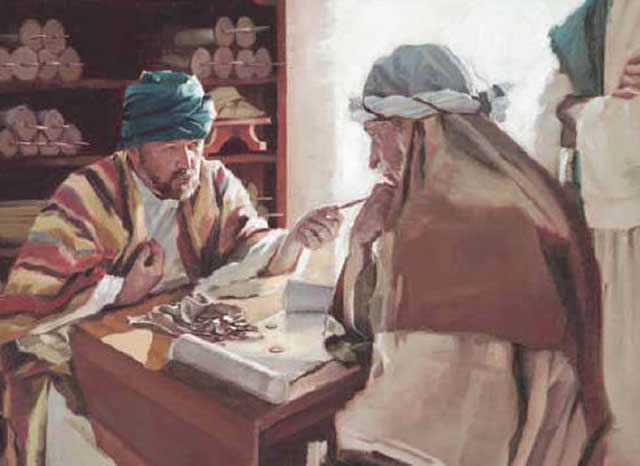
“There was a certain rich man who had a manager handling his affairs. One day a report came that the manager was wasting his employer’s money.”[1]  That’s how one of the most confusing and challenging of all the parables of Jesus begins.  

A rich man discovers that his manager is squandering his assets, so he decides to fire him and insists on a final accounting so he can audit the manager’s books.  The manager, realizing that his future is suddenly not too bright, decides to curry favor with the people who are in debt to his boss by reworking the books in their favor.  To everyone’s surprise, the boss admires the manager’s shrewdness.  Even more surprising, Jesus tells his followers that they could learn a thing or two from the crooked manager.  

So what do you think Jesus is trying to tell us here?

Before we dive too deeply into this odd story, I want to say a word about parables in general.  As I mentioned, this is one of the most confusing and challenging of all the parables,  but frankly, all of Jesus’s parables should challenge us if we’re listening to them properly.  If we think we have found an easy explanation for a parable, we’re probably short-circuiting its power.  Parables are supposed to stick with us and needle us and make us ask ourselves tough and touchy questions.

“What makes the parables mysterious, or difficult,” says Amy-Jill Levine, “is that they challenge us to look into the hidden aspects of our own values, our own lives.  They bring to the surface unasked questions, and they reveal the answers we have always known, but refuse to acknowledge.  Our reaction to them should be one of resistance rather than acceptance.”[2]  John Dominic Crossan says that a parable “shatters our complacency” and forces us to look outside of our comfortable assumptions about life.  Robert Funk said that a parable asks us to “cross over” into the kingdom, the mysterious land that Jesus is trying to evoke for us and in us. 

“A parable,” says Thomas Moore, “is the opposite of a gentle teaching story.  It confronts us, asking us to change our way of seeing things.  It turns conventional ideas upside down.  Its very point is to make us uncomfortable.”

So think about this parable of the dishonest manager again.  Who do you side with?  Who in this story are you inclined to like?  Who are you inclined to dislike?  Is there someone in this story you maybe identify with?  The rich man who discovers that his manager is squandering his assets?  The manager, himself, who cooks the books when he finds out he’s getting the sack?  The debtors who have their debts reduced, who, by the way, don’t object even a little bit to what the manager is doing?

Would it surprise you to learn that the people who originally heard this story in the first century—people listening to Jesus tell it or listening to it being read from Luke’s gospel—those original listeners probably didn’t feel any sympathy for any of these characters.

The common belief in their world was that there is only so much good stuff to go around.  If someone was wealthy, it was usually assumed that they had accumulated their assets by cheating someone else out of theirs, or by flat-out stealing.  So the people who originally heard this parable would not have felt any sympathy for the rich man whose assets have been squandered and who ends up with a reduced payback on the loans he’s made.

But what about the debtors?  Well, did you notice that the commodities they owe are in really large quantities?  The first borrower owed 800 gallons of oil.  This isn’t some poor schmo who borrowed a cup of oil to do a little cooking and keep the lamps lit for an evening.  Same with the guy who has borrowed the wheat.  He owes a thousand bushels of wheat—that’s 60 thousand pounds of wheat.  So, who borrows these kinds of goods in such large quantities?  Commodities traders.  Or merchants.  And people didn’t generally have a high opinion of them, either, because they marked up the prices on everything they sold as much as the market would bear, and with daily necessities like oil and wheat, the market would bear a lot, especially since the empire was the biggest customer for those things.  

There is also another important economic dynamic in the background of this parable that the original audience would have been well aware of but that we wouldn’t know about just from reading of Luke’s text.  Remember, Jesus was a Jew and most of his audience were Jews.  They would have assumed that the characters in the parable were Jews, too.  There were very clear laws in the Torah, in Exodus, Leviticus and Deuteronomy, that prohibited charging interest.[3]  The Jewish Virtual Library[4] sums up those laws this way: “The prohibition on interest is not a prohibition on usury in the modern sense of the term, that is, excessive interest, but of all, even minimal interest.  There is no difference in law between various rates of interest as all interest is prohibited.”

All interest on loans was prohibited.  And yet we know from abundant records that wealthy landlords in Jesus’ day were often loan sharks.  Since charging interest was prohibited, they created ways to charge interest without it looking like they were charging interest.  Most often they did this by rolling the interest into the principal.  New Testament scholar William Herzog says that the hidden interest rates appear to have been about 25% for money and 50% for goods.  The rich man’s manager would probably have also been taking his own cut of the profits on top of that 50%,  and then on top of all that there would be taxes owed to Rome.  And all those costs got passed down the line to the eventual consumer.

The upshot of all this is that when the crooked manager cuts the oil merchant’s debt from 800 gallons to 400, he is extracting his boss’s interest so that the oil merchant now owes something closer to what he actually borrowed.  Same thing with the wheat merchant, although the crooked manager doesn’t give him quite as big a break.

By reducing the debts of the oil and wheat merchants, the manager is bringing their debt more into conformity with the law—with Torah.  This is why the rich man who made the original loans can’t be seen to complain about it.  It would expose his own violation of the law.  So he smiles, takes his lumps, and admires the shrewdness of his former manager. 

So what does Jesus want us to get from this parable?  When you have all the information, none of the characters comes off looking like a role model.  It’s true that the crooked manager did a small good deed, a bit of a mitzvah, for the two merchants, but giving them a break was all about his own self-interest, and he gave his former boss the shaft in the process.  

 “If you’re not faithful with other people’s things, why should you be trusted with your own?” said Jesus. That question sounds like it’s directed at people like the dishonest manager.  But biblical scholar Barbara Rossing has suggested that Jesus might really have someone else in mind with that question.  She suggests that he’s talking to the the wealthy landowners of this world, that he’s  talking about being faithful to what rightfully belonged to the peasant farmers who were being financially squeezed into giving up their land by people like the rich man in this parable.  

When we read this parable it’s tempting to ask ourselves, “How does Jesus want me to judge these people?”  But maybe what Jesus is really asking us to evaluate is the economic system they’re all trapped in.

Even the most benign economic systems create a kind of bondage.  In this parable Jesus was painting a portrait of common economic practices that trample on the poor, practices that lock them into bearing the heaviest load of a debt-driven economy in which the bondage of financial obligation rises all the way up to the bankers at the top.  And, of course, the Empire gets its cut.

It’s not all that different for us in today’s world.  Almost all of us live with some degree of debt—car loans, mortgages, credit card debt, student loans.  According to the Federal Reserve Bank of New York, as of June 30 of this year, household debt in the U.S. reached an all-time high of $16.15 trillion.  That’s up from 15.6 trillion last year.  According to Debt.org, that averages out to $90,460 of debt per person.  

Credit card balances this past year saw their largest year-over-year percentage increase in more than twenty years, and aggregate credit limits on cards saw their largest increase in over ten years.  All this debt is a major contributing factor to the top-heavy disparity in wealth distribution in this country, a system in which the gap between rich and poor keeps getting wider while the middle continues to shrink.

In this parable, Jesus was telling his followers—telling us—to pay attention to the world’s economic dynamics, to pay attention to how the game is played.  He’s telling them, as Professor Matt Skinner said, “You either play the system or the system plays you.”[5]  

“No one can serve two masters,” said Jesus. “For you will hate one and love the other; you will be devoted to one and despise the other. You cannot serve God and be enslaved to money.”   If we’re not careful, money can become a kind of religion.  But it’s a religion that enslaves.  So pay attention.  Use your worldly resources to benefit others and make friends.  And keep an honest eye on who you’re serving, because no one can serve two masters.


[1] New Living Translation

[2] Amy-Jill Levine; Short Stories by Jesus, Introduction, p. 3

[3] Exodus 22:25, Leviticus 25:35, Deuteronomy 23:20

[4] JewishVirtualLibrary.com, Usury

[5] Matt Skinner, Sermon Brainwave #862, Luther Seminary

The Joy of (Re)Connecting

Luke 15:1-10

So this one time, some Pharisees and religion teachers were getting all cranky because Jesus was having way too much fun with the wrong crowd.  Tax collectors and known sinners—you know, those people who color outside the lines where the religious boundaries are concerned—these kinds of people kept coming to listen to him and he didn’t shoo them away or disrespect them or anything. On the contrary, he would welcome them and invite them to join the discussion!  Sometimes he would even break bread with them.  Basically, he treated them like they were all old friends at a reunion.

This didn’t sit well with the holier-than-thou guardians of propriety.  They didn’t think associating with “those people” was appropriate for a well-known rabbi, especially one with such a growing following.  They thought he should be setting an example for the rabble.  Well, he actually was setting an example, it just wasn’t the one they wanted him to set.   So they were grumbling about him.

Jesus overheard all their crabby comments, of course.  He thought about calling them out on their snooty attitude, but what good would that do?  It would just make them defensive and even more stand-offish when what he really wanted was for them to loosen up and join the party.  So he tried to reframe their thinking with a couple of hypothetical scenarios.

“Suppose a guy has a hundred sheep,” he said, “and one of them wanders off and gets lost.  “Won’t he leave the other ninety-nine in the wilderness to go search for the one that is lost until he finds it?  And when he finds it, he will joyfully carry it home on his shoulders.  And when he gets home, he will call all his friends and neighbors and say, ‘Rejoice with me because I have found my lost sheep!’  It’s like that.  There is more joy in heaven over one lost sinner who repents than over ninety-nine righteous people.

“Or how about this—suppose a woman has ten silver coins on her necklace and she loses one.  Won’t she light a lamp and sweep the entire house and get down on her knees to sweep under furniture until she finds it?  And when she does find it, she’ll call all her neighbors and friends and say, ‘Rejoice with me!  I’ve found my lost drachma!  It’s just like that!” said Jesus.  “There is joy in the presence of God’s angels when even one sinner repents!”     

Now I am absolutely sure that some of the people listening to Jesus spin these hypotheticals were chuckling, and I am just as sure that some of them were scratching their heads because there is some obvious craziness in these little stories.  Leave ninety-nine sheep in the wilderness while you go off searching for one?  Who would do that?  And sheep don’t repent.  Coins don’t repent.  And is it really repentance?  The sheep didn’t do anything to help himself be found—he didn’t wander home all sheepish about being lost.  The silver coin didn’t roll itself over to rejoin the other nine coins on the necklace. 

Or are these stories allegories maybe?  Is the shepherd God?  But does God leave ninety-nine obedient sheep at risk in the wilderness to go find the one that’s lost?  Maybe.  But that does raise questions, especially if you’re one of the ninety-nine.  

So maybe God is like the reckless shepherd who puts everything at risk to find the one lost sheep. Maybe God is like the woman who drops everything and lights a lamp and cleans house until she finds that lost silver drachma.  Maybe.

Or maybe something else is going on here.  Sheep and coins don’t repent—at least not the way we usually understand repentance.  They don’t apologize.  They don’t have a change of mind or a change of heart.   

But what if Jesus is giving us a new definition of repentance?  What if repentance is not about clearing some kind of moral bar?  What if it’s not about moral rectitude or moral correction?  What if repentance is about being brought back to where you fit in God’s grand design, being brought back into the community and communion?  What if repentance is about crossing all those artificial barriers we put up between each other, those barriers that divide us into opposing camps?

Maybe repentance is about being brought back together.  Maybe it’s about reconnecting.[1]

That would explain this other thing.  Did you notice how many times Jesus mentions joy in these two little stories?  Five times!  The shepherd carries the sheep joyfully! He calls out to his neighbors to Rejoice with me!  Jesus says there is joy in heaven when a lost sinner is reconnected with the community.  The woman who finds her lost coin calls out to her neighbors Rejoice with me!  And once again, Jesus says there is joy in the presence of the angels when even one lost sinner is reunited with companions.  It’s all about the joy!

Jesus wanted the Pharisees to understand that they were missing out on the joy!  He wanted them to understand that there is joy in making connections with people you might ordinarily be reluctant to associate with.  There is joy when we step out of our clique or private club to go out and meet the wider world.  

Matt Harding is a guys who knows all about that.  

Matt was living the dream.  He was working as a Video Game Developer, creating new games for Activision, one of the biggest companies in the business.   He was kicking around ideas for a new game with his team one day, when somebody suggested, “Let’s do a ‘shoot ‘em up’ game.  Those are very popular.”  Matt said sarcastically, “Sure.  How about Destroy all Humans?[2]  Matt was being facetious, but the boss liked the idea and gave the game a green light. And that’s when Matt quit.  “I didn’t want to spend two years of my life writing a game about killing everyone,” he said.  

Now Matt had time on his hands, and a fair bit of savings, so he decided to see the world.  One day in Saigon, Matt was in kind of a goofy mood so he did this funny little dance in front of a restaurant, which his travel buddy caught on video.  It gave them a good laugh, so they decided that they would do this everywhere they were going on their trip around the world. 

When they got home, they cut together all these fun little clips to create a three minute video of Matt dancing in all kinds of interesting places all over the world.  And that would have been the end of it, except that Matt’s sister uploaded the video to this new thing called YouTube™.     

Dancing Matt became an internet phenomenon almost overnight.  So Matt decided to go out into the world and do it again, only this time he would invite people to dance with him.  And dance they did.  Over a period of about 15 years he recorded and posted six Dancing Matt videos which have brought joy to people all over the world.  (You can find all of them at www.wheretheheckismatt.com.) 

When NPR asked Matt what he had learned as he danced through the world, he said, “Here’s what I can report back: People want to feel connected to each other. They want to be heard and seen, and they’re curious to hear and see others from places far away. I share that impulse. It’s part of what drives me to travel.”

In her TED talk about Vulnerability, Brené Brown said, “A deep sense of love and belonging is an irreducible need of all people.  We are biologically, cognitively, physically, and spiritually wired to love, to be loved, and to belong.  When those needs are not met, we don’t function as we were meant to.  We break.  We fall apart.  We numb.  We ache.  We hurt others.  We get sick.”

Right now our country is in a grumbling mood…and so is much of the rest of the world.  We’re not functioning as we were meant to.  We have found too many ways to separate ourselves from each other.  We have turned too many people into “those people,” the ones we don’t want to be seen with. As a result, we’re missing the joy.  We’re missing the celebration.

We need to repent, not with apologies or penance, but by reconnecting.  We need to find our way back into where we fit in God’s grand design, into community and communion.  We need to bring ourselves back together.  And maybe even dance with strangers.  Because that’s where the joy is.


[1] Special Thanks to Prof. Matt Skinner and Sermon Brainwave for this perspective.

[2] Destroy All Humans is in its 7th version and is available on multiple platforms.  Clearly there’s money in nihilism.

How Far Will You Go?

Luke 14:26-33

When I was 19, my best friend, Mackay, and I decided that it would be all kinds of fun to ride our bicycles from Long Beach, California to Ensenada, Mexico.  And so one sunny morning in June, we set off pedaling down the Pacific Coast Highway with sleeping bags, a 2-person tent and a few other necessities strapped to our bikes. 

The hills of Laguna slowed us down a bit more than we had anticipated, but it was still too early for lunch when we reached San Clemente, so we decided to push on and have lunch in Oceanside.  But at the south end of San Clemente, we ran into a very big obstacle that we hadn’t planned on.  Camp Pendleton Marine Base.  

We knew we wouldn’t be able to ride through Pendleton on the freeway, but we thought we could ride through the base on the old highway, which, according to our maps, still ran alongside the freeway.  The very nice Marine guard at the entrance to the base told us that that was not going to happen–  because the old highway was long gone.  

After some begging and pleading and a few choruses of “Gosh, We’ve Ridden All This Way,” he got on the phone and managed to get permission for us to ride through the base.   He sketched out a map for us and gave us very strict instructions to stay on the route he had outlined for us,  making it clear that straying off that route could have grave consequences, including but not limited to death, dismemberment or being imprisoned.  

An hour and a half later, we were utterly lost on a winding dirt road when a very perturbed Marine in a jeep came roaring up to us and asked us what the H-E-DOUBLE-Q we thought we were doing.  He also told us that we were perilously close to a live-fire range, then threatened to throw us in the stockade or make us enlist or both before finally deciding to guide us down to the southern end of the base.  He sent us off with a warning that if we ever set foot or bicycle tire on the base again there would be dire consequences unless, of course, we were in a Marine uniform.  

We had lost a lot of time on the confusing roads of Pendleton, so we powered through Oceanside and into San Diego without stopping for lunch.  Then came the ordeal of getting through San Diego on surface streets which proved to be far more complicated and took much longer than we had planned.  And just so you know, not even the military had GPS yet in those days, so we were at the mercy of outdated gas station roadmaps.  

The sun was getting ready to call it a day by the time we crossed the border into Tijuana.  We grabbed a couple of tacos from a taco cart then raced the sun for the last 14 miles to Rosarito Beach where we camped for the night.

The rest of the trip was pretty uneventful.  The ride from Rosarito to Ensenada on the old road up across the mountain—the only way bicycles were allowed to go—was a challenging but beautiful ride.  After a night in Ensenada, we turned around and headed for home.  

We spent the night at Rosarito Beach again, had a good breakfast at the cantina, then set out for the border.  We made good speed and got to Tijuana at about three in the afternoon which gave us plenty of time to make it to Silver Strand State Beach in San Diego where we planned to pitch our tent for the night.

And that’s when we ran into another obstacle we hadn’t planned on.  There were three long lines of cars waiting to cross the border into California.  We rode our bikes up between the lines of cars to the state line expecting that the border guard would just wave us through—after all, where would a couple of guys on bicycles hide anything?   But the guard at the border wasn’t having it.  He gave us a lecture about trying to cut the line then told us to go all the way back to the end of the line.  Two hours later after standing in the heat astride our bikes and breathing exhaust fumes from all the cars, we finally got back to the border where the same guard just waved us across without even asking for our I.D.   

At that point, we pulled over to the side of the road and took stock of where we were and what lay ahead of us.  We were exhausted, hot and sweaty.  Our legs were trembling and aching.  We didn’t even want to think about trying to get through Pendleton again.  What we wanted most was a good shower, a long, cold drink and a good meal. What we wanted was to be home.  

The bicycle ride that we had thought would be all kinds of fun had turned out to be all kinds of challenging.  Our stamina had evaporated in the exhaust fumes and unrelenting sunshine while we waited at the border.  We were fresh out of  possibility.  Our ride was over.  We made our way to the airport and, grateful for small miracles, managed to snag seats on a flight back to Long Beach.  

“Who would build a tower without first figuring out how much it’s going to cost?” asked Jesus.  “What king would go to war without first figuring out if he has a chance of winning?”  Who would ride a bicycle to Ensenada without making sure that they could actually get there and back?

Luke tells us that large crowds were traveling with Jesus as he made his way toward Jerusalem.  They had been watching him heal people.  They had been listening to him as he taught them about the kingdom of God and how radically different it is from the kingdom of Caesar.   The crowd was drawn to him.  They liked him.  They liked the different world he described, the better world that he told them is possible.  A lot of them were probably wondering what it might be like to be part of his inner circle—to be his disciple.

But there’s a big difference between being a fan and being a disciple.  

Jesus wants to make it clear to the crowd that becoming a disciple means putting him and the kingdom of God first.  Jesus wants them to understand that  becoming a disciple means you join him in making the kingdom of God a reality on earth as it is in heaven.  And Jesus wants us to understand that the other kingdoms of this world are going to resist you when you do that.  

The kingdom of family may be perfectly happy for you to be a fan of Jesus, even for you to embrace some of the things he teaches.  But they may not be so happy when you start giving away time and resources that they feel they have a claim to.  “Whoever comes to me and does not hate father and mother, wife and children, brothers and sisters, yes, and even life itself, cannot be my disciple,” said Jesus.  And no, he didn’t mean a disciple has to have some kind of intense animosity toward family, but he did mean that you, as a disciple, have to be willing to turn away from them, to let them go, when what they want is trying to pull you away from where Jesus is leading you.

The kingdoms, the empires of this world will resist you when you become a disciple of Jesus and set to work in earnest to make God’s reign a reality in your life and in the world.  

The kingdom of consumerism will sneer at you for not having the newest, shiniest, most fashionable, most advanced everything—clothes, gadgets, house, car or whatever when you, as a disciple of Jesus, learn to be satisfied with what you have and to give away what you don’t really need. 

The kingdom of capitalism will call you a socialist or maybe even a communist when you, as a disciple of Jesus, insist that those who have more should contribute to the well-being of those who have less.  When you remind them, as Jesus did, that God did not intend for the bountiful resources of the earth to enrich only a few, they will call you a radical and try to silence you.

The empire of power will oppose you when, as a disciple of Jesus, you call for liberating the oppressed and setting the captives free.  When you, as a disciple of Jesus, insist that all people are equal and beloved in God’s sight so the opportunities and benefits of life together in a civil society should be equal, too, regardless of race or gender or color or sexuality.  They will call you a trouble-maker and try to put a stop to you…one way or another.

“Whoever does not carry the cross and follow me cannot be my disciple,” said Jesus, and those people in the crowd, especially the wannabe disciples, knew he wasn’t just using hyperbole.  They knew that the cross he was talking about wasn’t a metaphor.  He was telling them there would be a real cross with real nails and real pain…because when you try to establish the kingdom of God in the midst of the empire of coercive power, coercive power will try to stop you.  Brutally.  

If you want to be my disciple, then stop and think about what that might cost you says Jesus.  There’s no shame if you can’t go that far.  There’s no shame if you just want to follow in the crowd and listen from a safer distance.  But you should know, eventually that won’t be enough.  

Eventually the Word of God will bring you to a place where either you will summon up the stamina and will to finish the ride… or call it quits.  Eventually either the vision of the kingdom of God will become all-consuming for you, or you will dismiss it as a nice but unobtainable ideal—or maybe some kind of prize in the afterlife if you are nice enough to qualify.

Traveling with Jesus sounds like all kinds of fun.  And it does have its rewards.  There are healings along the way.  He’s a marvelous teacher and the kingdom he envisions is beautiful.  He loves you and isn’t shy about making that known.   Jesus loves the crowd… but not everyone in the crowd is ready to go all the way to discipleship.  

Lots of people can ride a bicycle.  Comparatively few can ride it all the way to Ensenada and back.

How far will you go?