
Message Received

Matthew 10:40-42

I’ve been thinking a lot about Eric.  I remember how Eric was attracted by the crowd one Sunday evening when we were doing Stories, Songs, and Supper.  I was pretty sure when I first saw him that he was homeless although to be fair, his clothes were cleaner and neater than most in that condition.  

He stood at the church door and asked what was happening as he saw people gathering, greeting each other, laughing, and we told him, “It’s a thing we do called Stories, Songs, and Supper.  We share a meal then sing a bunch of old familiar songs, then someone tells a story, then we sing a little more.”  We invited him to come in and join us.  So he did.

While he was eating he told us a bit about himself—he had a gift of gab—then after supper he helped clear the tables.  He joined right in with the singing and he had a pretty decent voice.  Somewhere in the midst of all that let it be known in his own gregarious way that joining with us that evening was a particular treat for him because it happened to be his birthday.  So we all sang Happy Birthday to him.  At the end of the evening, as he was leaving, he asked if he could borrow a book from the book table in the fellowship hall.  He took a novel and promised to return it.

The next Sunday, Eric was there for Sunday morning worship.  Soon he was participating in Adult Education classes and Bible study.  He joined in with one of our small groups in the work they were doing with Lutheran Social Services.  In almost no time Eric had become an important member of our little family of faith. 

We welcomed Eric into our lives and Eric welcomed us into his.  And we were all richer for it.

“Whoever welcomes you welcomes me, and whoever welcomes me welcomes the one who sent me,” said Jesus in the tenth chapter of Matthew.  This is the same gospel in which Jesus later says, “I was hungry and you fed me, I was thirsty and you gave me something to drink, I was a stranger and you welcomed me… Truly I tell you, just as you did it to one of the least of these who are members of my family, you did it to me.”

Christ often comes to us in ways we’re not expecting.  When we welcome the unexpected stranger, or graciously accept a welcome when we are the unexpected stranger, we experience the presence and grace of God in new and enriching ways.

I remember one dreary afternoon when the sky was the color of lead and the rain was relentless.  The light coming in my office window had unconditionally surrendered to winter and my mood matched the weather.  Suddenly I heard this bright, jazzy music coming from downstairs.  I ran down the stairs and there in the Fellowship Hall was Eric, pounding out boogie-woogie on the old out-of-tune piano.  Who knew?  He had come in to the hall to get out of the rain and the mood had come on him to just sit down and play.  He apologized for disturbing me and I told him, “No apologies necessary!  You brought light into a gloomy day! Keep playing.”

“Whoever welcomes a prophet in the name of a prophet will receive a prophet’s reward; and whoever welcomes a righteous person in the name of a righteous person will receive the reward of the righteous.”

We learned a lot from Eric.  We learned a little about life on the streets.  We learned more than we wanted to know about our neighbors’ attitudes toward the homeless.  We learned how the police and the justice system in our city respond to those who are experiencing homelessness.  We learned about our own attitudes toward those living rough.  Most of all, though, we experienced an energy and vitality that’s been missing since he left us.  All this because we welcomed one gregarious man into our party on his birthday.

As I read the scriptures and the history of the Church, I see a story where the Holy Spirit is always trying to open the door of welcome wider.  Sadly, though, every time the Spirit pushes the door open wider, there are more than a few trying to close it.  

God made a covenant with Abraham and told him that his descendants would be a blessing to all nations, but then his descendants tried to make it a “descendants only” club. 

Jesus welcomed “tax collectors and sinners” to his fellowship table but the Pharisees were scandalized and critical.  How could he be from God if he associated with such people?  Then down through the years, even the followers of Christ, people calling themselves by his name, would make all kinds of gateway tests of belief and morality to decide who was worthy of coming to Christ’s table.

When the Church was barely up and running Peter, under the direction of the Holy Spirit, baptized Cornelius and his household, Roman gentiles.  In response, James and the other Apostles back at headquarters in Jerusalem had a tizzy fit and raised all kinds “who gave you permission” questions.  

St. Paul placed women in the pastorate and leadership ranks of the congregations he established (Junia, Julia, Prisca, Lydia, Euodia, Scyntyche), but before he was cold in his grave other patriarchal hands were editing his writing (1 Cor. 14:34-36) while still others borrowed his name to write  the women out of their jobs (1 Timothy 2).  

Not exactly welcoming.

This month in the ELCA we celebrate the 50th anniversary of a change in wording in the bylaws of the Lutheran Church in America and the American Lutheran Church, two of the predecessor bodies of the ELCA.  Fifty years ago they voted to change the word “man” to the word “person” in their bylaws, thereby opening the door for the ordination of women. 

Fifty years later, women clergy often struggle with challenges that male clergy do not.  They deal with sexual harassment, disrespect, and often lower pay due to gender-based discrimination.  Some congregations still refuse to call a woman as pastor even when there are no other candidates.  The saddest part of that is that in doing so these congregations are depriving themselves of the gifts these talented women bring with them, gifts that could revitalize and renew them.  

When I think of the women pastors I know, I feel a tremendous hope and confidence for the future of the church.  If anyone can lead us to a brighter day, they can.

“Whoever welcomes a prophet in the name of a prophet will receive a prophet’s reward; and whoever welcomes a righteous person in the name of a righteous person will receive the reward of the righteous; and whoever gives even a cup of cold water to one of these little ones in the name of a disciple—truly I tell you, none of these will lose their reward.”

Eric taught us this lesson well: When we welcome the unexpected guest, we receive unexpected gifts. 

Fifty years ago the Spirit moved to open the door wider so that the church could receive the bountiful gifts that women bring through ordained service.  Eleven years ago the Spirit opened the door wider again when the ELCA voted to allow the ordination of LGTBQ persons.  And the church is richer for their ministry.

Today we stand at the edge of a tidal shift in our culture in regard to race, economic structures, and societal systems.  The Holy Spirit is pushing the door open yet again and maybe, maybe even pushing down the walls.  Church will be different.  There are new prophetic voices to hear.  New righteous persons to receive.  New gifts being given.  The only question is, will we welcome them?

In Jesus’ name.
 

Don’t Be Afraid

Matthew 10:24-39

[Jesus said,]   “A disciple is not above the teacher, nor a slave above the master;  25 it is enough for the disciple to be like the teacher, and the slave like the master. If they have called the master of the house Beelzebul, how much more will they malign those of his household! 

26  “So have no fear of them; for nothing is covered up that will not be uncovered, and nothing secret that will not become known.  27 What I say to you in the dark, tell in the light; and what you hear whispered, proclaim from the housetops.  28 Do not fear those who kill the body but cannot kill the soul; rather fear him who can destroy both soul and body in hell. (Gehenna) 29 Are not two sparrows sold for a penny? Yet not one of them will fall to the ground apart from your Father.  30 And even the hairs of your head are all counted.  31 So do not be afraid; you are of more value than many sparrows. 

32  “Everyone therefore who acknowledges me before others, I also will acknowledge before my Father in heaven;  33 but whoever denies me before others, I also will deny before my Father in heaven. 

34   “Do not think that I have come to bring peace to the earth; I have not come to bring peace, but a sword. 

35       For I have come to set a man against his father,

         and a daughter against her mother

         and a daughter-in-law against her mother-in-law; 

36       and one’s foes will be members of one’s own household.  37 Whoever loves father or mother more than me is not worthy of me; and whoever loves son or daughter more than me is not worthy of me;  38 and whoever does not take up the cross and follow me is not worthy of me.  39 Those who find their life will lose it, and those who lose their life for my sake will find it.

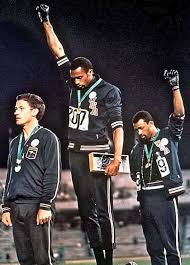
Standing up for what you believe in, standing up for the right thing, can cost you. 

When Tommie Smith and John Carlos won the gold and bronze medals in the 200 meter dash in the 1968 Olympics in Mexico City, they stood on the awards podium with their black-gloved fists raised in what the press called a Black Power salute to call attention to  the ongoing fight for civil rights in the United States.  Tommie Smith and John Carlos called it a Human Rights Salute.  Standing with them on the podium was the silver medalist, a white man, an Australian named Peter Norman.  Norman didn’t raise his fist but he did something else that brought down the whirlwind.   In solidarity with Smith and Carlos, he wore the Olympic Project for Human Rights badge on his uniform.  

After the race, Carlos and Smith had told Norman what they planned to do during the ceremony and Norman encouraged them.  They asked Norman if he believed in human rights.  He said he did.  Then Smith and Carlos asked Norman if he believed in God.  He said he believed strongly in God and that what they were about to do was more important than any athletic accomplishment.  And then he said, “I’ll stand with you.” On their way to the medals ceremony Norman saw the Human Rights badge being worn by Paul Hoffman, a white member of the US rowing team and asked if he could borrow it for the ceremony.  He didn’t feel it was appropriate to raise his fist because that particular symbol belonged to the people whose civil rights were being denied.  But he could wear the patch.

That moment of solidarity was costly for Peter Norman.  He never returned to the Olympics.  Back in Australia he became a figure of controversy and got somewhat lost in his own life.  “If we were getting beat up,” said John Carlos years later, “Peter was facing an entire country and suffering alone.”

A disciple is not above the teacher, nor a slave above the master;  it is enough for the disciple to be like the teacher, and the slave like the master. If they have called the master of the house Beelzebul, how much more will they malign those of his household!” says Jesus in today’s gospel reading.  In other words, if they’re going to call Jesus himself the devil, don’t be surprised if they call you worse.  

This comes near the end of a long  section where Jesus is sending his disciples out on their first mission to proclaim the Good News—remember the good news?  the Reign of God is arriving?—but  now he’s telling them that this Good News, this news that people have waited for for eons is going to be disruptive, and some people aren’t going to like that.  

People are funny.  We can pray week after week, day after day, year after year “your kingdom come, your will be done on earth as it is in heaven.”  But when it gets down to actually working to make that happen, people get cranky because then we actually have to change things—our politics, our religious practices, our structures and systems…even ourselves.  “Do justice, love kindness, and walk humbly with your God” makes a lovely needlepoint but it can turn everything upside down when you actually put it in practice, especially the do  justice part.

Don’t be afraid, says Jesus. Do not be afraid of opposition.  You know it’s coming so just face it.  If you trust me, if you believe in what I’ve been teaching, then live by it.  Proclaim it.  Act on it.  Shout it from the rooftops. What’s the worst they can do to you?  Kill you?

Do not fear those who kill the body but cannot kill the soul; rather fear him who can destroy both soul and body in hell. (Gehenna)

Okay, two things here, and I’ll take the last one first.  Hell.  Hell isn’t hell. The actual word here is Gehenna which was a valley just outside Jerusalem where all the city trash was dumped and burned, including the carcasses of dead animals. It’s not the Hell of popular imagination.  Think city dump.  So, fear the One who can toss your whole self into the trash heap.

The second thing:  Soul.  The Greek word here is psyche.  Soul is one translation.  It can also mean life.  In this context, though, maybe think of it as your true self.  Jesus is saying don’t be afraid of those who can only kill your body.  Save your fear for God who can completely undo you.  Remember in Isaiah chapter 6 where Isaiah stands before the throne of God and says, “Woe is me for I am lost.”?  The Hebrew word there which we translate as lost is nidmeti.  It can mean lost or silenced.  It can also mean unmade. It’s the same idea here. 

Fear the One who can destroy both body and soul.  Fear the One who can destroy your true self.  God is one of only two entities in the universe who can unravel your true self.  And, spoiler, God won’t.  God will not.  God loves you with a passion.  God may work furiously to reshape you, to rid you of poisonous thoughts, ideas and attitudes, to smooth certain rough edges, but God will not destroy you.  

God may, however, let you destroy yourself.  God loves you enough to give you free will.  And you are the only other entity in the universe who can destroy your soul, you should be careful and thoughtful with that gift.  

One of the reasons, I think, that Christ gives us the high honor and calling of announcing and building the beloved community is to help steer us away from the numerous rabbit holes of self-destruction we could dive into, and also to give us trustworthy companions for the journey of life.  But, to take us back to where we started, Jesus knew that doing this, announcing that it’s time for a systemic do-over, would bring opposition and confrontation.

“Do not think that I have come to bring peace to the earth; I have not come to bring peace, but a sword.” 

There’s a similar passage in Luke 12 where Jesus says, “I came to bring fire to the earth, and how I wish it was already kindled.”  I don’t think that Jesus is saying in these passages that he is intent on creating conflict.  I think he is simply acknowledging that conflict is inevitable when we proclaim the kingdom and work for it because the whole and healthy society that God envisions, the kingdom of heaven, the reign of God is very much at odds with business as usual in the earth of empires and economies.

There will be opposition.  There is opposition. And some of it is brutal.  That’s why Jesus said, “Whoever does not take up the cross and follow me is not worthy of me.”

Scholar and theologian John Howard Yoder points out that the cross was “the standard punishment for insurrection for the refusal to confess Caesar’s lordship.”  The phrase ‘take up your cross’ was commonly used by Zealots when they were recruiting.  It was a call to stand in defiance and opposition to Rome and the systems of empire that perpetuated oppression.  

But there was another dimension to it.  Roman citizens could not be crucified.  If a citizen was guilty of a capital offence, even insurrection, they would be beheaded.  Crucifixion was reserved for those of lesser stature, the invisible non-persons of the empire who opposed it.  “Take up your cross” was not just a call to stand in defiance of Rome, it was also a call to identify with the people on the margins.  It was a way of saying “Stand with the poor, the downtrodden, the nobodies.” 

“Those who find their life will lose it, and those who lose their life for my sake will find it.”  And here we find the word psyche again in the Greek text, this time translated as life.  Life. Soul.  Self.  This is such a cryptic saying from Jesus.  Here’s how I understand it:  If you go looking for yourself, you’ll lose yourself, but if you lose yourself in the life of Christ, you’ll find yourself.  

I think maybe Jesus is saying stop worrying about the meaning of your life or what, exactly your soul is, or even who you are deep down in your soul.  Let go of all those esoteric questions and lose yourself in the business of the reign of God.  Work for equality and equity.  Feed the hungry.  House the homeless. Take care of the sick.  Bring hope to the hopeless.  Stand with those who need you to stand with them.  Act on your faith.  It may cost you.  There will be opposition.  Don’t be afraid.  The reign of God, the kingdom of heaven is in reach.  In Jesus’ name.

Harassed and Helpless

Matthew 9:35-10:8

Jesus went about all the cities and villages, teaching in their synagogues, and proclaiming the good news of the kingdom, and curing every disease and every sickness.  36 When he saw the crowds, he had compassion for them, because they were harassed and helpless, like sheep without a shepherd.  37 Then he said to his disciples, “The harvest is plentiful, but the laborers are few;  38 therefore ask the Lord of the harvest to send out laborers into his harvest.” 

1  Then Jesus summoned his twelve disciples and gave them authority over unclean spirits, to cast them out, and to cure every disease and every sickness.  These are the names of the twelve apostles: first, Simon, also known as Peter, and his brother Andrew; James son of Zebedee, and his brother John;  3 Philip and Bartholomew; Thomas and Matthew the tax collector; James son of Alphaeus, and Thaddaeus;  Simon the Cananaean, and Judas Iscariot, the one who betrayed him. 

5  These twelve Jesus sent out with the following instructions: “Go nowhere among the Gentiles, and enter no town of the Samaritans,  but go rather to the lost sheep of the house of Israel.  7 As you go, proclaim the good news, ‘The kingdom of heaven has come near.’  Cure the sick, raise the dead, cleanse the lepers, cast out demons. You received without payment; give without payment.

———————————————————————————————————

When he saw the crowds, he had compassion for them, because they were harassed and helpless, like sheep without a shepherd.

There’s more than a little irony in that statement.  In reality they had a lot of shepherds.  They had layers of government starting with the well-organized and highly structured hierarchy of Roman authoritiy enforced by a pervasively deployed military.  In addition to the Romans, there was the territorial tetrarch, Herod Antipas, who also had his own small army to ensure compliance with his whims.  Then, more or less voluntarily, the people were subject to the religious hierarchy with its class structure, requirements and factions. 

Oh, they had shepherds.  Too many shepherds.  But they were the kind of shepherds who were more interested in their fleece and mutton than in leading them to green pastures.  

They had shepherds.  But no one leading them with purpose.  No one showing them a vision of a better day.  No one giving them hope.

And then came Jesus, moving through the cities and villages, teaching in their synagogues and proclaiming the good news of the kingdom, the basilea—the reign, the rule, the sovereignty of heaven.  Jesus stood up in their sacred places and announced that the reign of heaven was arriving, was at hand, was in reach, was happening.  

This euangelion – the word that is translated as good news, or gospel, the word that gives us our word evangelism—this good news that Jesus preached was a promise of hope to a hopeless people, a people harassed and helpless.  

This good news was also—make no mistake—political.  

Jesus stood up in the holy places of his people, in a territory under the iron-fisted dominion of the Roman Empire, in a region also under the capricious authority of an impulsive local king and declared publicly that the Reign of heaven was beginning.  The people listening to him understood that Jesus was talking not just about a new spiritual reality, but about a restructuring of all reality—a restructuring that would include politics, economics, and social structures.  They had heard the promise from Isaiah and the prophets.  They had seen the outline in the egalitarian laws of Torah with its profound concern for the stranger, the alien, and the poor.  They knew the promise of the kingdom.

When Jesus saw the crowds, he had compassion for them, because they were harassed by the powers that were supposed to bring order and stability to their lives and helpless to do anything about it.  So he stood in their holy places and announced that the future that had been promised for so long, the hope they had waited for, was within reach.  They understood that he was saying that the revolution was beginning.  They just didn’t understand how he intended to conduct it, that it would not begin with fighting in the streets but with the transformation, the conversion if you will, of hearts and minds and lives.

It’s been two thousand years and we’re still misunderstanding Jesus even when we have his words and his methods right in front of us.

One of my colleagues shared with us in a meeting this week that she was frustrated and more than a little heartbroken because she got pushback from some members of her congregation for being too political in her last two sermons.  I know her well and I know she preached from the gospel text.  But here’s the thing—She’s black, a black woman pastor, preaching to a mostly white congregation.  With all the things happening in our country right now following the murder of George Floyd, with the demonstrations and riots, she had to say something.  After a lifetime of living in a culture where simply being black makes her and her children and her grandchildren “harassed and helpless” she had to say something.  The culture set the agenda and the gospel texts opened the door to speak.  She wasn’t political.  She was personal.  She described the experience she and her family and friends have had living with racism in this country.  She describe how racism is deeply rooted in so many of the systems in this country. She described how what they have experienced is contrary to the love and teaching of Jesus.

But there were people in her congregation who didn’t want to hear what she had to say even though it was rooted in the gospel.  It made them uncomfortable.  The words of Jesus, the Word of God spoken from the context of her life made them uncomfortable.  

The Word became flesh and stood among them.  But it wasn’t just spiritual or academic or religious.  It was real.  And it didn’t just speak words of comfort.  

So they pushed back.

Somewhere early on we, and by “we” I mean The Church universal, got lost in our religion. We forgot that the purpose of our religion is to help unite us for the practice of our faith.  And somewhere along the way as we wandered through the labyrinths of our theologies and liturgies and litanies even our vocabulary began to shift.

Take the word evangelism.  It means to share the gospel, the good news.  But somewhere along the way the content of the good news got swapped out.  Today for most people sharing the gospel means telling people that Jesus is our Savior or converting people to Christianity, however they might describe that.  But what was the good news, the gospel that Jesus told his disciples to announce?  Did he say, “Go out and tell everyone about me.  Tell them I’m the Son of God and that I’m here to save them and give them eternal life.” 

No, he did not.

He said, “Go to the lost sheep of the house of Israel.  As you go, proclaim the good news, ‘The kingdom of heaven has come near.’

That’s part of his genius, by the way.  Go first to people who already know what you’re talking about.  You won’t have to spend a lot of time explaining what you mean by “the kingdom of Heaven.”  Start with an audience that knows how to hear you.  Start with a vision they’ve already heard about.

Why aren’t we saying that, or words to that effect to the people we know who are ready to hear it?  Maybe evangelism wouldn’t be so frightening if we started our conversations with something like, “You know, I think an egalitarian society, a culture of equality is a real possibility.  I think, with God’s help it can be done.”  Or maybe something even simpler.  “You know, I think we really can have liberty and justice for all.  A more perfect union.  Life, liberty and the pursuit of happiness. What’s stopping us?”

And look at how Jesus tells his disciples to demonstrate what the reign of Heaven looks like:  cure the sick, raise the dead, cleanse the lepers, cast out demons.

We can do that.  Well some of it, anyway.  

There’s a story that St. Francis told his brothers one day that he was going to go to a nearby village to preach and asked a young novice to come with him.  On his way he passed an injured man and stopped to tend to his wounds and helped him back to his home.  A little farther down the road Francis and the novice came upon man who was homeless and hungry.  Francis shared some food with him and arranged for him to stay at a nearby house.  And so it went as they traveled down the road, they would encounter someone in need and Francis would care for them.  As the sun dropped lower in the sky, Francis told the novice that they should turn around and head back to the monastery for evening prayers.  “But,” said the novice, “you were going to the village to preach to the people!”  “My friend,” said Francis, “that’s what we’ve been doing all day.”

Proclaim the reign of Heaven.  Cure the sick.  Raise the dead.  Cleanse the lepers.  Cast out demons.  

Cure the sick.  We may not have the power that Jesus had in his hands to heal with a touch, a power he passed on to those first disciples, but we have other kinds of power.  We have the power to see to it that everyone gets proper medical care.  

According to the Kaiser Family Foundation 27.9 million people in this country still don’t have health insurance of any kind.  Last year 24% of Hispanics did not see a doctor because of cost concerns. The same statement applies to 21% of blacks, 19% of American-Indian Natives, 15% of Native Hawaiians and other pacific islanders, 14% for whites, and 11% for Asians.

Jesus tells us to cure the sick.  Why not start by helping the sick have the most basic tool they need to get to the people who are best equipped to cure them?  Why not start with universal health care?

Raise the dead.  We may not be able to revive dead persons like Jesus did, but we know we can revive dead hopes and dreams and opportunities.  We know we can help to open closed doors.  We know we can create a more level playing field.

Cleanse the lepers.  Who has been declared “unclean” in our culture?  Who has been cast out of the church or the society?  I think that in a figurative way, being Reconciling in Christ, opening the church to LGBTQ people has been and continues to meet this marching order from Christ.  The difference, of course, is that LGBTQ persons never were unclean.  It was the church’s position and opinion that needed to be cleansed and still does in some sectors.  We can do that.

Cast out demons.  This is our most immediate task, and easily the hardest.  The ingrained racism that’s rooted so deeply in our hearts and in our culture  is, plainly and simply, demonic.  It is clearly the mandate of Jesus to rid the world and our own hearts and minds of this demonic infection that threatens to destroy us.  But to do this means that each and every one of us will have to do some difficult ongoing work.  It means we have to educate ourselves.  It means we have to open our eyes to all the pernicious ways racism has wound its roots into our laws and lives.  It means that we need to be intentional about listening to our black friends and all our friends of color so we hear and understand more about their experience and see through their eyes.  It means that we learn how not to become defensive when we hear about white privilege, that, in fact, we learn to see it and understand how those of us who are white have lived by different rules.  It means that, in the name of Jesus, when we see injustice or unfairness, we name it and stand up to it, that we stand alongside our brothers and sisters of color who are standing up for their rights.  

These are the signs of the reign of heaven. Healing. Reviving. Restoring. Cleansing. Standing against evil.  These are the things we can do that preach the good news that Jesus proclaimed, even when we have no words.

As you go, proclaim the good news, “The kingdom of heaven has come near.”  With liberty and justice for all.

When the Spirit Speaks

On the sixth day of Sivan, seven weeks and one day after the Feast of Unleavened Bread, on the day of Shavuot which the Hellenized Jews call Pentekosta, the streets of Jerusalem were filled with people from every tribe and nation, from the far reaches of the empire and beyond, some even from Cush, Iberia and Ethiopia, from Scythia and the Parthian empire.  Jews and proselytes, curious gentiles and ambitious traders had come from everywhere to be in the Holy City for the festival of the first fruits of spring and to remember the giving of Torah to Moses.  

The followers of Jesus were in the city, too, gathered all together in one place, in one room, waiting as Jesus had instructed, waiting for a signal, waiting for what was to come next.  Then suddenly the house where they were sitting was filled with a sound from heaven, a sound like a hurricane.  It filled the house and drove them to their feet while something that looked like tongues of fire danced between them until a flame seemed to alight on the head of each one of them.  They felt a presence swell up inside them and knew it was the Holy Spirit.  

The Spirit drove them out of the house and into the street where they began to speak to the crowd in languages they had never known as the Spirit spoke through them proclaiming the love and grace of God as it had been made known to them in Jesus the Christ.  They spoke of God’s works of power through Jesus, his feeding of multitudes, his healings, his teaching.  They spoke of how he welcomed strangers and touched lepers.  They spoke of how he challenged the self-righteous and embraced the neglected.

On the day of Shavuot, the Festival of Harvest which was also called Pentekosta, the day on which Moses had been give the Law, the Holy Spirit began to spread the good news of the Reign of God through Jesus, the Christ, across the empire of Caesar and beyond.

Now two millennia later, on the 31st day of May, on the day that Christians call Pentecost which is also called Whitsunday or Whitsun, we are not all together in one place.  We are not all together in one room, though we may be gathered in one ZOOM.  

This is a strange birthday for the Church as we begin to contemplate moving back into our facilities, our sanctuary, after months apart in our homes.  There are so many practical questions to consider.  Is it really safe yet?  Will our people be able to adapt to the new practices required for safe worship in this time of pandemic or will they revert to old, ways of doing things simply out of habit—ways which are now unsafe?  With all the restrictions and safeguards, is it even worth doing now?  Should we wait until there is a vaccine?   Those are all good questions.  Necessary questions.

But I have other questions.

What have we learned from this time of isolation?  How has the Holy Spirt spoken to us?  Was this, somehow, the work of the Holy Spirit—not the virus, to be clear—but the separation?  Was it the work of the Spirit to send us out of our sanctuary and into our homes for a time—a time of contemplation and reflection?  Have we used this time to reflect on what it means to be the Church of Jesus Christ?  Have we used this time to listen to the Spirit, to discern what Christ is calling us to do and to become?  Are we listening now?

The Spirit has been speaking as always.  I’ve been hearing the Holy Spirt, not in the tongues of xenolalia or glossolalia, but in the everyday voices and silences of the congregation.  I’ve been hearing the Spirit and seeing the Spirit in phone calls, in prayer requests, in ZOOM meetings, in emails, in cards, letters and postcards, and on social media.  The Church is alive even if we are not all together in one place.  The church is open even if the building is closed.  The Spirit is still speaking.

On that first Pentecost the Spirit came upon them with the sound of a hurricane.  What kind of sound is the Spirit making now?

Sometimes, certainly, the Spirit speaks in silence.  The silence of our isolation.  The silence of our thoughts.  Sometimes in that silence the Spirit speaks to us with sighs too deep for words about our own lives and hearts and hopes and dreams.  As I listen to the Spirit in silence, I have been hearing the silence of a nation that has not yet grieved for 100,000 dead.

I believe, though, that there is also a sound that is carrying the presence of the Holy Spirit, a sound louder and deeper and broader than a hurricane and more turbulent than an earthquake, and yet often we seem deaf to it.  I wonder if we haven’t been sent out of our places of worship and into our homes so we could hear it better and learn to see the hand of God at work.  I wonder if our ears and minds and even our souls haven’t been so preoccupied with our hymns and liturgies and the pageantry of worship that we’ve been deaf and blind to the things the Spirit of God is engaged in, the things God is call us engage with.

At the beginning of creation the Spirit moved over the turbulent welter and waste of the waters to bring order out of chaos.  On this day of Pentecost is the sound of melting glaciers and rising seas the sound of the Spirit calling us to begin an era of re-creation, to take meaningful action in the battle against climate change?  Are we being called anew to fight pollution, to restore the earth, to cherish God’s creation?

In his day, the prophet Amos was filled with the Holy Spirit and empowered to challenge the economic disparities of Israel and to predict catastrophe for the wealthy.  In a country where 10% of the households have 70% of the wealth, in a country where 40 million have filed for unemployment as businesses have closed due to the pandemic, where Wall Street seems disconnected from Main Street, is the Spirit calling us to reexamine our priorities and restructure our economic systems?

In an era when the people of Israel thought that all God cared about was religion done rightly and in the right place, the Holy Spirit spoke through Isaiah and later through Micah and said quite literally, “I do not want your bull.  Not while the poor are languishing.  Not while there is rampant injustice.  Take care of those in need.  Give justice where it has been subverted. Bring me a contrite spirit and a broken heart and then we’ll talk about worship.”  In a day when we get caught up in discussions about the propriety or impropriety of on-line communion, when we’re deep in discussions about when and how to open our sanctuaries, when the very issue of reopening our churches has become a political flash point and fodder for the political divide, is the Holy Spirit, maybe telling us to cool our jets, to make sure first that our ministries and priorities are in order, that our hearts are in the right place, and then we can talk about worship in our buildings?

On that first Pentecost the Holy Spirit used a sound like a hurricane and tongues of flame to move the followers of Jesus into the streets.  On this day of Pentecost there is another sound and another fire as the Spirit of God moves through our streets.  It is the sound of the grief, the anger, and frustration of those who have been unheard, a grief and anger long suppressed and now unleashed.  The flames are flames of rage that have long been suppressed in the hearts of our sisters and brothers of African descent.  It is the wail of mourning for George Floyd, for Ahmaud Aubrey, for Breonna Taylor, for Eric Garner, for Trevon Martin, for the 9 killed at Bible Study at Mother Emmanuel AME Church, for Emmett Till, and for countless others.  The raging wind we hear is the sound of millions of voices sighing together the words of Fannie Lou Hamer, that they as a people and as individuals, are “sick and tired of being sick and tired.”  It is the Spirit, the Breath of God, squeezed from a people who are crying out “I can’t breathe.”

When I listen to the Spirit at this time of Pentecost I hear all of this.  A voice says, “Cry out!” and I say “What shall I cry out?”  And I hear the Spirit say, “Fix This!”  

When I listen to the Spirit I hear the words of Jesus reading from the scroll in the synagogue, words we drank in with our baptism when his mission became ours: “The Spirit of the Lord is upon me.  The Lord has anointed me to bring good news to the poor, to open the eyes of those who have been blinded by ugly ways of thinking, to liberate those who have been oppressed by hideous words and evil ideas, and to set the captives free.  Fix This.”

When I listen to the Spirit at this time of Pentecost I hear the narrative voice of the Gospel of John, words about Jesus that also became words about us in our communion: “Indeed, God did not send the Son into the world to judge or condemn the world, but so that the world might be saved, healed, made whole through him.  Fix This.”

When I listen to the Spirit at this time of Pentecost that’s what I hear.  I hear the brokenness.  I hear the lament and anger.  

But I also hear the promise and the call of God.  I hear the reminder that we have been anointed, empowered and called by the Spirit to be God’s tools of healing and restoration.  I hear the Spirit calling us to fulfill the promise.  

I hear the Spirit saying Fix This.  Fix it in your heart and in your mind.  Then help others fix it in theirs.  The Spirit of the Lord is upon us, calling us to transform the flames of anger and fear into flames of love.  May the winds of lament become the breath of grace and kindness and healing.  And with the power of the Spirit, immersed in the love of Christ, we will fix this.

That’s what I hear.  

What do you hear?